




Karate Labs has been a trusted open-source framework for API and UI test automation, known for combining API, performance, and UI testing under one roof. Its simplicity and flexibility have made it popular among developers who prefer a code-centric approach. However, as testing has grown more complex, with increasing emphasis on mobile testing, scalability, AI-driven automation, and integration with modern CI/CD pipelines, many teams are searching for tools that go beyond Karate’s capabilities.
In this article, we’ll explore the top eight Karate Labs alternatives for 2025, comparing their features, strengths, and best-fit use cases to help teams choose the right tool for faster, more maintainable, and scalable automation.
Table Of Contents
Why Seek Karate Labs Alternatives?
Karate Labs is a solid all-in-one framework for API, UI, and performance testing, but teams often outgrow it as their needs expand. Common triggers include a steeper setup and DSL learning curve for newcomers, plus the need for richer reporting and test-management workflows than Karate provides out of the box. Many organizations also want broader language choice, larger ecosystems, or commercial support options as they scale.
Coverage gaps can matter too. Karate’s UI testing relies on a Playwright-based driver, which some users find nuanced to configure, and mobile support is still labeled experimental, pushing teams toward platforms with first-class cross-browser and mobile coverage. If your roadmap includes CI at scale, mobile apps, or AI-assisted maintenance and analytics, evaluating alternatives can reduce flakiness, speed feedback, and lower long-term maintenance effort.
Automate API, web, and mobile tests in one unified, no code platform – Try for Free
Common User Pain Points & Feedback
Common feedback from real users shows that while Karate Labs works well for many API-heavy workflows, people often hit usability, coverage, support or maintenance pain points that prompt them to evaluate other tools. Below are the top issues many teams mention.
Setup and Learning Curve Difficulties
Although Karate is built around a readable syntax (Gherkin-style), many users report that initial setup, especially for UI or performance testing, and mastering its DSL (domain-specific language) can be tricky. For teams without much scripting background, getting a full-fledged test suite running often requires a steeper learning curve than expected.
Limited UI Testing and Mobile Support
Karate’s strength is primarily API testing, and while it does offer UI automation, several users find its UI capabilities limited compared with dedicated UI-testing frameworks. Mobile or hybrid-app testing is often flagged as weak or missing, forcing teams needing broad cross-platform coverage to rely on external tools.
Documentation and Community Support
Some users note that while there is documentation, certain complex scenarios or edge-cases lack clear guides or examples. And though the community around Karate is active, it’s smaller than for more established frameworks, so help isn’t always immediate or comprehensive when you hit deeper problems.
Integration and Commercial Support Limitations
Because Karate is largely open-source and community-driven, some teams feel wary about enterprise-grade support or integrations with specialized tools. Integrating with third-party CI/CD pipelines, reporting tools, or advanced dashboards can require extra glue code, which adds overhead especially for larger or regulated teams.
Architectural Complexity and Maintenance
As projects grow, maintaining large test suites built in Karate can become harder, especially when combining API, UI, performance and mocks. Tests may become brittle if selectors or UI flows change, and because UI-testing in Karate isn’t as mature as in dedicated UI tools, these maintenance overheads sometimes lead teams to look for more stable alternatives.
Comparison Table: Top 5 Alternatives
Here’s a quick comparison of the top five Karate Labs alternatives to help you identify which tool best aligns with your testing needs and team setup.
| Tool | Type | Best For | Highlights | Watch Outs |
| Testsigma | Low-code platform (SaaS) | Unified API, web, mobile testing with built-in management | Agentic AI generation, self-healing, parallel cloud runs, CI/Jira integrations | Cloud-first; advanced custom logic may need extensions |
| Playwright | Code-first framework | Cross-browser web + API tests in dev-heavy teams | Chromium/Firefox/WebKit, auto-waits, traces, fast CI parallelism | No native mobile/desktop apps; code skills required |
| Postman + Newman | API design/testing + CLI runner | Collaborative API testing and CI checks | Collections, environments, monitors, easy scripting | UI/web/mobile E2E needs separate tools |
| ReadyAPI (SmartBear) | Enterprise API suite | Large teams needing functional, security, virtualization | Data-driven tests, rich reports, broad integrations | Licensing cost; heavier admin |
| Rest Assured (Java) | Code-first library | JVM teams needing lightweight API testing | Fluent DSL, fits JUnit/TestNG, easy CI | Java-only; add your own reporting/parallel infra |
Top 8 Karate Alternatives
As testing needs grow beyond Karate’s DSL-based approach, teams often look for tools that are easier to scale, integrate, and maintain across web, API, and mobile projects. Below are eight of the best Karate Labs alternatives in 2025, each offering a different balance of flexibility, performance, and ease of use.
Testsigma

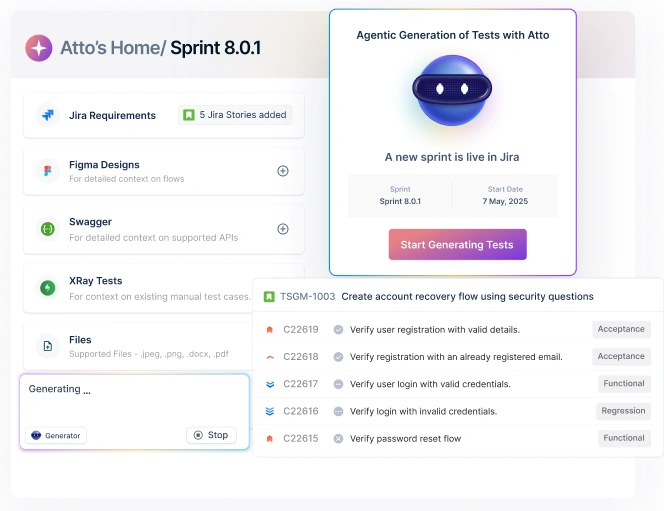
Testsigma is an agentic, AI-driven test automation platform that unifies API, web, and mobile testing with built-in test management. It combines plain-English authoring, AI agents for test generation and self-healing, cloud/device grids, and deep CI/Jira integrations to help mixed-skill teams ship faster with less maintenance.
Key Features
- Agentic AI to plan, generate, execute, heal, and document tests
- Plain-English/NLP authoring and recorder for rapid test creation
- Unified coverage: API, web (cross-browser), mobile (iOS/Android), plus Salesforce/SAP
- Self-healing locators, flaky detection, and proactive maintenance cues
- Parallel cloud execution across 3000+ browsers/devices with live debugging
- Built-in test management: requirements mapping, runs, reports, analytics
- CI/CD ready: GitHub Actions, GitLab, Jenkins, Azure DevOps; two-way Jira sync
- Enterprise controls: SSO, RBAC, audit logs, data governance
Pros
- AI-assisted authoring and maintenance dramatically reduce setup and upkeep.
- Low-code approach enables contributions from QA, devs, and product alike.
- Single platform for API, web, and mobile minimizes tool switching.
- Parallel cloud runs and rich artifacts speed feedback and triage.
- Strong integrations and traceability support regulated or large teams.
Cons
- Cloud-first model may not fit strict on-prem mandates without exceptions.
- Highly abstracted workflows can feel limiting for code-heavy customization.
Playwright

Playwright is a modern, code-first framework for end-to-end browser automation and testing. It supports multiple browsers (Chromium, Firefox, WebKit), runs across operating systems, and provides robust APIs that make writing, debugging, and running UI tests easier, especially for teams that want reliability, cross-browser coverage, and CI/CD integration without vendor lock-in.
Key Features
- Cross-browser testing: Chromium, Firefox, WebKit under a unified API
- Works on Windows, macOS, and Linux, compatible with headless or headed runs
- Multi-language support: JavaScript/TypeScript, Python, Java, .NET
- Auto-waiting and retry-on-assertions to reduce flaky tests
- Parallel and headless test execution for speed and CI-friendliness
- Powerful debugging tools: test recording (codegen), trace viewer, screenshots, and video capture
- Emulation of mobile-web environments (device profiles, touch/screen parameters)
- Built-in network request interception, mocking/stubbing, and test isolation via browser contexts
Pros
- Reliable cross-browser coverage and consistent behavior across different rendering engines.
- Robust test stability thanks to auto-waits/retries and built-in flake protection.
- Strong support for CI/CD pipelines and parallelization, good for fast feedback loops.
- Multi-language flexibility lets teams work in their stack of choice.
- Excellent debugging and reporting tools speed up root-cause analysis.
Cons
- Framework is web-only: no native mobile app, desktop, or API-only test management.
- Code-first approach requires developers; not ideal for non-technical or manual-testing teams.
- No built-in test management or reporting dashboard, you’ll need to stitch together with external tools.
Postman + Newman

Postman is a collaborative platform for designing, testing, and documenting APIs, while Newman is its CLI runner that executes Postman collections in CI/CD. Together, they cover the full API lifecycle, from mocking and environments to automated regression checks, making them a common upgrade path for teams moving beyond Karate’s DSL for API-focused work.
Key Features
- Collection-centric workflow with requests, examples, tests, and documentation
- Environments, variables, and secrets for reproducible runs across stages
- Mock servers, monitors, and workspaces for team collaboration
- Newman CLI for headless execution in pipelines with JUnit/HTML reports
- Pre-request and test scripts in JavaScript for assertions and data chaining
- API versioning, schemas, and contract validation with schema enforcement
- Integrations with Git, CI tools, and ticketing systems
Pros
- Familiar, visual workflow that accelerates API test authoring and review.
- Easy CI adoption with Newman and ready-made reporters.
- Strong collaboration features: workspaces, comments, and shared environments.
- Good for contract-first workflows with schema validation and mocking.
- Large ecosystem of templates, snippets, and integrations.
Cons
- Primarily API-focused; UI and mobile testing require separate tools.
- JavaScript-only scripting inside collections may limit language choice.
ReadyAPI

ReadyAPI is SmartBear’s enterprise suite for API quality that unifies functional, security, and performance testing with data virtualization and rich reporting. It’s designed for teams that need scalable, governed API testing across services and microservices, with CI/CD hooks, role-based controls, and support for complex data-driven scenarios.
Key Features
- Unified API testing: functional, contract, security (OWASP), and performance in one suite
- Broad protocol support (REST, SOAP, GraphQL) with schema validation and mocking/virtualization
- Data-driven testing with generators, datasets, and parameterized requests
- Visual test design plus scripting when needed (Groovy) for advanced logic
- Reusable assets: shared assertions, environments, and test steps across projects
- CI/CD integrations (Jenkins, GitHub Actions, Azure DevOps) and test reports (JUnit/HTML)
- Team features: RBAC, project sharing, audit trails, and management dashboards
Pros
- Comprehensive API quality tooling reduces the need for multiple separate tools.
- Strong support for complex, data-heavy, and governed enterprise workflows.
- Built-in security and performance testing shorten feedback loops.
- Virtualization and mocking simplify testing upstream/downstream dependencies.
- Mature ecosystem, support, and documentation for large organizations.
Cons
- Commercial licensing can be costly compared to open-source stacks.
- Heavier footprint and learning curve than lightweight libraries.
- Groovy-based customization may feel niche for non-JVM teams.
REST Assured

Rest Assured is a lightweight, code-first Java library for testing RESTful APIs. It offers a fluent, readable DSL that fits naturally into JVM stacks (JUnit/TestNG/Maven/Gradle), making it easy for developers to write expressive API tests, integrate with CI, and keep tests versioned in Git alongside application code.
Key Features
- Fluent DSL for requests, responses, and assertions (given/when/then)
- Built-in support for JSON/XML, path/query params, forms, and multipart uploads
- Easy auth: OAuth, Basic, Digest, and custom headers/tokens
- JSON schema validation and Hamcrest/AssertJ matcher support
- Request/response specs for reuse; filters for logging and hooks
- Seamless integration with JUnit/TestNG, Maven/Gradle, and CI pipelines
- Extensible via custom serializers, deserializers, and filters
Pros
- Very developer-friendly for JVM teams; lives naturally in the codebase.
- Minimal overhead, fast execution, and simple CI setup.
- Highly expressive assertions and strong matcher ecosystem.
- Easy reuse via specs/filters reduces duplication in large suites.
- Open source with broad community usage and examples.
Cons
- Java-only focus; not ideal for non-JVM teams.
- API-only: no built-in UI/mobile testing or test management features.
Katalon Platform

Katalon Platform is a unified, low-code test automation suite that combines web, API, mobile, and desktop testing with centralized analytics and orchestration. It blends record/playback and keyword-driven authoring with full Groovy/Java scripting, offering a path from quick starts to advanced customization. With hosted grids, built-in reports, and CI/Jira integrations, it targets teams that want one tool for authoring, execution, and insights.
Key Features
- Low-code authoring with keyword libraries, recorder, and BDD support
- Full scripting in Groovy/Java for custom logic and reusable components
- Cross-surface coverage: Web, API, Mobile (Android/iOS), and Windows desktop
- Self-healing locators, smart waits, and object repository for stability
- Test orchestration, scheduling, and parallel/cloud execution (hosted grids)
- Built-in dashboards, trend analytics, and artifact capture (logs, screenshots, videos)
- CI/CD integrations (Jenkins, GitHub/GitLab, Azure DevOps) and Jira linking
- Secrets/environments management and role-based access controls
Pros
- Single platform for API, web, mobile, and desktop reduces tool sprawl.
- Low-code start with a smooth path to code lets mixed-skill teams contribute.
- Central analytics and scheduling simplify governance and reporting.
Cons
- Commercial licensing and add-ons can be heavier than open-source stacks.
- Groovy/Java scripting model adds a learning curve for non-JVM teams.
Robot Framework

Robot Framework is a widely used open-source automation framework that supports keyword-driven, behavior-driven, and data-driven testing. Built on Python, it’s highly extensible, allowing teams to plug in custom libraries or leverage a rich ecosystem of community-supported libraries for web, API, database, mobile, desktop, and RPA testing. Its simplicity, readability, and modular design make it a strong alternative for teams wanting a scalable, maintainable approach without locking into a single testing style or technology stack.
Key Features
- Keyword-driven and BDD support using plain-text syntax, enabling easy onboarding for non-developers
- Large ecosystem of libraries like SeleniumLibrary, Browser/Playwright, RequestsLibrary, AppiumLibrary, and DesktopLibrary
- Python-based extensibility for custom keywords, reusable components, and integrations
- Built-in reporting with logs, execution graphs, screenshots, and step-level details
- Test tagging, variables, and data-driven patterns to scale suites cleanly
- Parallel execution supported via tools like pabot
- CI/CD friendly, integrating easily with Jenkins, GitHub Actions, GitLab, Azure DevOps, and containerized test environments
Pros
- Easy-to-read syntax lowers the barrier for manual testers and cross-functional contributors.
- Mature ecosystem with libraries covering web, API, mobile, DB, and desktop testing.
- Built-in reports and logs reduce the need for external dashboards.
- Highly extensible: write custom Python keywords or plug in existing libraries.
- Stable, widely adopted open-source project with strong community support.
Cons
- Keyword-driven style may feel verbose or restrictive for code-heavy teams.
- UI test stability heavily depends on the underlying library (e.g., Selenium).
- Parallelization and scalable orchestration often require additional tools like pabot.
Pact
Pact is a consumer-driven contract testing framework designed to ensure reliable communication between microservices. Instead of focusing on UI or end-to-end flows, Pact validates that services agree on the structure and content of API interactions, preventing integration issues before they reach staging or production. As microservice architectures grow, Pact becomes a powerful complement, or alternative, to broad API testing frameworks like Karate.
Key Features
- Consumer-driven contracts (CDCT) that define and validate expected API interactions
- Supports multiple languages, including Java, JS/TS, .NET, Ruby, Python, Go
- Pact Broker for storing, versioning, and verifying contracts across teams and pipelines
- Provider verification to ensure backend services meet contract expectations
- CI/CD readiness, with plugins for Jenkins, GitHub Actions, CircleCI, GitLab, and more
- Supports HTTP, messaging, and asynchronous interactions (Kafka, SNS/SQS, etc.)
Pros
- Prevents API breaking changes early in development.
- Great for microservices teams with many interdependent services.
- Lightweight and fast, ideal for shift-left testing.
- Pact Broker enables collaboration, versioning, and governance across teams.
- Reduces need for heavy end-to-end testing by validating contracts at the API layer.
Cons
- Not a replacement for functional API or UI testing, only covers contracts.
- Requires culture and process alignment between consumer and provider teams.
- Setup and management of Pact Broker add operational overhead.
How to Choose the Right Karate Alternative
Selecting the right Karate Labs alternative depends on your team’s skills, technology stack, and automation roadmap. Consider the following factors when making your choice:
Skill Set & Team Composition
Teams with mixed technical abilities benefit from low-code platforms like Testsigma and Katalon, which make automation accessible to non-developers. Developer-led teams, however, often prefer Playwright, Rest Assured, or Robot Framework because they offer full coding flexibility and tighter control.
Testing Surface Coverage Needed
If you need one tool for web, mobile, and API testing, Testsigma, Katalon, and Robot Framework provide unified coverage. For API-centric testing, Postman + Newman, Rest Assured, ReadyAPI, and Pact are better fits, while Playwright is ideal when cross-browser, code-first UI automation is the priority.
Scalability & CI/CD Maturity
Teams that require cloud-based parallel execution typically choose Testsigma or Katalon, which offer built-in grids and orchestration. For code-first pipelines integrated deeply with Git and CI tools, Playwright, Rest Assured, and Robot Framework scale more naturally.
Enterprise Requirements
Organizations needing strong governance, compliance, and enterprise support tend to favor ReadyAPI, Testsigma, or Katalon. Meanwhile, teams prioritizing open-source flexibility often choose Robot Framework or Playwright for their extensibility and control.
Specialized Needs
For microservices environments with frequent API changes, Pact is ideal due to its contract testing model. When projects rely heavily on data-driven or complex test scenarios, ReadyAPI and Robot Framework provide stronger support.
Conclusion
Karate Labs remains a strong tool for unified API, UI, and performance testing, but as automation demands grow, especially around mobile, CI/CD scalability, AI-driven maintenance, and enterprise governance, many teams look for alternatives that better fit modern workflows. Whether your priority is low-code authoring, faster parallel execution, richer reporting, contract testing, or flexible scripting, the eight alternatives above offer diverse paths to more maintainable, scalable, and future-ready automation in 2025.
FAQs
Karate Labs is strong for API testing but its UI and mobile capabilities are limited compared to modern, dedicated tools. Many teams find its DSL harder to scale, its reporting less robust, and its integrations less mature for enterprise workflows. Mobile testing is still experimental, and maintaining large UI suites can become complex due to flakiness and limited native tooling.
Testsigma offers a more user-friendly, low-code experience with plain-English test authoring, making it easier for mixed-skill teams to automate quickly. Unlike Karate, it provides unified API, web, and mobile testing, built-in test management, AI-driven maintenance, and a cloud device/browser grid. Teams typically find Testsigma faster to set up, more scalable, and easier to maintain over time.
For strong mobile and cross-browser support, Testsigma and Katalon offer built-in web, mobile, and device-grid capabilities. Playwright also provides excellent cross-browser automation, though it focuses on web rather than native mobile apps. Robot Framework can deliver broad coverage when paired with libraries like Selenium, Appium, and Browser.
Emerging tools include AI-driven platforms like Testsigma that automate planning, creation, and maintenance; Playwright for modern, reliable cross-browser testing; and Pact for contract testing in microservice environments. These tools reflect broader trends such as AI-assisted automation, cloud scalability, and API-first testing approaches.