

Table Of Contents
- 1 Key Takeaways
- 2 What is Test Management for JIRA?
- 3 What Are JIRA Test Management Tools?
- 4 Comparison of the 5 Best Test Management Tools for JIRA
- 5 Best Test Management Tools for JIRA
- 6 Key Features of the Best Test Management Tool for JIRA
- 7 Selection Criteria for the Best Test Case Management Tools for JIRA
- 8 Conclusion
- 9 Frequently Asked Questions
Key Takeaways
- Jira has no built-in test management. You need a connected tool to run QA inside or alongside it.
- Testsigma, Xray, and Zephyr Scale offer the deepest Jira integration on this list.
- Testsigma is the only tool here using AI agents, not just AI-assisted forms, for test generation and maintenance.
- Pricing spans free (Testsigma core, RTM under 10 users) to $8,000/month (QA Wolf, managed service).
- Choice comes down to three factors: depth of Jira-native execution, automation needs, and team size.
The best test management tools for Jira in 2026 are Test Management by Testsigma, Xray, Zephyr Scale, Zephyr Squad, and TestRail. These tools add test case creation, execution tracking, defect linking, and reporting to Jira, since Jira has no native test management module. Testsigma leads on AI-driven test generation with native two-way Jira sync.
What is Test Management for JIRA?
Test Management for JIRA is the process of planning, creating, executing, and tracking test cases directly within JIRA. Since JIRA is a project management and issue tracking tool by default, it doesn’t include test management features. However, with the help of test management tools integrated with JIRA, teams can handle entire QA workflows inside the development platform.
What Are JIRA Test Management Tools?
JIRA test management tools are plugins or integrations that extend Atlassian JIRA to support test case creation, execution, defect tracking, test planning, and reporting, all within JIRA or connected to it. JIRA doesn’t natively support full-scale test management; these tools help QA teams perform end-to-end testing workflows without leaving the JIRA environment.
Comparison of the 5 Best Test Management Tools for JIRA
Here’s how the five leading Jira-integrated test management tools compare on AI capability, traceability, execution, and automation.
| Features | Test Management by Testsigma | QAlity Plus | QA Wolf | Requirements and Test Management | Ranorex |
| AI-powered Test Case Management | Uses AI agents for test generation, maintenance, and optimization | No | Limited AI-powered tests | No | No |
| Requirement Traceability | Supports requirement categories and version tracking | Links test cases directly to Jira requirements | No | Traceability via RM tools or ALM suites | Traceability via CI/test management integration |
| Test Execution | Runner agent to run tests inside the browser | Test cycles and execution assignments inside Jira | Complete parallel execution across containers | Varies by tool; often includes planning and execution tracking | Supports functional, regression, and GUI testing via modular design |
| Defect Tracking | Integrates with bug reporting tools; can auto-report bugs from test results | Limited | Human-verified bug reports with context | Includes defect linking | No |
| Automation | Cloud-native codeless platform for web, mobile, APIs, and ERP | Limited, only to external APIs | Automates using Playwright (web) and Appium (mobile) | Often integrates with automated tests via plugins/APIs | Full automation support (C#, VB.NET, record/replay) |
| Test Environment | Supports managing test environments within configuration settings | Managed within Jira context | Cloud infrastructure-managed environments | Environment modeled within ALM tooling | No |
| Integrations | Integrates with CI/CD, bug trackers, custom fields, and user management | Integrates tightly with Jira ecosystem | Supports CI/CD integrations | Strong ecosystem integrations via ALM stack | Integrates with CI/CD tools: Jenkins, Azure DevOps |
Best Test Management Tools for JIRA
Some of the best test management software available in the market are as follows:
1. Test Management by Testsigma
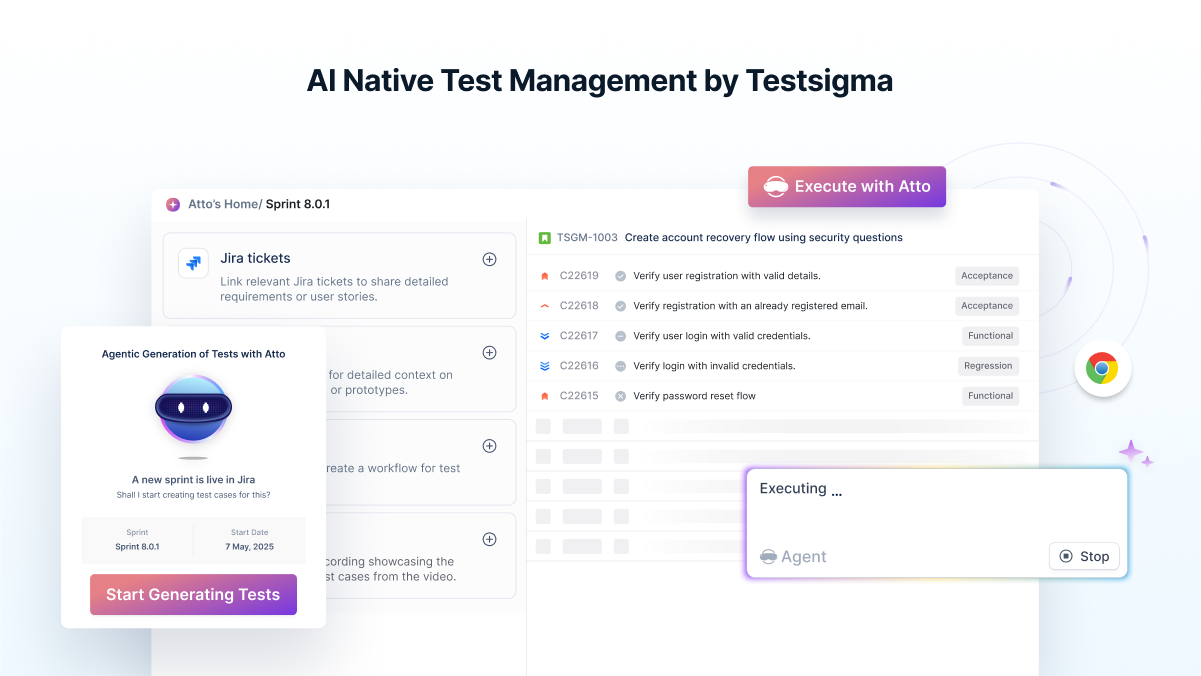
Test Management by Testsigma is an agentic test management platform for Jira that uses AI agents to generate, execute, and maintain test cases. It enables testers to run, organize, and maintain test cases efficiently, so you need not juggle between tools to support the tests. Built with modern Agentic AI, it seamlessly manages manual and automated tests through integrations.
Features of Test Management by Testsigma
- Generates test cases from Figma design, JIRA stories, prompts, or requirements.
- Uses natural language understanding to speed up test case creation.
- Automatically logs bugs from failed test steps with all details (logs, screenshots, steps).
- Seamlessly migrates test cases from Excel, CSV, and open-source tools.
- Keeps QA, Dev, and PM teams in sync using one tool.
Meet the AI agents that make QA effortless:
- Sprint Planner Agent – Detects a new Jira sprint and instantly organizes your test plan for it.
- Generator Agent – Creates test cases from a wide range of inputs, including user requirements, Figma designs, PDFs, documents, screenshots, prompts, images, and videos.
- Runner Agent – Validates generated tests and executes them directly in-browser, perfect for quick sanity checks and low-effort test runs.
- Bug Reporter Agent – Intelligently detects bugs and seamlessly pushes them to issue trackers like Jira, reducing triage time and improving the overall bug lifecycle.
Setup: Connect your Testsigma project to Jira in Project Settings, then log and view results directly from the Jira issue view under Jira App Actions.
Pricing: Core features are available for free forever, with advanced capabilities offered through flexible Pro and Enterprise plans. Pro plan starts at $8 per user per month annually.
2. QAlity plus

QAlity Plus is a Jira-native add-on for test case management, test cycles, and traceability reporting inside Jira issues. There are two versions of QAlity: QAlity and QAlity Plus. Both editions of Test Management for Jira are add-ons exclusive to Jira and offer features for test management incorporated with Jira. They give you resources to help you manage testing for your projects. It vividly shows procedures in the Jira issue and makes the testing outcomes visible.
Features of QAlity Plus
- Develop and oversee test cases.
- Test scenarios for export and import (exclusive to PLUS).
- Utilize test cycles to schedule the testing and monitor its progress.
- Run tests and flag steps that failed.
- Simple bug reporting and test-bug linking (PLUS exclusive).
- User assignments for test executions (PLUS exclusive).
- Through JQL, add more tests to the test cycle (PLUS exclusive).
- Check out the Test Execution Report.
- Traceability Report View (PLUS exclusive).
- Priority access to customer care desk as a QAlity Plus customer.
Pros
- Lightweight and easy to use inside JIRA.
- Free for small teams.
- Allows test case creation and execution directly in JIRA.
Cons
- No support for automation or external integrations.
- Lacks advanced reporting and dashboards.
Pricing: The advanced edition comes at a price of $10/month (for up to 10 users)
3. QA Wolf

QA Wolf is a cloud-based, fully hosted end-to-end testing platform that handles QA setup and execution with little to no code. It assists teams with quality assurance, enabling them to find defects and launch products quickly. The platform lets customers rapidly expand their UI test coverage and easily develop tests online.
Features of QA Wolf
- No setup or installation is necessary. Everything you need to get started is available right out of the box because QA Wolf is completely hosted.
- A simple, elegant UI. One clear and uncomplicated interface contains everything required to design and maintain tests, no switching back and forth between windows or apps.
- Any team member can design tests with practically no technical expertise. Developers can add unique JavaScript code to complex tests to help debug issues.
- Execute all of your tests concurrently and get results instantly.
Pros
- Cloud-based test automation and management platform.
- 100% code-free test creation using browser actions.
- Managed service option available (they write and maintain tests for you).
- Integrates with CI/CD, Slack, JIRA.
Cons
- Not ideal for teams that want to write tests in code.
- No full-featured manual test management.
- Can be expensive for smaller companies.
Pricing: QA Wolf doesn’t publish fixed pricing. It uses a flat monthly fee per automated end-to-end test, quote-based, contact sales for a plan.
4. Requirements and Test Management (RTM)

Requirements and Test Management (RTM) is a native Jira Cloud app that manages the entire software project, from requirements to production, inside the Atlassian suite. It is based on native Jira functionalities that assist in integrating testing with requirements, development, and reporting effortlessly. RTM is ideal for QA and analysts requiring a comprehensive project picture.
Features of Requirements and Test Management for JIRA
- Built-in requirements management.
- Modules for navigation and tree folder structures.
- Easy to execute tests.
- Provides templates for reusable test plans.
- Versatile filters for customizable reports.
- Basic support for automated testing (REST API).
- Programmable dashboards.
- Easily import test cases from other tools.
Pros
- Seamlessly integrates requirements and test management inside JIRA.
- Good traceability and coverage reports.
- Supports requirement hierarchies and custom workflows.
Cons
- UI can feel cluttered and complex.
- Not optimized for automated test integration.
- Might be overkill for teams not managing complex requirements.
Pricing: Free for up to 10 users. Paid plans start at $0.22–$1.82 per user per month.
5. Ranorex

Ranorex is a desktop-based test automation suite compatible with several UI technologies, including Java, HTML, C#, Flash, Android, iOS, and Silverlight. It lessens the need for test automation maintenance while providing total flexibility, including script-free testing for non-programmers.
Features of Ranorex
- Supports picture-based validation, allowing users to compare any or all of the application’s images with the intended image.
- Provides a reliable user interface object recognition model that relies on Ranorex XPath technology.
- Provides a spy engine that keeps track of every UI component shown on the application’s screen.
- Captures test cases directly from actual mobile devices with no code required to alter recorded steps.
- Lets users record UI activities without writing any code, then automate UI testing.
- Cross-platform testing runs across many mobile devices, including Android and iPhone.
Pros
- Robust desktop, web, and mobile test automation.
- Suitable for teams testing Windows applications.
- Integrated test management and reporting.
Cons
- Not cloud-based and can be desktop-heavy.
- Steeper learning curve for beginners.
- Less ideal for Agile/JIRA-based workflows.
Pricing: Ranorex has moved to custom, quote-based pricing (Studio Enterprise and Studio Runtime tiers), contacting their sales team for a quote. No public per-license figures are currently published.
6. Qadeputy

QADeputy is a lightweight, cloud-based test case management tool that streamlines processes related to test cases, runs, suites, and reports. Thanks to its centralized test management interface, you can increase your productivity. It also facilitates mobile stakeholder-based communication and real-time data, and its API greatly facilitates the integration process for pushing or retrieving data.
Features of QADeputy
- Allows for real-time app debugging and the replication of errors.
- Enables the user to record, document, and manage any encountered bugs.
- Connects the user’s application to other CI programs that are already installed.
- Offers access control to restrict access to sensitive data via authentication and authorization.
- Enables testing by providing the user with established settings.
- Allows for debugging.
Pros
- Lightweight cloud-based test management.
- Easy setup and clean UI.
- Integrates with JIRA, Slack, GitHub, and automation tools.
Cons
- Lacks native automation framework (depends on integrations).
- Reporting and dashboards are basic.
- Limited enterprise features.
Pricing: Annual plan is about $18/user/month with unlimited test suites, cases, runs, and integrations.
7. Xray

Xray is a comprehensive test management app that integrates fully with Jira, used globally by Agile teams as a first test management solution. It makes sure you are fulfilling all requirements. With its automated testing capability, you can increase productivity, set time priorities with risk-based testing, and use advanced reporting to help you decide well.
Features of Xray
- Arrange tests in different sets saved in tables.
- Built-in reports for later use.
- Traceability between execution, faults, and requirements.
- Integrates with top automation frameworks.
- Advanced Coverage Analysis.
- REST API integration into your CI/CD pipeline.
- Gadgets and advanced reporting.
- Full work visibility that complements Agile methodology.
Pros
- Comprehensive test management inside JIRA.
- Supports both manual and automated tests.
- Strong traceability and requirement coverage.
Cons
- Steep learning curve for new users.
- Some performance issues with large datasets.
- Pricing can increase with scale.
Pricing: Starting at $10 per month for a small team of up to 10 users.
8. Zephyr Scale

Zephyr Scale is a full-featured test management platform with seamless integration into Jira’s user interface, coordinating test design, authorship, execution, tracking, and reporting from a single location. You can construct and customize a test plan via Jira to handle a wide range of planning themes, such as scope, strategy, resources, environments, and risks, rather than using Microsoft Office tools to build the main test plan.
Features of Zephyr Scale
- Supports test plans and test execution cycles for Waterfall development.
- Adds to and updates the test library’s test cases.
- Develops test strategies to handle the test approach.
- Develops test cycles to organize the testing process.
- Conducts test cycles to verify specifications.
- Tracks coverage, advancement, and quality.
Pros
- Scalable test management tool for advanced use cases.
- Hierarchical test organization, like folders and components.
- Robust reporting, test reuse, and parameterization.
- Better for enterprise teams than Zephyr Squad.
Cons
- UI feels heavier than Zephyr Squad.
- Slightly more complex setup.
- Limited native automation features, as it relies on APIs.
Pricing: Standard plan: $10 per month | Advanced plan: $15 per month.
9. TestRail

TestRail is a standalone test case management tool that makes it simple to record information about test cases or scenarios and track progress across dashboards and activity reports. You can compare outcomes from various test iterations, setups, and completion dates. It provides insights to help plan upcoming testing activity and manage test techniques, cutting back the QA team’s reporting workload.
Features of TestRail
- Informative dashboard controls to track test progress.
- Increased customization for tailored outcomes.
- Advanced capabilities to compare different test results.
Pros
- Standalone, full-featured test case management.
- Advanced filtering, metrics, and reporting.
- Easy integration with JIRA, Jenkins, Selenium, etc.
- Scales well for large teams.
Cons
- Requires a separate login/environment outside of JIRA.
- Manual syncing is necessary for tight Agile workflows.
- Can get costly as the user count grows.
Pricing: Monthly cost per user ranges from $39 to $78 depending on the plan.
10. Zephyr Squad
Zephyr Squad is a customizable test management solution built directly into Jira that lets agile teams focus on test automation, test execution, and test design. You can organize test cases and monitor progress using charts and reports. Zephyr’s best feature is how simple it is to import test cases from MS Excel, and it includes a dedicated area for Behavior Driven Development (BDD) test cases for Agile projects.
Features of Zephyr Squad
- Supports tracking of bugs to help teams identify, log, and resolve issues efficiently.
- Allows data export and import for easy migration or backup.
- Provides visualization of data through dashboards and charts.
- Users can move and copy test cases, suites, and other artifacts.
- Includes quality control features to ensure testing meets predefined standards.
Pros
- Simple user interface.
- Built directly into JIRA Cloud/Data Center.
- Great for manual test case management in Agile teams.
- Decent dashboards and execution tracking.
Cons
- Limited automation support.
- Basic reporting compared to Scale.
- Can become cumbersome for larger projects or teams.
Pricing: Starts at $10 per month for up to 10 users.
11. Kualitee

Kualitee is an end-to-end test management tool and defect-tracking platform available in both cloud and on-premise editions. It centralizes the entire QA lifecycle from requirements to release, so teams can design, execute, and report on tests without jumping between separate point tools.
Features of Kualitee
- Hootie, Kualitee’s AI test case generator, automatically generates test cases from user stories, screen descriptions, or UI images.
- A centralized library of test cases reusable across different projects, builds, or modules.
- A built-in bug tracker to log, assign, and monitor defects, with sync to Jira, Azure DevOps, etc.
- Links requirements to test cases and defects to track how well business needs are tested and delivered.
- Dynamic, role-based dashboards with widgets, charts, and exportable reports.
Pros
- Supports multiple integrations with CI/CD tools and various other tools.
- AI capabilities help in test case creation, copilot support, and defect management.
- Offers visual insights on coverage, execution progress, and defect trends.
Cons
- The interface is often described as confusing, unintuitive, and challenging to use for certain tasks.
- Lacks support for Azure DevOps or many test automation tools that must be connected via a REST API.
Pricing: Free for 3 users; can cost $12/user/month based on the plan.
12. Qase

Qase is a modern, cloud-based test management platform built to simplify and streamline the QA process for software teams. Whether handling manual testing, automated test results, or both, Qase provides a structured, intuitive environment to improve QA efficiency and product quality.
Features of Qase
- Manage manual and automated testing from one unified platform: test cases, plans, runs, requirements, defects, and reports, without switching tools.
- Use AI to generate test cases from natural-language requirements and convert manual test cases into automated ones with minimal coding.
- Customizable dashboards, widgets, and Qase Query Language (QQL) for real-time progress tracking, reporting, and insights.
- Easy import of data from previous test management systems.
Pros
- Seamless integrations across tools foster collaboration between QA and dev teams.
- AI-driven test generation and automation significantly speed up testing workflows.
- Ideal for small or early-stage teams, thanks to the free tier and usability.
Cons
- No on-premise version, which can be a deal-breaker for industries demanding strict data control.
- Some limitations in customization, like dashboard flexibility, batch tagging, and repository default views.
Pricing: Free plan available. Teams plan: $35/user per month. Talk to sales for enterprise pricing plans.
Key Features of the Best Test Management Tool for JIRA
- Agile board integration – Test cases appear alongside stories, bugs, and tasks on the same Agile board, so testing status is visible without switching views.
- Hierarchical test organization – Test cases are grouped using functional decomposition, making large suites easy to navigate and maintain.
- Requirement-based views – Testers can jump from a requirement straight to every test case that validates it, without manually cross-referencing.
- Reusable test plans across environments – The same test plan can run across multiple environments (staging, QA, production) without duplicating test cases for each one.
- Consolidated test plan reporting – Results from all executions roll up into a single, clear view rather than scattered per-run reports.
- End-to-end traceability – A traceability matrix connects requirements, test cases, and defects, so coverage gaps and defect sources are easy to trace.
- Customizable dashboards – Widgets can be configured to surface the metrics that matter most to each team (pass/fail rates, coverage, open defects, etc.).
- Built-in test automation support – The tool should support automated test execution, not just manual testing, to keep pace with faster release cycles.
- Automated results inside Jira – Automation results should surface directly in Jira issues, so no one needs to leave Jira to see pass/fail status.
Check out the test cases for JIRA here: Testcases for Jira
Selection Criteria for the Best Test Case Management Tools for JIRA
Choosing the right test case management tool for Jira comes down to a handful of factors that determine whether it actually fits into your team’s daily workflow, not just its feature list. Here’s what to weigh:
- Seamless Jira Integration – Does it work natively within Jira issues, workflows, and permission schemes, or does it require constant context-switching between two systems?
- Ease of Use – Can testers and non-technical stakeholders pick it up quickly, or does it demand significant training before anyone’s productive?
- Automation Support – Does it connect cleanly to your existing automation frameworks and CI/CD pipeline, so automated results feed back into the same place as manual ones?
- Real-Time Reporting & Dashboards – Can you configure views that show test progress and quality trends at a glance, for both individual contributors and stakeholders who just need the summary?
- Traceability – Is there a clear, queryable link between requirements, test cases, defects, and execution history, so you can prove coverage and trace a failure back to its source?
- Pricing Model & Total Cost of Ownership – Does the pricing structure (per-user, per-instance-tier, flat fee) actually match how your team is organized, and does the cost stay predictable as you scale past 10, 50, or 100 users?
- Security & Compliance – Does it support role-based access control, audit trails, and any compliance requirements your industry demands (SOC 2, HIPAA, etc.)?
Conclusion
Management is important, be it in daily chores or complex work commitments. Testing is no different. It is a process that needs proper management tools to ensure easy execution and proper workflow.
The tools discussed above are one of a kind, with features that will help you at every step. These Jira test management tools facilitate the work and assist engineers in achieving the intended results throughout the process. As a result, these tools are vital to the testing business.
Frequently Asked Questions
Test Management by Testsigma is one of the best Jira test management tools with AI-driven workflows, seamless JIRA integration, and an intuitive interface. It makes test management smarter, faster, and more efficient. It is ideal for teams looking to move beyond traditional tools and embrace the future of quality assurance.
Using JIRA for your test case management has the following benefits: it provides streamlined processes for developers and testers, you can create test scenarios as custom tasks, it provides good reporting, it has excellent tool support, the learning curve could be shortened if you’re already familiar with Jira, and you can easily alter the format of your test cases.
No. Jira handles issue tracking and agile planning; test case creation, execution tracking, and QA reporting need a connected tool like Testsigma, Xray, or Zephyr.
Requirements and Test Management (RTM) is free for up to 10 users. Testsigma’s core features are free with no user cap on the entry tier.
Xray tends to score higher on traceability and requirement coverage. Zephyr Scale is stronger for enterprise-scale test organization with folders and parameterization. Team size and reporting depth should decide the pick.