Searching for a BrowserStack Alternative?
Most teams looking for a BrowserStack alternative aren′t unhappy with how it runs tests, they′ve just outgrown a setup where authoring, visual, accessibility, and test management are separate products, AI lives behind a separate license, and desktop, Salesforce, and SAP aren′t covered at all. Testsigma brings all of it into one agentic, AI-powered platform that authors, heals, and analyzes tests across web, mobile, desktop, API, Salesforce, and SAP.






















How Testsigma Redefines What′s Possible



3 Reasons Testsigma Wins Against BrowserStack
Agentic AI in the core, not a separate product
BrowserStack′s AI authoring and self-healing are real, but they live inside Low Code Automation, a separate product on top of Automate and App Automate. Adding AI to your existing suite means another subscription and another dashboard. Testsigma′s agents are part of the platform from day one. Orchestrated by Atto, its AI coworker, they author tests from plain language, designs, or requirements, run them at scale.
One platform, not a stack of products
BrowserStack splits testing across Automate, App Automate, Percy, Accessibility, Test Management, and LCA. Each is licensed, learned, and monitored on its own, and cost compounds as scope grows. Testsigma covers web, mobile, desktop, API, Salesforce, SAP, visual, and accessibility under one license and one reporting layer, so the platform reasons about quality across your whole application instead of fragmenting it across tools.
Coverage BrowserStack′s automation doesn′t reach
BrowserStack′s automation suite is scoped to web and mobile. Desktop apps on Windows and macOS are unsupported, and there is no native path for Salesforce, SAP, or functional API testing. Testsigma automates all of it end to end, with AI agents authoring, healing, and analyzing tests across the full application portfolio instead of just the parts that run in a browser.
Common User Feedback on BrowserStack

Pricing Gets Hard to Forecast at Scale
BrowserStack publishes per-product pricing for Live, Automate, App Automate, Percy, and others, with variable cost driven by parallel sessions per product. Teams that need Automate, App Automate, Percy, and Test Management together commonly report that annual spend becomes hard to forecast as parallelisation grows. Testsigma′s pricing is also tied to parallels and seats, but the surface area is one product instead of several.

AI Features Live in a Separate Product
BrowserStack′s Low-Code Authoring Agent and Self-Healing Agent are real and shipping, but they′re part of Low Code Automation rather than embedded in Automate or App Automate. Teams that want AI-assisted authoring and self-healing on top of their existing scripted suites usually need to adopt LCA alongside their current product, which adds another subscription and another dashboard.

No Native Support for Desktop or ERP Testing
BrowserStack′s documentation is explicit that Live is for browser and web testing on Windows and macOS, and that installing native desktop applications or third-party software is not supported. App Live and App Automate address mobile, not desktop. Teams testing Windows or macOS desktop apps, Salesforce, or SAP need a separate tool for that part of the workflow.
Session Spawn Times Under Load
Reviewers occasionally report session queuing or slower spawn times during heavy CI/CD windows on shared cloud infrastructure. This is not unique to BrowserStack, since most cloud grids behave this way at peak, but it is a recurring theme in evaluations, especially for teams with deployment-gated runs where a queued session stalls the pipeline. Teams consolidating onto a single platform have one execution layer to plan capacity around instead of several.
Benefits of using Testsigma
10X
Faster Test Development
90%
Lesser Test Maintenance
30%
Shorter Development Cycle
How Testsigma Compares to BrowserStack
Platform Overview
| Features | | |
|---|---|---|
| Core Approach | Unified agentic AI test automation platform | Suite of specialised products (Live, Automate, App Automate, Percy, Accessibility, LCA, Test Management, Test Observability) |
| Supported Use Cases | Web, mobile, desktop, API, Salesforce, SAP, visual, accessibility | Web and mobile primarily; desktop and ERP not supported |
| Authoring | Natural-language NLP authoring in every plan | Scripted in Automate/App Automate; no-code in LCA (separate product) |
| AI Agents | Crew of five agents orchestrated by Atto, across all test types | Low-Code Authoring Agent and Self-Healing Agent within LCA |
| Self-Healing | Across web, mobile, desktop, API | Available in LCA Pro and above |
| Visual Testing | Built into the core platform | Percy (web) and App Percy (mobile) sold separately |
| Accessibility Testing | Built in (WCAG 2.2) | Sold as a separate Accessibility product |
| Test Management | Built in | Test Management sold as a separate product |
| Pricing Model | Parallels + seats; one product | Parallels per product + seats across multiple products |
| Deployment | Public cloud, private cloud, on-premises (Enterprise) | Public cloud |
Cross-Browser & Web Test Automation
| Features | | |
|---|---|---|
| No-Code Authoring | Built in | Available via Low Code Automation (separate product) |
| Self-Healing | Built in | Available via LCA Pro |
| 2FA Workflow Support | Built in | Possible via test code; no out-of-the-box flow |
| Framework Compatibility | Run existing Selenium / Appium / Playwright scripts on Testsigma cloud | Selenium, Playwright, Cypress, WebdriverIO, etc. on Automate |
| Parallel Execution | Supported (plan-dependent) | Supported (parallels purchased per product) |
| Local / Tunnel Testing | Supported | Supported |
| Browser/OS Combinations | 3,000+ on Testsigma cloud | 3,500+ on BrowserStack cloud |
| Real Device Cloud | 3,000+ real devices | 30,000+ real devices |
Mobile App Test Automation
| Features | | |
|---|---|---|
| No-Code Mobile Authoring | Built in | Available via LCA |
| Self-Healing on Mobile | Built in | Available via LCA Pro |
| Billed Separately from Web | No, same license | Yes, App Automate is a separate product |
| App Types Supported | Native, hybrid, mobile web | Native, hybrid, mobile web |
| Frameworks Supported | Native authoring + Appium/Espresso/XCUITest scripts | Appium, Espresso, XCUITest, EarlGrey on App Automate |
| Geo-Specific Testing | Supported | Supported |
| Real iOS & Android Devices | 3,000+ real devices | 30,000+ real devices |
Desktop, API, and Enterprise Application Testing
| Features | | |
|---|---|---|
| Desktop Application Testing (Windows/macOS) | Supported (Enterprise plan) | Not supported |
| Functional API Testing (REST) | Built in | Not a dedicated product; management APIs only |
| API + UI Workflows in One Test | Supported | Requires external API testing tool |
| Salesforce-Specific Automation | Supported | Not supported |
| SAP / ERP Testing | Supported | Not supported |
AI and Low-Code Capabilities
| Features | | |
|---|---|---|
| Test Generation from Natural Language | Built in (Generator agent) | Built in (Low-Code Authoring Agent in LCA) |
| Self-Healing Tests | Built in (Healer agent) | Available in LCA Pro |
| AI-Assisted Failure Analysis | Built in (Analyzer agent) | Test Observability product offers AI debugging |
| Coverage Across Test Types | Web, mobile, desktop, API, Salesforce, SAP | Web and mobile within LCA |
| Add-On vs Core | Core platform capability | Delivered via LCA product (separate license) |
| AI Test Case Suggestion from Requirements/Stories | Supported (from Jira, Figma, video) | Supported within LCA via NL prompts |
AI and Low-Code Capabilities
| Features | | |
|---|---|---|
| Visual Regression Testing | Built into the platform | Percy and App Percy (separate products) |
| WCAG Accessibility Testing | Built in | Separate Accessibility product |
| Unified Reporting Across Functional + Visual + Accessibility | Yes | Per-product dashboards |
| AI-Backed Visual Validation | Supported | Supported within Percy and LCA |
Migrating from
BrowserStack to Testsigma
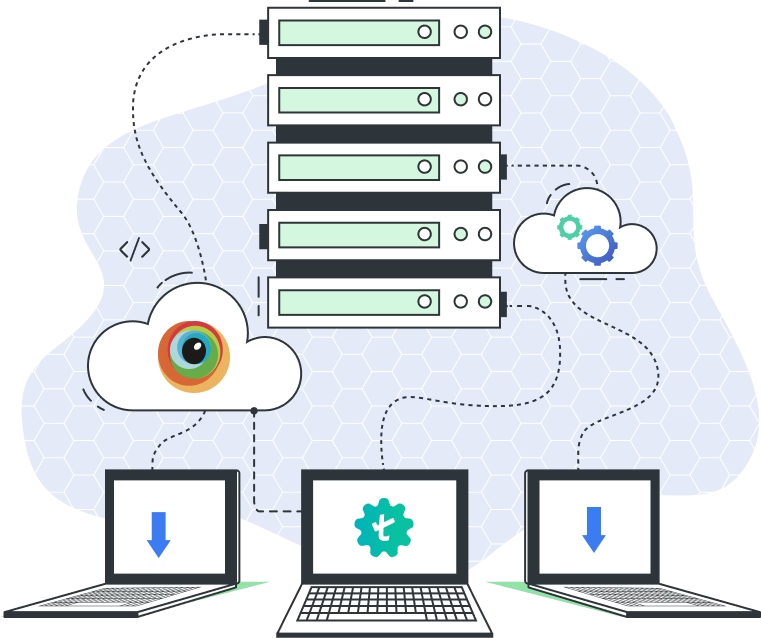
Most teams switching from BrowserStack don′t need a wholesale rewrite. Existing Selenium, Appium, Playwright, Cypress, Espresso, and XCUITest scripts run on Testsigma′s execution cloud with configuration changes rather than reauthoring. Native CI/CD plugins for GitHub Actions, Jenkins, Azure DevOps, CircleCI, and Bitbucket replace BrowserStack hooks without breaking the pipeline. New test creation typically shifts to Testsigma′s natural-language authoring, so the migration tends to look like preserving existing scripted coverage while adding faster, lower-maintenance authoring on top, alongside the additional test types (desktop, Salesforce, SAP) BrowserStack doesn′t cover.
Testament of the Value Delivered
25M+
TestExecuted
10K+
QATeams
70%
ReducedTesting Effort

We run 5000+ test cases overnight, wake up to the results, and fix issues swiftly. The productivity boost and resource optimization achieved with Testsigma are truly commendable.


Automated Test Coverage


The clean UI and intuitive workflows make automation effortless. Instead of writing test cases from scratch, I can generate accurate AI-driven cases in minutes for any type of testing.

Reduced Test Creation Time
We run 5000+ test cases overnight, wake up to the results, and fix issues swiftly. The productivity boost and resource optimization achieved with Testsigma are truly commendable.
Automated Test Coverage
The clean UI and intuitive workflows make automation effortless. Instead of writing test cases from scratch, I can generate accurate AI-driven cases in minutes for any type of testing.
Reduced Test Creation Time