


Kobiton has been a go-to choice for mobile app teams that need quick access to real Android and iOS devices. But as testing has evolved, so have the expectations around speed, stability, automation, and AI-driven efficiency. Many teams now find Kobiton’s device lag, limited device availability, unstable sessions, and restricted automation flexibility too limiting for modern release cycles.
If you’re looking for something faster, more reliable, and better equipped for 2025’s testing demands, this guide breaks down the best Kobiton alternatives, from AI-powered platforms to large real-device clouds and open-source solutions. Whether you’re scaling automation or improving test coverage, here are the top tools worth considering.
Kobiton has been a go-to choice for mobile app teams that need quick access to real Android and iOS devices. But as testing has evolved, so have the expectations around speed, stability, automation, and AI-driven efficiency. Many teams now find Kobiton’s device lag, limited device availability, unstable sessions, and restricted automation flexibility too limiting for modern release cycles.
If you’re looking for something faster, more reliable, and better equipped for 2025’s testing demands, this guide breaks down the best Kobiton alternatives, from AI-powered platforms to large real-device clouds and open-source solutions. Whether you’re scaling automation or improving test coverage, here are the top tools worth considering.
Table Of Contents
- 1 Why Seek Kobiton Alternatives?
- 2 Common User Pain Points & Real Feedback
- 3 Comparison Table: Top 5 Alternatives
- 4 Top 8 Kobiton Alternatives
- 5 FAQs
Why Seek Kobiton Alternatives?
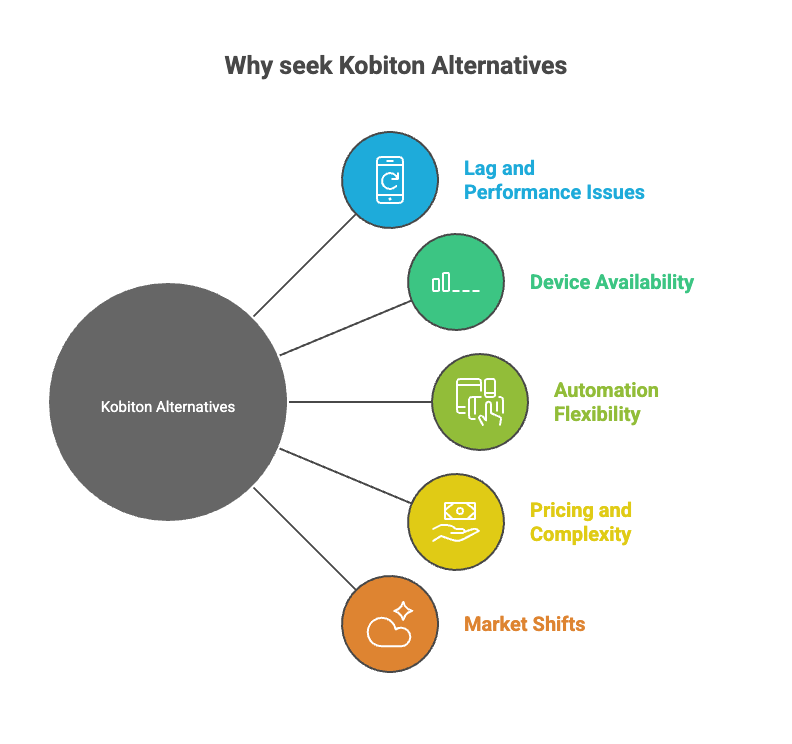
Many teams start with Kobiton because it offers easy access to real mobile devices, but as testing needs grow, its limitations become harder to ignore. Lag, outdated devices, and limited automation flexibility can slow down fast-moving QA teams. Here’s why more companies are actively exploring stronger, more modern Kobiton alternatives.
When Kobiton Works Well
Kobiton is a good fit for teams that primarily need real-device access for manual or exploratory mobile testing. If your testing workflow is simple, your device coverage needs are limited, and you’re running basic Appium scripts without large-scale automation, Kobiton performs reasonably well. It’s also useful for teams that don’t want to manage an in-house device lab and prefer a straightforward, cloud-based way to test on physical Android and iOS devices.
Where Kobiton Falls Short
As teams scale, Kobiton’s limitations become more noticeable. Many users report laggy device performance, slow response times during iOS sessions, and unstable connections that interrupt debugging. Device availability can also be an issue, with newer phones sometimes missing or delayed. On the automation side, Kobiton’s framework flexibility is limited compared to platforms that support Selenium, Playwright, Appium, and browser testing in one place. Combined with pricing concerns and setup complexity, these challenges make it harder for growing teams to rely on Kobiton long-term.
Market Shifts to AI & Unified Testing
The testing landscape has changed quickly, with more teams adopting AI-driven tools that generate tests automatically, self-heal broken scripts, and unify web, mobile, and API testing under one platform. Instead of stitching together multiple tools, QA leaders increasingly prefer solutions that handle planning, execution, and reporting in one workflow. This shift makes traditional device-focused platforms like Kobiton feel limited, especially when modern teams expect automation that adapts, scales, and integrates seamlessly with fast CI/CD pipelines.
Common User Pain Points & Real Feedback
Customers often switch from Kobiton after running into recurring challenges around stability, device availability, and test maintenance as their teams scale. This section highlights the most common pain points users report, along with real feedback that influenced their move to more modern testing platforms.
Device Lag & Slow Response
Many users experience noticeable delays when interacting with real devices, especially during live iOS sessions or when running multiple concurrent tests. This slows down debugging and manual validation significantly.
Outdated Device Library
Testers often mention that new iPhone and Samsung models take too long to appear in the cloud. For teams needing the latest devices for compatibility checks, this creates coverage gaps.
Frequent Connection Drops
Live device sessions sometimes freeze, disconnect, or time out mid-test. These interruptions force testers to restart sessions, wasting time and breaking test flow.
Appium Setup Complexity
Integrating Appium or connecting local environments is frequently described as more time-consuming than expected. Teams say initial setup and troubleshooting require more effort compared to other device clouds.
Limited Automation Flexibility
While Kobiton supports Appium, users find it restrictive compared to platforms that run Appium, Selenium, Playwright, and real-device plus browser tests in the same pipeline.
Affordable but Feature-Light Perception
Though pricing is attractive, QA teams feel they sacrifice reliability, integrations, and advanced features that competitors like BrowserStack or Sauce Labs offer.
Reliability Concerns
Users consistently highlight unstable performance during peak hours, longer load times, and inconsistent device availability, all of which reduce trust in the platform for mission-critical testing.
Comparison Table: Top 5 Alternatives
Before diving into detailed reviews, here’s a quick snapshot of how the leading Kobiton alternatives compare. This helps you quickly narrow down which tools are worth a deeper look for your team.
| Tool | Major Focus | Best For | Unique Advantage |
| Testsigma | AI-powered, unified web + mobile automation | Teams wanting one platform for mobile, web, API & desktop testing | Agentic AI that plans, generates, executes tests & reports bugs |
| BrowserStack | Large real-device & browser cloud | Teams needing the broadest real-device and browser coverage | Huge, constantly updated device/browsers farm with high stability |
| Sauce Labs | Enterprise-grade test automation & analytics | Regulated or large enterprises with complex pipelines | Deep debugging, analytics & compliance-friendly tooling |
| Perfecto | Mobile-first test orchestration & monitoring | Mobile-heavy teams needing robust, at-scale real-device testing | Strong mobile focus with advanced monitoring & reliability |
| TestGrid | Affordable real-device + cross-browser testing | Budget-conscious teams and startups | Cost-effective device lab with both mobile and browser automation |
Top 8 Kobiton Alternatives
If you’re exploring tools beyond Kobiton, you’re likely looking for better device coverage, smarter automation, or a more scalable testing workflow. Here are the top Kobiton alternatives that offer stronger capabilities, AI-driven testing, or more flexibility for modern QA teams.
1. Testsigma

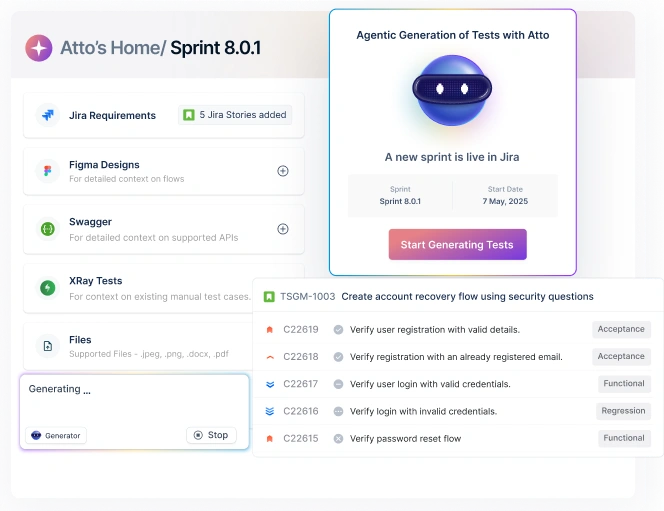
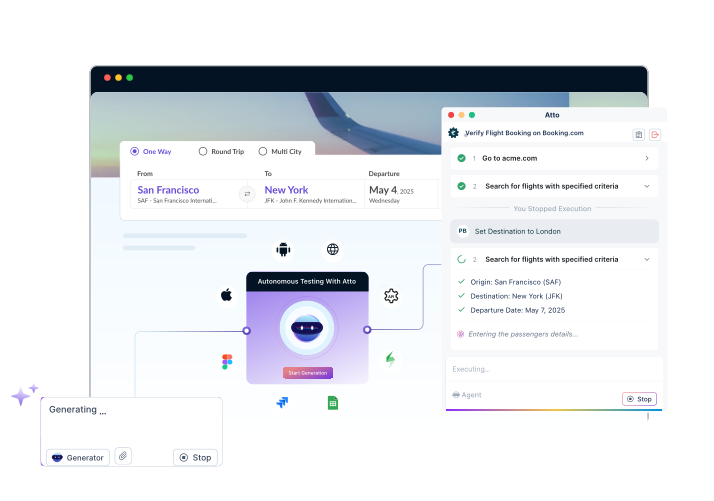
Testsigma is a cloud-based, no-code test automation platform that goes beyond device farms to offer end-to-end web, mobile, desktop, and API testing. Its new agentic test automation capabilities (AI Coworker Atto) let teams turn plain-English ideas or user stories into automated tests in seconds. If you’re evaluating Kobiton alternatives and want more than just device access, Testsigma is a strong fit for teams looking for faster authoring, lower maintenance, and tight CI/CD integration.
Key Features
- AI test creation: Generate automated tests instantly from plain English or user stories.
- AI auto-healing: Automatically adapts tests to UI changes to reduce flakiness.
- 3000+ real & virtual devices: Test across a vast Android/iOS cloud device lab.
- Parallel execution: Speed up regression cycles by running tests simultaneously.
- End-to-end platform: Covers mobile, web, API, and desktop testing in one tool.
Pros
- Very easy to use with no-code English-like steps.
- AI agents accelerate test creation and boost coverage.
- Auto-healing cuts maintenance significantly.
- Huge device availability without managing hardware.
- Unified platform reduces reliance on multiple tools.
Cons
- May feel feature-heavy for teams needing only device testing.
- Some planning needed to structure test suites effectively.
2. BrowserStack

BrowserStack is a widely used cloud testing platform offering access to 30,000+ real mobile devices and browsers, making it one of the largest device labs in the industry. Its mobile testing product, App Automate, supports Appium, Espresso, XCUITest, Maestro, and more, delivering fast, scalable test execution for modern CI/CD pipelines. For teams comparing Kobiton alternatives, BrowserStack stands out for its massive real-device coverage, mature ecosystem, and strong enterprise reliability.
Key Features
- 30,000+ real devices: Extensive Android/iOS device lab with day-zero access to new OS versions.
- Support for major frameworks: Run Appium, Espresso, XCUITest, Maestro, and more without code changes.
- AI-powered test stability: Self-Healing Agents, auto-reruns, and smart locator suggestions reduce failures.
- Real-world device workflows: Test biometrics, SIM-based auth, Apple Pay, CPU/memory usage, and more.
- CI/CD ready: 150+ integrations with Jenkins, GitHub, Jira, Azure DevOps, Slack, and others.
Pros
- Huge pool of real devices with strong global availability.
- Highly reliable infrastructure with fast test execution and parallel runs.
- Strong enterprise-grade support for secure, private device clouds.
- Rich debugging tools, logs, video, analytics, performance metrics.
- Easy integration across DevOps ecosystems.
Cons
- Can get expensive for high parallel usage or private device needs.
- Limited in-built no-code authoring compared to full automation platforms.
3. Sauce Labs

Sauce Labs is an enterprise-grade mobile testing platform focused on continuous quality across the entire SDLC, combining real devices, virtual devices, visual testing, error reporting, and AI-driven insights in a single ecosystem. With its new Sauce AI agents, teams get actionable test intelligence that cuts down debugging time and speeds up release cycles—making it a powerful Kobiton alternative for organizations prioritizing reliability, scale, and compliance.
Key Features
- AI-driven insights: Identifies patterns, bottlenecks, and root causes across test data for faster decisions.
- 9000+ real devices: Secure, managed Android/iOS devices accessible anytime for large-scale testing.
- High-speed emulators & simulators: Reliable and CI/CD-optimized execution for early-stage testing.
- Visual testing support: Detect UI regressions across web, mobile web, and native apps.
- Continuous quality suite: Integrated error reporting, app distribution, diagnostics, and analytics.
Pros
- Strong AI capabilities for intelligent test analysis and faster debugging.
- Broad device coverage with both real devices and optimized virtual devices.
- Built-in visual, functional, and performance testing in one platform.
- Enterprise-grade security, compliance, and a dedicated Trust Center.
- Ideal for large engineering teams needing scale, governance, and reliability.
Cons
- Pricing may be premium compared to simpler device-only platforms.
- Setup and configuration can feel complex for smaller teams.
4. Perfecto

Perfecto is an enterprise-grade testing platform that unifies web, mobile, desktop, and complex UI validation into a single AI-driven system. Known for its ‘test anything, maintain nothing’ approach, Perfecto uses agentic AI to validate difficult UI elements, stabilize automation, and reduce maintenance, making it a strong Kobiton alternative for teams needing advanced, visual, and cross-platform testing at scale.
Key Features
- AI-driven validation: Automatically validates complex UI elements like dashboards, carousels, maps, and dynamic data.
- Cross-platform automation: Create one test that runs across web, mobile, desktop, iOS, and Android.
- Real & virtual devices: Comprehensive device coverage for native mobile testing.
- Low-code & scriptless options: Use natural-language steps or migrate existing Selenium/Appium scripts.
- Diagnostic insights: AI-powered triage to quickly pinpoint failures and reduce feedback loops.
Pros
- Excellent for testing visually complex or dynamic UIs.
- Strong AI capabilities that significantly reduce script maintenance.
- Unified platform for web, mobile, desktop, and enterprise apps.
- Flexible approach, supports code-based, low-code, and scriptless testing.
- Enterprise-grade compliance with SOC 2, ISO 27001, GDPR, and on-prem deployment options.
Cons
- Can feel heavy for teams that don’t need advanced cross-platform or visual testing.
- Pricing is on the higher side for smaller QA teams.
5. TestGrid

TestGrid is a cloud and on-premise mobile testing platform offering 100+ real Android and iOS devices with options for manual, automated, and no-code testing. Its flexibility, combined with strong real-device features like network simulation, biometrics testing, and performance profiling, makes it a practical Kobiton alternative for teams wanting hands-on device access with codeless automation capabilities.
Key Features
- 100+ real devices: Access cloud, on-prem, or hybrid device labs for Android/iOS testing.
- Manual, automated & no-code testing: Supports Appium, scriptless automation, and real-device exploratory testing.
- Real-world simulation: Test under network throttling, gestures, battery/CPU stress, and biometric flows.
- Turbo Mode for iOS: Low-latency remote interaction for faster iOS control and debugging.
- MDM-ready & secure: Supports VPN, MDM, GDPR/HIPAA environments for secure enterprise testing.
Pros
- Offers cloud, on-premise, and hybrid deployment flexibility.
- Great for teams needing exploratory, automated, and no-code testing in one platform.
- Strong real-device capabilities like network, load, performance, gestures, and biometrics.
- Ideal for regulated industries with MDM and secure testing requirements.
- Device reservation and detailed visual reports enhance collaboration.
Cons
- Smaller device pool compared to BrowserStack or Sauce Labs.
- Advanced features like performance/load testing may require more setup.
6. AWS Device Farm

AWS Device Farm is a scalable mobile and web testing service that lets teams run manual and automated tests on 2,500+ real devices and multiple desktop browsers without maintaining infrastructure. As a Kobiton alternative, it appeals to teams already in the AWS ecosystem who want reliable device access, parallel execution, and deep debugging support powered by AWS’s cloud scale.
Key Features
- 2,500+ real devices: Test on a large fleet of physical Android and iOS devices with accurate performance metrics.
- Parallel automated testing: Run tests concurrently across devices and browsers to speed up execution.
- Real-world simulation: Configure network, location, language, and device state for realistic test conditions.
- Framework flexibility: Supports Appium, Espresso, Calabash, TestNG, Cucumber, and built-in no-script testing.
- Private device lab: Reserve dedicated devices with persistent settings for secure, isolated testing.
Pros
- Large, reliable device fleet backed by AWS infrastructure.
- Deep debugging insights with logs, videos, performance data, and grouped issue reports.
- Ideal for teams already invested in AWS services and DevOps workflows.
- Easy CI/CD integration through APIs, plugins, and SDKs.
- Option for private devices for high-security or long-running test needs.
Cons
- No built-in codeless or AI-driven test authoring like modern automation platforms.
- UI and overall experience feel more utilitarian compared to testing-focused vendors.
7. Testim

Testim (by Tricentis) offers an AI-powered mobile testing solution designed to simplify automation for native, hybrid, and cross-platform apps. With cloud-based recording, stable AI-driven element detection, and a virtual mobile grid, it helps teams rapidly create, manage, and execute mobile tests without the heavy setup typically required with Appium, making it a good Kobiton alternative for teams that want faster, low-maintenance automation.
Key Feature
- AI-powered test authoring: Record and create tests in the cloud with no installation or coding required.
- Stable element detection: Proprietary AI identifies hard-to-detect UI components for resilient, low-maintenance tests.
- Virtual Mobile Grid: Execute tests across a wide range of virtual iOS and Android environments.
- Integrated test management: Organize tests, track versions, and run checks as part of CI/CD workflows.
- Debugging insights: Dashboards, visualizations, and logs help diagnose failures quickly.
Pros
- Very easy to start, no local device setup or complex configuration.
- AI-driven locators significantly reduce flaky tests and maintenance.
- Supports native, hybrid, Flutter, and React Native apps.
- Strong integration with CI/CD pipelines and release gating.
- Clear debugging tools with visual logs and network insights.
Cons
- Primarily uses virtual devices, so fewer real-device capabilities compared to Kobiton or BrowserStack.
- Not ideal for teams needing deep device-level testing (battery, biometrics, network throttling).
8. Cerberus Testing

Cerberus Testing is a fully open-source, low-code automation platform that supports web, mobile, API, desktop, and database testing in a single unified interface. It focuses on collaboration, ease of authoring, and fast regression execution, making it a strong Kobiton alternative for teams that want a flexible, community-driven, and cost-effective solution without vendor lock-in.
Key Features
- Low-code automation: Create reusable test components and workflows without heavy scripting.
- Unified testing: Supports web, mobile, APIs, desktop apps, data layer checks, and end-to-end scenarios.
- Parallel execution: Run tests across environments and integrate directly into CI/CD pipelines.
- Built-in monitoring: Includes UX monitoring, performance checks, and data validation.
- Open-source ecosystem: Fully open-source with community support, GitHub contributions, and transparency.
Pros
- 100% open-source no licensing fees and full customization freedom.
- Broad coverage across multiple testing types in one platform.
- Easy onboarding with low-code authoring and reusable libraries.
- Good fit for teams needing functional, regression, and integration testing.
- Strong community presence with Slack, GitHub, and shared best practices.
Cons
- Device coverage is smaller compared to commercial cloud device farms.
- Requires more manual setup and configuration than hosted enterprise platforms.
Conclusion
Switching from Kobiton can significantly boost your testing ROI by giving your team access to smarter automation, broader device coverage, and lower maintenance workflows. Many of today’s alternatives offer capabilities beyond device access, AI-driven authoring, auto-healing tests, and unified platforms that streamline end-to-end testing.
Among them, Testsigma stands out for its all-in-one approach and self-healing automation that helps teams ship faster with fewer flaky tests. Its no-code authoring, AI agents, and support for mobile, web, API, and desktop testing make it a strong upgrade for teams wanting both speed and scalability.
If you’re ready to modernize your testing stack, try Testsigma for free or book a demo and experience AI-powered test automation firsthand.
FAQs
The best Kobiton alternatives in 2025 include Testsigma, BrowserStack, Sauce Labs, Perfecto, TestGrid, AWS Device Farm, Testim, and Cerberus Testing. Each offers real-device testing, automation support, and modern features that go beyond Kobiton’s capabilities, depending on your team’s needs.
Teams often move to Testsigma for its unified platform, AI-powered test creation, and self-healing automation that reduces flakiness and maintenance. It also supports web, mobile, API, and desktop testing in one place, making it more scalable than device-focused solutions.
Testsigma generally offers better value by combining device access, automation, test management, and AI features under one platform. Kobiton’s pricing can increase as you scale device usage, whereas Testsigma provides more comprehensive functionality for broader testing needs.
Several alternatives including Testsigma, BrowserStack, Sauce Labs, Perfecto, TestGrid, and AWS Device Farm, support both real devices and virtual environments like emulators and simulators, offering more flexibility for different stages of testing.
Yes. Most major Kobiton alternatives integrate seamlessly with CI/CD platforms such as Jenkins, GitHub Actions, GitLab, Azure DevOps, CircleCI, and Bitbucket, enabling automated test execution as part of your release pipelines.