


Table Of Contents
Overview
What are SDLC and STLC?
SDLC (Software Development Life Cycle) is a structured framework for planning, designing, building, testing, and deploying software. STLC (Software Testing Life Cycle) is a structured set of phases for planning, designing, executing, and closing testing to verify and validate software quality.
What is the difference between SDLC and STLC?
SDLC covers the full journey of building and delivering software, while STLC focuses only on the testing activities that validate quality. SDLC’s output is a working product, whereas STLC’s output is a validated, stable release with defects identified and tracked. SDLC is primarily owned by engineering and product roles, while STLC is owned by QA and testing teams.
How SDLC and STLC Work Together in Real Projects?
SDLC and STLC run in parallel, with QA starting test planning and scenario design from the requirements stage (shift-left testing). As development progresses, testing validates each feature continuously, not just at the end. This alignment reduces defects, rework, and release delays by keeping development and quality checks synchronized.
SDLC and STLC shape how software is built and validated, ensuring teams deliver reliable products at speed.
While SDLC structures development from planning to deployment, STLC strengthens quality through systematic testing, making both lifecycles essential for predictable releases and efficient collaboration.
Understanding SDLC vs. STLC isn’t just theoretical; this clarity directly improves quality, reduces release anxiety, and keeps development teams and QA teams aligned.
What Are SDLC and STLC?
Software teams move fast, and these two lifecycles keep that speed under control. SDLC shapes the journey from idea to deployment, while STLC adds the safety net that validates every step before it reaches users.
What is SDLC (software Development Life Cycle)?
Definition: The Software Development Life Cycle (SDLC) is a structured framework that guides how software is planned, designed, built, tested, and deployed. It brings clarity and repeatability to development, helping teams manage complexity and deliver features in a predictable way.
Examples: SDLC isn’t a single method; teams choose from different models based on their project needs.
Common examples include:
- Waterfall for sequential, requirement-heavy projects
- Agile for iterative, fast-moving development
- V-Model for strict validation and verification mapping
- Spiral for risk-driven, large-scale projects
Explore each model in detail in our blog on SDLC Model and Phases.
Usage: Engineering teams use SDLC to bring order to product development: whether defining requirements, breaking down features, aligning design and coding tasks, or coordinating releases. It acts as a shared blueprint that keeps developers, analysts, and product owners moving in the same direction.
What is STLC (software Testing Life Cycle)?
Definition: The Software Testing Life Cycle (STLC) is a structured sequence of phases dedicated to verifying and validating software quality. While SDLC covers the entire development journey, STLC focuses specifically on test planning, preparation, execution, and closure to prevent defects and ensure reliability.
Examples: STLC typically includes phases such as:
- Requirement Analysis to understand what needs to be tested
- Test Planning to define scope, strategy, tools, and timelines
- Test Case Design to prepare scenarios and data
- Environment Setup to mirror production-like conditions
- Execution & Reporting to run tests and document outcomes
These steps help clarify what is STLC in software testing and how it operates as a repeatable quality framework.
Usage: Teams use STLC to ensure every requirement is testable, every feature is validated, and potential issues surface early.
Modern tools like Testsigma streamline this process with AI-assisted test creation, automated execution, and real-time reporting. Although STLC is a subset of SDLC, it runs in parallel so that testing can shape development rather than follow it.
Key Differences between SDLC and STLC
SDLC and STLC run side by side but solve very different problems. SDLC shapes how the product is built from idea to deployment, while STLC ensures every part of that product is thoroughly tested before release.
Understanding these differences helps teams assign responsibilities clearly, avoid gaps, and maintain quality throughout the lifecycle.
| Aspect | SDLC (Software Development Life Cycle) | STLC (Software Testing Life Cycle) |
| Primary Goal | Plan, design, build, and deliver software | Verify, validate, and ensure the built software works correctly |
| Scope | Covers the entire development lifecycle | Focuses only on structured testing activities |
| Key Teams Involved | Developers, Product Managers, Business Analysts, Architects | QA Engineers, Test Leads, Automation Engineers |
| When It Starts | After requirement gathering | After development or when features become test-ready |
| When It Ends | With deployment and ongoing maintenance | With test closure, reporting, and release sign-off |
| Core Activities | Requirements → Design → Coding → Integration → Deployment | Test planning → Test case design → Environment setup → Execution |
| Final Output | A functional, ready-to-use software product | A stable, validated, bug-free release |
| Common Tools | Jira, Git, GitHub, Jenkins | Testsigma, Selenium, TestRail, Postman |
| Focus Area | Building features | Ensuring feature quality |
| Responsibility | Creation | Verification |
This table highlights the difference between SDLC and STLC and why both are necessary for building and validating reliable software.
Phases of SDLC Vs. STLC
While SDLC and STLC operate independently, comparing their phases side-by-side reveals how each contributes to quality. SDLC moves from idea to deployment; STLC ensures every SDLC stage is test-ready and defect-free.
6 Phases of SDLC
The SDLC moves in a logical progression: from understanding what needs to be built to delivering and maintaining it. Each phase feeds into the next, creating a predictable cycle that keeps teams aligned and reduces development risks.
1. Requirement Analysis
The process begins with gathering and clarifying business needs. Stakeholders, analysts, and product managers collaborate to define what the software should achieve, what constraints exist, and what success looks like.
This phase lays the foundation for everything that follows.
2. System Design (HLD/LLD)
Once requirements are clear, architects convert them into structured designs.
High-Level Design (HLD) outlines the system architecture, modules, and interactions, while Low-Level Design (LLD) dives into specifics such as workflows, UI layouts, and data handling. Together, they serve as the blueprint for development.
3. Development
With the design finalized, developers bring the system to life. Code is written, reviewed, and aligned with the planned architecture.
This is typically the longest and most resource-intensive stage, where the product starts taking shape feature by feature.
4. Testing & Integration
After development, the software is integrated and evaluated for functionality, performance, and reliability. Testers verify that each component works individually and as part of the larger system.
This is where the SDLC and STLC difference becomes clear: development hands over the build, and testing ensures its quality.
5. Deployment
Once validated, the software is rolled out to production or released for user access. Deployment may happen in phases, such as staging, pilot releases, or full launches, depending on the project’s complexity and risk tolerance.
6. Maintenance
After release, teams continue refining the product. This includes fixing bugs, optimizing performance, addressing user feedback, and rolling out updates.
Maintenance keeps the software relevant, secure, and aligned with evolving business needs.
6 Phases of STLC
Just like SDLC, the Software Testing Life Cycle follows a well-defined sequence. Each phase prepares the ground for the next, creating a disciplined approach to verifying software quality and ensuring every requirement is validated before release.
1. Requirement Analysis
STLC begins by understanding what needs to be tested. QA teams review functional and non-functional requirements, identify unclear or high-risk areas, and ensure everything is testable.
This step sharpens the scope of testing and aligns QA with business expectations.
2. Test Planning
With clarity on the requirements, test leads outline how testing will be carried out. They define the testing scope, objectives, approach, tools, timelines, and deliverables.
Resource planning and risk mitigation strategies are also finalized here, setting the direction for the entire cycle.
3. Test Case Design
Next, testers convert requirements into detailed test cases, scenarios, and test data. These artifacts determine what will be validated during execution and serve as the backbone of STLC testing efforts.
Well-written test cases improve coverage and reduce ambiguity later.
4. Test Environment Setup
A reliable test environment is essential for accurate testing. QA teams configure devices, systems, servers, or virtual machines to replicate real-world usage conditions.
This ensures the tests reflect how end users will actually experience the product.
5. Test Execution
With everything ready, testers execute manual or automated test cases, document results, report defects, and verify fixes.
Modern platforms like Testsigma streamline this phase by automating execution and providing real-time insights into quality.
6. Test Closure
The cycle concludes with formal evaluation and reporting. Teams consolidate metrics, analyze defect trends, validate coverage, and prepare sign-off documents. This phase provides insights that guide future releases and strengthens the overall testing strategy.
These phases help clarify what is STLC, what is STLC in software testing, and how STLC phases drive quality within the development process.
How SDLC and STLC Work Together in Real Projects
SDLC and STLC run in parallel, not sequentially. Testing does not wait until development is completed. Instead, QA starts preparing test scenarios right from the requirement phase. This early-start approach is known as shift-left testing, and it dramatically reduces defects, rework, and release delays.
Example 1: V-Model Approach
The V-Model directly maps each SDLC phase with a corresponding STLC phase:
- Requirements ↔ Testing Requirements
- Design ↔ Test Case Design
- Coding ↔ Test Execution
This structure makes the relationship between STLC vs. SDLC transparent and predictable.
Example 2: Agile Sprint Workflow
Most modern teams use Agile sprints:
- Development and testing of a feature happen in the same sprint.
- As developers code, testers create automation suites and test scenarios.
- By sprint end, features are ready for demo and deployment.
Here, verifying features early and often helps teams maintain sprint velocity and reduces bottlenecks.
AI-Powered Integration
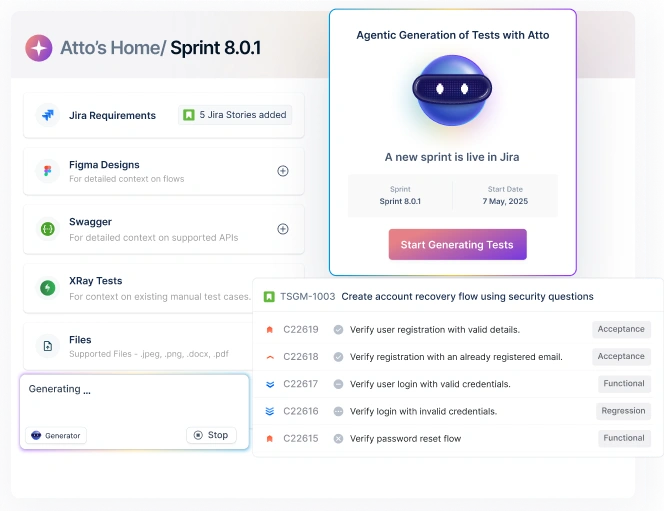
With AI-powered platforms like Testsigma, STLC can begin even earlier:
- Test cases are auto-generated from requirements.
- AI identifies coverage gaps.
- Tests run automatically in CI/CD pipelines.
This aligns testing with SDLC at every stage, improving coverage without slowing development.
Tools Used in SDLC and STLC
Both SDLC and STLC require different toolsets, but together they create a complete pipeline.
Popular SDLC Tools
SDLC relies on tools that help teams plan work, manage code, and automate delivery across the development pipeline.
- Jira: Project and sprint management
- GitHub: Source code version control
- Jenkins: Automation and CI/CD
Popular STLC Tools
STLC depends on tools that streamline test creation, execution, tracking, and overall quality assurance.
- Testsigma: AI-powered end-to-end test automation
- Selenium and TestRail: UI automation and test management
- Postman: API testing
Pro Tip: Choose tools that support cross-platform testing, CI/CD pipelines, and reusability across teams. This is especially helpful for SDLC in manual testing when transitioning toward automation.
Why SDLC and STLC Are Both Important
Both lifecycles contribute unique strengths that ensure consistency, reliability, and release confidence.
- SDLC ensures structured development: Without SDLC, teams would rely on ad-hoc processes, leading to delays and unpredictable outcomes.
- STLC ensures quality verification: STLC prevents defective features from reaching users and validates whether the product truly meets requirements.
- They create a complete product pipeline: SDLC builds; STLC verifies. When both align, teams deliver faster without compromising stability.
Expert Note:
A senior QA lead summarizes it well:
“SDLC gives you the ‘what’ and ‘how’ of building software. STLC gives you the confidence that what you built truly works.”
This dual-cycle approach is why the combination of SDLC and STLC, and testing coverage remains a core principle in modern engineering.
Accelerating Both Lifecycles with Modern Testing
SDLC provides the blueprint for building software, and STLC ensures that every feature meets quality standards before release. When teams understand SDLC vs. STLC, collaborate early, and adopt automation, the entire development pipeline becomes smoother and more efficient. Modern QA teams increasingly adopt AI-driven testing platforms like Testsigma to streamline STLC phases and integrate testing throughout SDLC. This eliminates bottlenecks, speeds up releases, and strengthens user trust in your product.
FAQs on SDLC Vs. STLC
Yes, STLC is a dedicated testing component within SDLC focused solely on validation and quality assurance.
SDLC begins first. STLC starts when development reaches the testing stage or when requirements become test-ready.
It reduces bugs, ensures requirement coverage, and prevents critical issues from reaching production.
SDLC is how you build software; STLC is how you test and validate it.