



Table Of Contents
- 1 Key Takeaways
- 2 The AI vs QA Debate: Why It’s More Complicated Than Headlines Suggest
- 3 What AI Can Already Automate in Software Testing
- 4 What AI Still Cannot do in QA (and May Never Will)
- 5 How to Thrive as a QA Engineer in 2026
- 6 How the QA Engineer Role is Changing
- 7 Skills QA Testers Need to Stay Relevant in an AI World
- 8 How Leading Companies are Using AI with Human Testers Together
- 9 How Testsigma Empowers QA Teams
- 10 Move Forward With Human-Assisted AI Testing
- 11 FAQ’s
Key Takeaways
- AI is not replacing QA testers anytime soon, despite AI now handling repetitive testing tasks at scale.
- The rise in flawed AI-generated code has increased the need for human judgment.
- Testers are evolving into quality strategists who guide AI, assess risk, and ensure products meet real-world expectations.
- AI can already generate test cases from requirements, prioritize high-risk scenarios, create test data, fix broken scripts, and predict defects.
- AI still cannot perform true exploratory testing, understand business context, detect ethical bias, manage cascading system failures, or make judgment calls in high-stakes scenarios.
With global software spending reaching $1.4 trillion in 2026, generative AI has become the foundation for building and shipping products at record speeds. However, over half of all AI-generated code contains logical or security flaws, making human oversight more critical than ever. This article explores why testers must evolve into quality intelligence experts rather than being replaced by automation.
The AI Vs QA Debate: Why It’s More Complicated Than Headlines Suggest
For years, we saw scary headlines saying, “Will AI take over QA jobs?” But the 2026 reality is a lot more nuanced. While AI can handle up to 40% of standard tasks in major companies, 70% of CEOs are using that extra time to chase new revenue and build more features. They’re mostly trying to grow their output.
The Probabilistic Shift
Traditional testing is deterministic. You write a script: If I click A, then B should happen. It is binary: pass or fail. AI is probabilistic, so it operates on patterns and likelihoods. This means that 100% test coverage no longer means 100% certainty.
Because AI is non-deterministic, we need human testers to provide strategic differentiation. You are the one who navigates the uncertainty that the AI creates. Human judgment is the final word on whether a product is truly ready for the world.
The Instinct Gap in Action
Consider a checkout process that has a 200ms delay. An AI might see this as a minor blip because it fits within a normal pattern. However, a human tester understands the business context. If that delay happens during a massive Black Friday sale for a major retailer, it could cost millions of dollars. AI lacks this instinct. It doesn’t understand the high stakes of a specific moment.
Facing the Panic
Despite the growth, more than half of software testers believe that they are stuck in automation debt. They’re failing to adapt to AI-driven workflows. The thing is, they mostly work at companies that rushed to use basic AI tools without a plan. Now they are stuck fixing fragile AI-generated tests that keep breaking.
If you feel this way, remember that the industry is actually shedding legacy roles to make room for high-value quality strategists. The demand for AI-aware testers has never been higher.
What AI Can Already Automate in Software Testing
By 2026, AI has moved from being a helper to being a structural layer in the testing process. It handles the repetitive part of your work.
Agentic Test Generation
We’ve moved past simple automation into autonomy. Next-generation AI agents use Natural Language Processing (NLP) to read user stories and requirements. They then create their own test cases.
- Risk-Based Prioritization: These agents don’t just test everything; they find the high-risk areas that could break the whole system.
- Data Synthesis: AI can create thousands of variations of valid and invalid test data in seconds. This includes complex things like two-factor authentication (2FA) and multi-step forms.
- Efficiency: Teams using agentic generation have seen a 40% reduction in the time it takes to prepare for a test.
Self-Healing and Maintenance
The biggest waste of any QA engineer’s skills has always been maintenance. If a developer moves a button, the test may break. Self-healing frameworks are becoming standard in 60% of new tools. If an element changes, the AI automatically repairs the script. This reduces manual maintenance for you to scale your tests without needing more people to fix them.
Predictive Defect Analytics
AI has started to predict bugs as well. By looking at code changes and past failures, AI tools can tell you exactly where a defect is likely to pop up. Even when a test does fail, AI-driven Root Cause Analysis (RCA) clusters the errors and tells you why it happened.
| AI Feature | Efficiency Gain | Business Impact |
| Agentic Generation | 40% less prep time | Faster time-to-market |
| Self-Healing Scripts | 60% less maintenance | Lower operational costs |
| Predictive Analytics | 30% fewer forecasting errors | Targeted risk mitigation |
| Root Cause Analysis | 85% less manual effort | Rapid debugging cycles |
What AI Still Cannot Do in QA (and May Never Will)
While AI is powerful, it has a ceiling for now. There are parts of quality assurance that only a human can handle. Reddit also thinks that AI is backward-looking. As it learns from data that already exists, it can’t imagine a future that hasn’t happened yet.
Creative Exploratory Testing
Experienced testers have a “What if?” instinct. You might think, “What happens if I try to checkout while my internet is flickering and I’m also changing my address?” AI agents operate within boundaries. They are fragile when they meet highly custom logic or brand-new interfaces. They still can’t discover unknown-unknowns, the usage patterns that nobody even thought to look for.
Contextual Business Validation
AI can check if a function works, but it can’t tell if the function is good for the business. In a fintech app, a transaction might be technically correct, but if the user interface feels shady or untrustworthy, the user will leave. This is about emotional satisfaction, a metric that requires human empathy to measure.
Ethical Governance and Bias
AI cannot audit itself for fairness. If an AI model is used for credit scoring or hiring, it might have hidden biases. Human testers are now essential for testing the AI itself. You are the one who ensures the models are fair, transparent, and follow the law. This is even a legal requirement in many places now, making human oversight non-negotiable.
Managing Cascading Failures
In 2026, systems are interconnected. An error in one AI agent can spread through a whole network. You still need human Risk Architects to design how these agents interact. AI agents currently cannot manage their own resources or know when to escalate a problem to a human manager based on a feeling.
How to Thrive As a QA Engineer in 2026
If you want to stay ahead of the future of QA testing, follow these steps:
- Stop writing scripts and start writing prompts. Learn how to give AI agents clear, behavior-driven instructions.
- Get certified in AI Testing. The ISTQB® AI Testing (CT-AI) certification is now a standard for senior roles. It covers things like ML data validation and ethical compliance.
- Focus on Quality Intelligence. Instead of finding bugs, focus on analyzing the data that AI gives you to help your company make better release decisions.
- Adopt low-code platforms. Use Testsigma to go from manual to automated testing using plain English.
How the QA Engineer Role is Changing
The QA tester job security 2026 is not disappearing but undergoing a metamorphosis. We are moving from executing tests to orchestrating quality. This shift is already visible in the industry, where testers who adapt to AI are becoming more productive rather than obsolete.
The AI Test Orchestrator
This is the most important new role. You are responsible for onboarding AI agents. You teach them the domain-specific context that isn’t written in any manual, and ensure that marketing, engineering, and finance are aligned.
- Workflow Translation: Break down big business goals into tasks that agents can handle.
- Human-in-the-Loop Governance: Act as the safety net, making sure the AI doesn’t go off the rails.
The Blurring Line between Dev and QA
Developers now own a lot of the basic AI test automation. This frees testers up to become a Quality Engineer. From designing the architecture to advocating for the customer’s perspective, you’re now a business interpreter who translates technical risks into business impact.
Skills QA Testers Need to Stay Relevant in an AI World
To survive the 2026 job market, you need a human-AI hybrid skill set. While coding is still important, the focus has shifted toward higher-order technical and strategic capabilities.
Technical Mastery
- AI Literacy: Understanding how models interpret data and detecting bias.
- Advanced Automation: Proficiency in underlying infrastructures like Selenium and Playwright remains necessary for building the tracks that AI agents run on.
- API and Cloud-Native Expertise: Deep understanding of microservices and cloud-scale validation.
Soft Skills As a Competitive Advantage
As AI handles the grunt work, soft skills are the primary differentiator for human testers.
- Critical Thinking: Evaluating risks that AI might miss.
- Leadership and Coaching: Mentoring developers and influencing architectural decisions to ensure testability.
- Empathy: Understanding the emotional satisfaction of a user, something a machine cannot feel.
Many senior roles now also require the ISTQB® AI Testing (CT-AI) certification. This syllabus ensures that testers can use ChatGPT for software testing, among other tools, covering everything from ML data validation to ethical compliance.
How Leading Companies Are Using AI with Human Testers Together
Leading organizations in 2026 have moved to integrate AI into multiple organizational pipelines. Here are a few examples of how AI is being used to accelerate processes:
Hansard (global Insurance)
By adopting low-code automation, Hansard reduced its regression cycle from 3 weeks to less than 1 week. This allowed them to cut the sprint time from 8 weeks to just 5. That is a 300% reduction in regression time, allowing for faster monthly deployments.
Credit Saison
This fintech leader achieved 80% automated test coverage, running over 5,000 tests daily. This allowed them to scale without a massive increase in headcount. Humans now focus on high-priority risks while AI handles the routine checks.
Perfectmind
This SaaS provider used AI to automate 90% of its manual regression suite. They went from 10 days of execution down to just 2 days. That is 5X faster execution thanks to AI-augmented tools.
Ntuc First Campus
As a large retail and childcare operator, they used AI-powered no-code testing to bridge skill gaps. With only two technical experts in a 16-member team, AI allowed domain experts to contribute to testing. They improved efficiency by 30% and cut maintenance time by nearly a third.
Nestlé
Nestlé uses 3D models of products to generate visuals for thousands of markets. Human testers work alongside AI to ensure these virtual replicas look real and comply with local cultural norms. This task requires human visual and cultural judgment that AI lacks.
Adidas and Walmart
At Adidas, AI generates shoe designs, while humans focus on the final validation of structural integrity. Walmart’s Trend-to-Product tool reduced lead times by 70%. AI handles the routine validation so humans can focus on stress-testing assumptions early in the cycle.
Logistics (dhl & Samsung)
These enterprises have integrated AI assistants directly into their delivery pipelines. They manage quality gates globally, shifting the role of the tester toward being an automation architect.
How Testsigma Empowers QA Teams
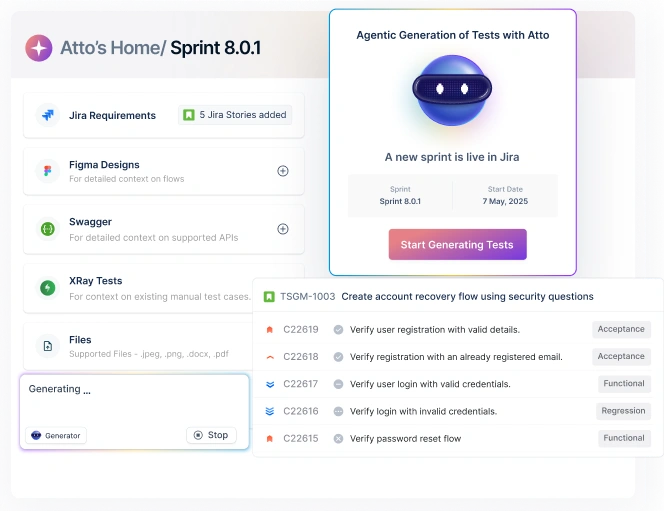
Testsigma utilizes NLP, allowing you to create tests in plain English. At the core is Testsigma Copilot and Atto, an AI coworker that mobilizes agents to autonomously plan, design, and optimize tests.
- Self-Healing Resilience: Automatically repairs failures caused by UI changes, reducing maintenance effort by 90%.
- 10X Faster Development: Teams report a tenfold increase in the speed of test development by removing manual scripting complexity.
- Digital Assurance: Supports end-to-end testing across web, mobile, desktop, and enterprise apps like Salesforce and SAP.
Testsigma is designed to automate the repetitive 80% tasks like test generation, script maintenance, and cross-browser execution. Start Testing.
Move Forward with Human-Assisted AI Testing
The Solo Engineer case study is a powerful rebuttal to the replacement theory. By moving to Testsigma, a single engineer delivered the impact of an entire QA team, increasing monthly test executions from 330 to over 3,000+. This allowed a small startup to achieve enterprise-level quality without a massive team of engineers. Try Testsigma with a free trial and see how it automates your functional tests across browsers.
FAQ’s
AI will not fully replace testers because it still lacks human intuition and the ability to understand complex business needs. Instead, the role is shifting from manual execution toward high-level strategy and managing AI tools.
AI is taking over boring, repetitive work like writing basic scripts, managing test data, and running routine regression checks. This shift allows humans to focus on creative and analytical tasks that machines cannot handle.
You should focus on learning how to guide AI tools through prompt engineering and overall test strategy design. The most valuable testers are now those who decide what to test rather than those who simply run the tests.
Following a simple, repetitive script manually is dying out since AI can do it much faster. However, exploratory testing is more important than ever because human judgment finds the unique bugs that AI often misses.
You don’t need to worry if you are willing to learn how to work alongside these new tools. The only real risk is for those who refuse to adapt, as companies now crave experts who can lead AI to find real results.