




SoapUI has long been a trusted tool for testing SOAP and REST APIs, but modern QA teams now need faster, scalable, and easier automation options. In 2026, SoapUI alternatives offer broader support for CI/CD, cloud execution, and no-code automation making API testing simpler and more efficient.
Whether you’re seeking a SoapUI free alternative, an open-source API testing tool, or an AI-powered platform that unifies web, mobile, and API testing, this guide highlights the best alternatives to SoapUI for every use case.
Table Of Contents
Why Look beyond SoapUI?
While SoapUI remains a reliable and feature-rich API testing tool, many teams find it less adaptable to today’s fast-paced, automation-driven environments. As projects scale and integrate with CI/CD pipelines, teams seek faster, more collaborative, and less script-heavy tools that support REST, SOAP, and modern APIs like GraphQL.
That’s why testers and developers increasingly explore SoapUI alternatives, from open-source tools like Apache JMeter to AI-powered, unified platforms like Testsigma, for better scalability, usability, and maintenance efficiency.
Common User Pain Points & Feedback
Real-world user feedback from developer communities and QA forums reveals recurring issues with legacy API testing tools like SoapUI:
- Scalability Limitations: Tools such as SoapUI and Postman often struggle with large-scale test suites, data-driven testing, and complex CI/CD integrations.
- Standalone Tool Constraint: Many GUI-based tools lack deep integration with code-based frameworks, making automation workflows harder to maintain.
- Performance and UI Bloat: Users frequently cite slow performance and cluttered interfaces that hinder quick debugging and collaboration.
- Learning Curve and Maintenance Overhead: Tools like JMeter and SoapUI require technical setup and maintenance skills, delaying onboarding for new testers.
- Trust in Newer Tools: While emerging options like Hoppscotch and Apidog are lightweight and fast, some teams question their long-term maturity and enterprise readiness.
These pain points underscore why QA testing tools and teams are shifting toward tools that combine speed, simplicity, and scalability across multiple testing types.
How We Selected These Alternatives
To shortlist the best alternatives to SoapUI in 2026, we applied the following key criteria:
- Scalability & Performance: Ability to handle enterprise-level workloads and parallel API tests without lag.
- Ease of Use: Low-code or codeless workflows enabling faster test creation and execution.
- Integration Support: Compatibility with CI/CD tools, version control systems, and cloud infrastructures.
- Protocol Coverage: Support for SOAP, REST, GraphQL, WebSocket, and more.
- Collaboration & Reporting: Built-in analytics, dashboards, and real-time collaboration features.
- Pricing & Accessibility: A mix of free, open-source, and premium options to fit different team sizes and budgets.
Top 7 SoapUI Alternatives for API Testing in 2026
Looking for a faster, smarter alternative to SoapUI? In 2026, teams are choosing tools that offer no-code automation, CI/CD integration, and better scalability for modern API testing. From Testsigma’s AI-powered platform to lightweight options like Hoppscotch and Insomnia, here are the top SoapUI alternatives redefining API testing this year.
| Tool | Key Strength | Best For | Pricing |
| Testsigma | AI-powered, no-code testing for API, web, and mobile in one platform | Teams seeking unified, end-to-end automation | Free trial & paid plans |
| Postman | Powerful API client with collaboration, mocks, and automation via Flows | Developers and API-first teams | Free tier + paid plans |
| Apache JMeter | Open-source tool for API and performance/load testing | QA engineers needing scalable performance testing | Free (Open Source) |
| Parasoft SOAtest | Enterprise-grade AI-assisted API, load, and security testing | Large organizations with complex service stacks | Commercial (Enterprise) |
| Hoppscotch | Lightweight, fast, open-source API client | Small dev teams and individuals | Free (Open Source) |
| Insomnia | Beautiful, modern API design and testing platform | Developers needing secure collaboration | Free tier + paid plans |
| Apidog | Design-first, all-in-one API design, test, and documentation platform | Teams wanting full API lifecycle in one tool | Free tier + paid plans |
1. Testsigma

When it comes to finding a modern SoapUI alternative for API testing, Testsigma redefines speed and simplicity with its AI-powered, no-code automation platform. Built for both developers and QA teams, it allows you to generate and run API tests instantly from Swagger/OpenAPI, Postman collections, or plain English commands, no scripting required.
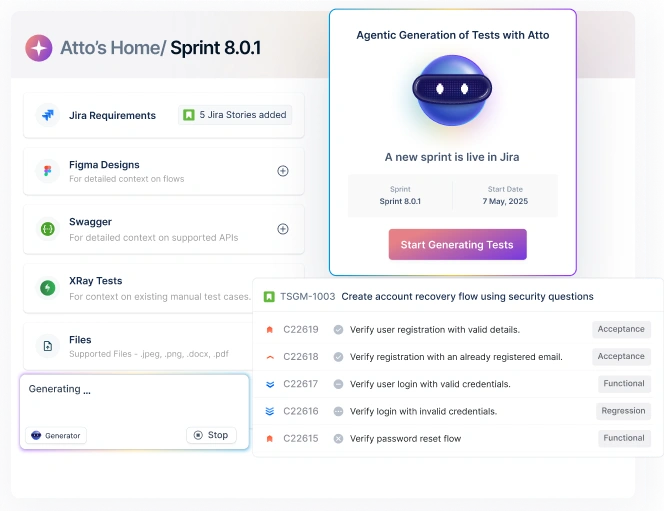
With agentic AI coworker Atto, guiding test creation, validation, and maintenance, Testsigma enables seamless CI/CD integration, real-time validations, and unified API + UI + database coverage in one cloud-based environment.
Key Features
- Instant Test Generation: Create automated API tests directly from documentation or natural language prompts.
- Smart Assertions: Auto-suggests validations and schema comparisons with flexible, AI-driven response checks.
- Data Handling: Capture dynamic values like tokens or IDs and reuse them across test flows.
- Parameterization: Manage multiple data sets and environments effortlessly without hard-coding.
- CI/CD Ready: Integrates smoothly with Jenkins, GitHub Actions, GitLab, and other pipelines for continuous testing
- Unified End-to-End Testing: Combine API, UI, and DB testing to ensure full workflow validation.
- Advanced Reporting: Step-level logs, response diffs, and AI-highlighted anomalies for faster debugging.
Pros
- Fast, no-code automation with AI assistance for faster authoring and execution.
- End-to-end capability covering API, UI, and database in a single workflow.
- Easy integration into DevOps pipelines with detailed, visual reporting.
- Low maintenance thanks to AI self-healing and reusable components.
Cons
- Highly complex or niche cases may require light custom scripting.
- Teams moving from code-based tools might need a short adjustment period.
2. Postman

Postman is one of the most popular API development and testing platforms, known for its developer-friendly interface, rich collaboration features, and comprehensive lifecycle coverage from design to deployment. It started as a simple REST client but has evolved into a full API platform supporting design, documentation, mocking, monitoring, and automation.
For teams looking for a SoapUI alternative that emphasizes collaboration and ease of use rather than heavy scripting, Postman delivers a smooth GUI-based experience with optional scripting for advanced use cases.
Key API Features
- API Client: Build, send, and debug REST, SOAP, GraphQL, and WebSocket requests with built-in authentication handling (OAuth 2.0, AWS Signature, etc.).
- Collections & Workspaces: Organize requests, automate workflows, and collaborate across teams in shared cloud or local environments.
- Postman Flows: A low-code canvas to visually create API workflows and integrations without writing code.
- Mock Servers: Simulate endpoints for early testing or when backend services are unavailable.
- Monitors & Insights: Schedule API checks, track uptime/performance, and integrate alerts with Slack, Datadog, or New Relic.
- Postman CLI (Newman): Run collections from the command line or CI/CD pipelines for automated regression tests.
- API Governance & Security: Enforce schema validation, secret management, and organization-wide policies at scale.
- AI Assistant (Postbot): Generate tests, documentation, and workflows using natural language prompts.
Pros
- End-to-end lifecycle coverage
- Highly collaborative, ideal for distributed API and dev teams.
- Low learning curve with optional scripting flexibility in JavaScript.
- Extensive integrations with CI/CD, Git, and analytics tools.
- Free tier available, making it an accessible SoapUI free alternative for individuals or startups.
Cons
- Can feel resource-heavy with large collections or slow network conditions.
- Some advanced collaboration and governance features require paid plans.
3. Apache JMeter

Apache JMeter is one of the most powerful open-source alternatives to SoapUI, developed by the Apache Software Foundation. Originally built for load testing web applications, it has since evolved into a comprehensive tool for performance, functional, and API testing. As a 100% Java-based application, JMeter runs on any platform and supports extensive customization through plugins, scripts, and CI/CD integrations, making it a go-to choice for technical teams seeking flexibility and scalability.
Key API Features
- Protocol support: Test across HTTP(S), SOAP, REST, FTP, JDBC, JMS, LDAP, TCP, and mail protocols.
- Full-featured IDE: Record, build, and debug test plans quickly; supports correlation and parameterization.
- Command-line (CLI) mode: Run large-scale or distributed tests headlessly for performance benchmarking.
- Dynamic HTML reports: Generate detailed metrics and visualizations for throughput, latency, and errors.
- Data extraction & correlation: Capture and reuse dynamic values (from JSON, XML, HTML, etc.) across requests.
- Extensibility: Add samplers, timers, or assertions via Groovy/BeanShell scripting and community plugins.
- CI/CD integration: Easily connects with Jenkins, Maven, and Gradle for automated regression or load tests.
Pros
- Completely free and open-source, making it one of the best SoapUI alternative open source tools.
- Highly extensible, ideal for technical users who prefer scripting and custom frameworks.
- Excellent for performance and load testing as well as API validation.
- Large community and plugin ecosystem for advanced analytics and integrations.
Cons
- Steeper learning curve for beginners compared to GUI-driven tools.
- UI can feel dated, especially for complex test plan management.
- Requires technical setup and Java familiarity for configuration and scaling.
4. Parasoft Soatest

Parasoft SOAtest is an enterprise-grade, AI-assisted api testing tool built for complex service-oriented and microservices architectures. It goes far beyond basic functional API validation, offering codeless test creation, AI-driven impact analysis, integrated performance and security testing, and service virtualization. For large organizations that need precision, compliance, and continuous quality, SOAtest is one of the most comprehensive alternatives to SoapUI available today.
Key API Features
- AI-powered test creation: Generate data-driven test cases automatically from API traffic, Swagger specs, or plain English descriptions.
- Service virtualization: Simulate unavailable or unstable APIs instantly using Parasoft Virtualize’s AI assistant to remove environment dependencies.
- Functional, performance, and security reuse: Convert a single functional test into performance and penetration tests, reducing tool sprawl.
- Change Advisor: Detect API changes and update affected test cases in bulk with smart recommendations.
- Test Impact Analysis (TIA): Automatically run only the tests affected by recent code changes to cut regression time by up to 90%.
- Broad protocol support: Works with over 120 message formats and protocols, including REST, SOAP, Kafka, gRPC, GraphQL, and HL7.
- Comprehensive reporting: Delivers HTML, PDF, XML, and dashboard analytics with traceability across quality metrics.
- CI/CD integration: Seamless integration with Jenkins, Azure DevOps, Bamboo, and TeamCity for continuous testing pipelines.
Pros
- Enterprise-ready scalability for regulated or complex environments.
- AI-driven codeless workflows make automation approachable to non-technical users.
- All-in-one testing suite (functional, security, performance, and virtualization).
- Strong analytics and governance for compliance-heavy industries like finance, healthcare, and government.
Cons
- Commercial enterprise tool (no free tier), but offers trials and dedicated onboarding.
- Feature-rich interface may feel overwhelming for smaller teams focused only on simple REST API validation.
5. Hoppscotch

Hoppscotch is an open-source, developer-first API testing and collaboration platform designed to be lightweight, fast, and highly accessible. Originally created as a minimalist Postman alternative, Hoppscotch has grown into a full-featured tool that supports REST, GraphQL, WebSocket, and MQTT protocols. It’s ideal for developers and small teams seeking a clean, privacy-friendly, and cloud-synced API client without the overhead of enterprise suites like SoapUI or Postman.
Key API Features
- Cross-platform compatibility: Works on Web, macOS, Windows, Linux, and CLI, making it easy to test APIs anywhere.
- Multi-protocol support: Handle HTTP, GraphQL, WebSocket, Socket.IO, MQTT, and Server-Sent Events from a single interface.
- Real-time collaboration: Share collections, workspaces, and requests with team members instantly.
- Cloud & local sync: Sync data securely across devices with local-first storage no tracking or ads.
- Collections & environments: Organize APIs into folders, manage variables, and maintain different environments easily.
- Pre- and post-request scripting: Write small scripts for request setup or response validation.
- Code snippet generation: Instantly convert requests into multiple languages and frameworks.
- One-click migration: Import from Postman, Insomnia, or cURL with minimal setup.
- Open-source and self-hostable: Host your own instance for full control and privacy.
Pros
- Free and open source, making it an excellent SoapUI alternative free option.
- Fast, lightweight, and clutter-free compared to heavier API tools.
- Supports multiple API types beyond REST, including GraphQL and MQTT.
- Collaborative and developer-centric, with easy sharing and real-time editing.
- Strong privacy posture, no tracking, analytics, or intrusive ads.
Cons
- Limited enterprise-level features like deep analytics, governance, or test automation.
- Primarily suited for developers, not full-scale QA workflows.
6. Insomnia

Insomnia, developed by Kong, is a sleek, modern, and open-source API design and testing platform that emphasizes developer experience, collaboration, and security. Known for its minimal yet powerful interface, it enables teams to debug, design, mock, and test APIs with precision.
As a SoapUI alternative in API automation testing, Insomnia stands out for its simplicity, multi-protocol support, and integration with Git and cloud-based storage, allowing teams to sync projects, collaborate in real time, and maintain version control with ease. Its growing plugin ecosystem and Vault integrations (introduced in Insomnia 11) make it suitable for developers and DevOps teams focused on API lifecycle management.
Key API Features
- Multi-protocol support: Test HTTP, gRPC, GraphQL, WebSocket (WSS), and SSE APIs in a single workspace.
- API design & specification: Build and validate APIs using OpenAPI and Swagger specifications directly in the editor.
- Mock servers & debugging: Instantly mock endpoints and debug requests to simulate production-like environments.
- Git & cloud sync: Sync collections securely via local Git or Insomnia Cloud, supporting team collaboration and version control.
- Vault integrations: Securely store and share credentials, tokens, and secrets across environments.
- Command-line interface (CLI): Automate tests and workflows through the Insomnia CLI.
- Plugins & customization: Extend functionality using community-built or custom plugins.
- Role-based access (RBAC): Manage users and teams with granular permissions.
Pros
- Open source with a free tier, a solid SoapUI free alternative for developers and small teams.
- Elegant UI and intuitive experience, great for rapid debugging and prototyping.
- Supports multiple API types, including GraphQL and gRPC.
- Git integration for seamless version control and team sync.
- Strong security and secret management through Vault and encrypted workspaces.
Cons
- Primarily developer-focused, not an end-to-end QA automation suite.
- Limited reporting and analytics compared to enterprise-grade tools.
7. Apidog
Apidog is a fast-growing, design-first, all-in-one API development and testing platform that merges the capabilities of Postman, Swagger, Stoplight, and SoapUI into one interface. It offers a unified environment for API design, debugging, automated testing, documentation, and mocking, making it a promising SoapUI alternative for teams aiming to manage the full API lifecycle from a single workspace.
Key API Features
- Design-first workflow: Visually design APIs using OpenAPI support and reusable components to create clear, structured specs before coding begins.
- Spec-based validation: Test APIs directly against their specifications to automatically catch inconsistencies or breaking changes.
- Low-code automation: Build end-to-end API test flows with assertions, data-driven logic, and CI/CD integration, without writing full scripts.
- Smart mock servers: Instantly generate realistic mock responses from your schema, allowing front-end teams to work before the backend is live.
- Auto-sync documentation: Convert live API specs into interactive docs with “Try It Out” features, code samples, and version control.
- Collaboration & workspaces: Organize APIs by domain or microservice within shared team workspaces for full visibility.
- Cross-platform access: Available as a web app, desktop app, or self-hosted instance with secure sync options.
Pros
- Truly unified platform combining design, mock, test, and documentation workflows.
- Low-code automation suitable for both developers and QA engineers.
- Smart mock and spec validation accelerate early-stage development.
- Clean, visual interface with easy onboarding and collaboration.
- Free tier available with affordable pricing for teams.
Cons
- Relatively newer tool, so long-term enterprise support and plugin ecosystem are still maturing.
- Advanced governance or compliance controls not as extensive as legacy enterprise suites.
How to Choose the Right Tool for Your Team?
Selecting the best SoapUI alternative depends on your team’s workflows, project complexity, and automation goals. Keep these key factors in mind:
Consider Protocol Support (soap, REST, Graphql)
Ensure the tool supports all the API types you work with. While most modern tools focus on REST and GraphQL, legacy systems may still require SOAP protocol compatibility.
Consider Team Skill-Set and Scripting Vs No-Code
If your team prefers low-code or codeless automation, platforms like Testsigma are ideal. For developer-heavy teams, tools like Postman or JMeter offer greater scripting flexibility. For UI or web automation comparisons, check out our detailed guide on Selenium vs Cypress to understand which framework aligns best with your testing workflow.
Consider Integration with CI/CD, Cloud & Scalability
Pick a tool that integrates seamlessly with DevOps pipelines (Jenkins, GitHub Actions, GitLab, etc.) and scales with your testing needs. Cloud-based solutions help teams run tests continuously and in parallel, speeding up release cycles.
Conclusion
Choosing the right SoapUI alternative depends on your team’s size, technical expertise, and testing goals. If you need a modern, AI-powered, and no-code platform, Testsigma stands out as the best all-in-one solution for API, UI, and mobile testing, helping teams automate faster and scale effortlessly.
For developers seeking flexibility, Postman and JMeter remain reliable options, while tools like Hoppscotch, Insomnia, and Apidog cater to teams who value simplicity and collaboration. No matter your choice, the key is to find a tool that aligns with your workflow, integrates seamlessly into your CI/CD pipeline, and evolves with your testing needs.
FAQs
Yes, SoapUI is still a capable tool, especially for teams working with SOAP and REST APIs in smaller projects.
It’s time to consider a SoapUI alternative if you’re facing slow performance, high maintenance, or limited integration with CI/CD pipelines.
Yes, tools like Testsigma unify API, UI, mobile, and database testing into a single platform. This helps QA and development teams create end-to-end automated tests without juggling multiple tools.