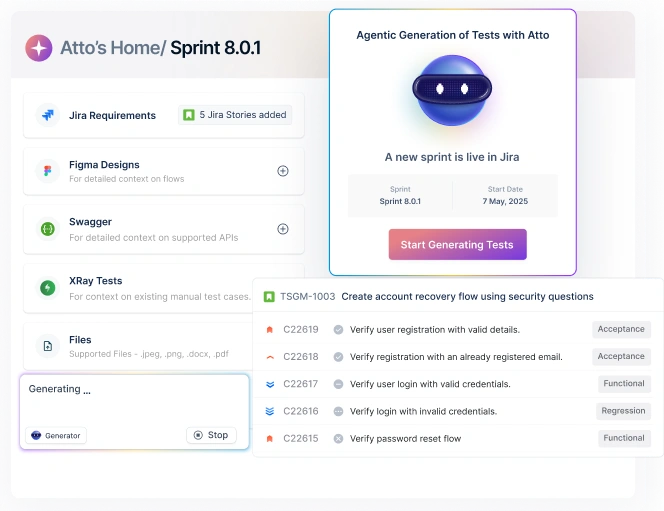





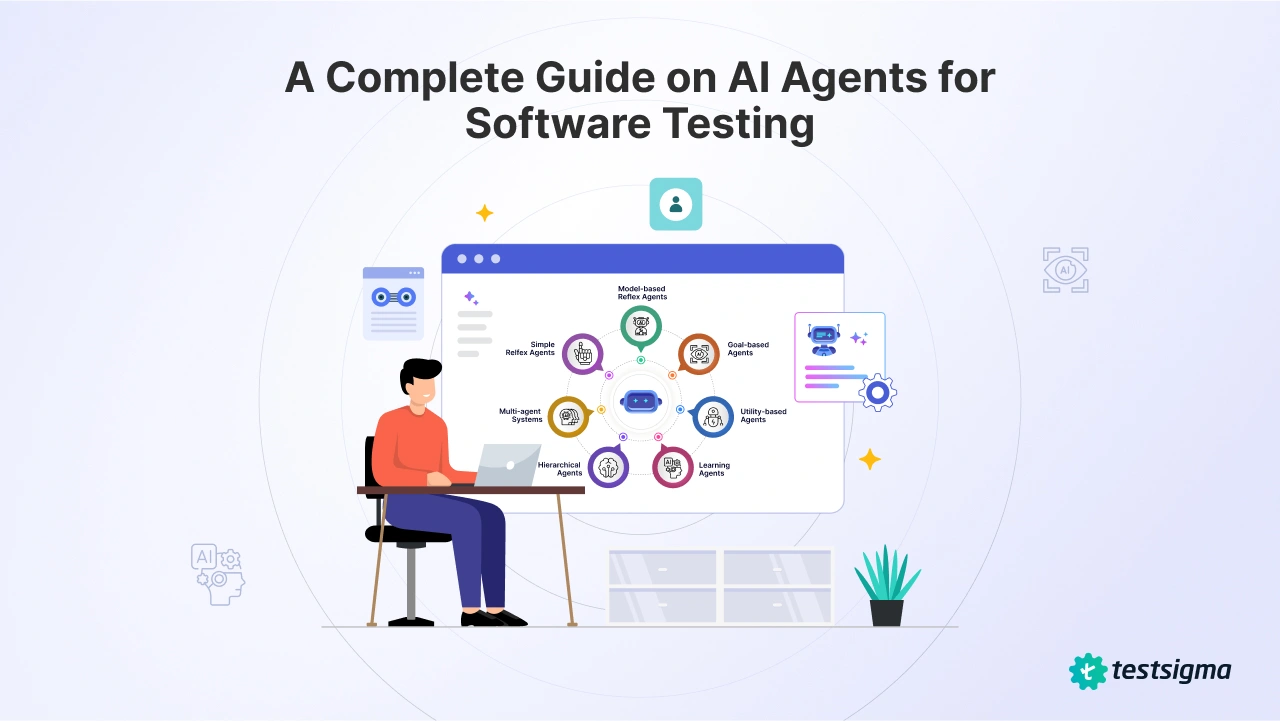
Agentic AI testing uses autonomous AI agents, not just AI-assisted scripts, to plan, generate, execute, and adapt tests with minimal human input. Unlike AI-assisted testing, which helps a human write tests faster, agentic testing takes the actions itself: perceiving the app under test, deciding what to test next, and adapting when the UI or API changes. Testsigma’s Atto is one example of coordinating a crew of specialized agents across the testing lifecycle.
TL;DR
- Agentic AI testing = autonomous agents act (plan, execute, adapt), not just generate suggestions for a human to run.
- Key distinction: AI-assisted testing helps you write tests faster; agentic testing takes over running and adapting them too.
- Five defining traits: autonomous agents, context awareness, goal-driven decisions, continuous learning, and real-time (RAG-based) reasoning.
- The AI agents market was valued at $3.7B in 2023 and is projected to reach $103.6B by 2032 (44.9% CAGR), a concrete signal of how fast autonomous systems are being adopted across industries.
- Testsigma’s Atto coordinates seven specialized agents, Generator, Planner, Execution, Coverage Planner, Analysis, Maintenance, and Reporting; across the testing lifecycle.
- Agentic testing is the architecture; vibe testing is one application of it, purpose-built for validating AI-generated, intent-described apps.
- Agentic doesn’t mean locked in: Atto’s agents are built to sit alongside whatever coding agent shipped the code (Claude Code, Copilot, or a human) and whatever QA stack already runs (Playwright, Appium, or Testsigma), reading each sprint’s changes against test coverage and producing one confidence score rather than requiring a single-vendor pipeline.
Table Of Contents
- 1 What Is Agentic AI Testing?
- 2 Agentic Testing vs. AI-Assisted Testing
- 3 How Does Agentic AI in Testing Work?
- 4 Key Aspects of Agentic AI in Testing
- 5 Benefits of Using Agentic AI in Testing
- 6 Why Businesses Need to Adopt Agentic AI
- 7 Best Practices for Implementing Agentic AI Testing
- 8 How Testsigma Helps With Agentic AI Testing
- 9 Benefits of Using Testsigma
- 10 FAQ’s On Agentic AI Testing
What is Agentic AI Testing?
Agentic AI testing is an advanced form of AI testing powered by autonomous agents. These agents are AI systems built to plan, organize, and execute tests independently, acting as AI coworkers for QA teams, working with minimal human intervention.
Agentic Testing Vs. AI-Assisted Testing
This distinction gets confused often, so it’s worth stating plainly:
| Key Items | AI-Assisted Testing | Agentic AI Testing |
|---|---|---|
| Who acts | A human runs and adjusts what AI suggests | The agent acts autonomously |
| Scope | Helps write or summarize tests | Plans, executes, and adapts tests |
| Adaptation | A human updates the script when things change | The agent perceives change and adapts in real time |
| Example | AI suggests a test case for a human to approve and run | Atto’s agents detect a new sprint, generate tests, run them, and report bugs unattended |
A short way to remember it: AI-assisted helps you write. Agentic helps you run.
How Does Agentic AI in Testing Work?
Agentic AI in software testing operates through autonomous, intelligent agents that function like abstract sensors, constantly perceiving, interpreting, and acting within their environment. Here, that environment is the Application Under Test (AUT) and the broader test execution ecosystem: code repositories, CI/CD pipelines, logs, and test reports.
These agents analyze UI elements, APIs, and test data to understand the structure and behavior of the AUT in real time. They continuously monitor the application’s state, recognize changes like UI shifts or API schema updates, and adapt the testing strategy dynamically, without waiting for a human to notice and respond first.
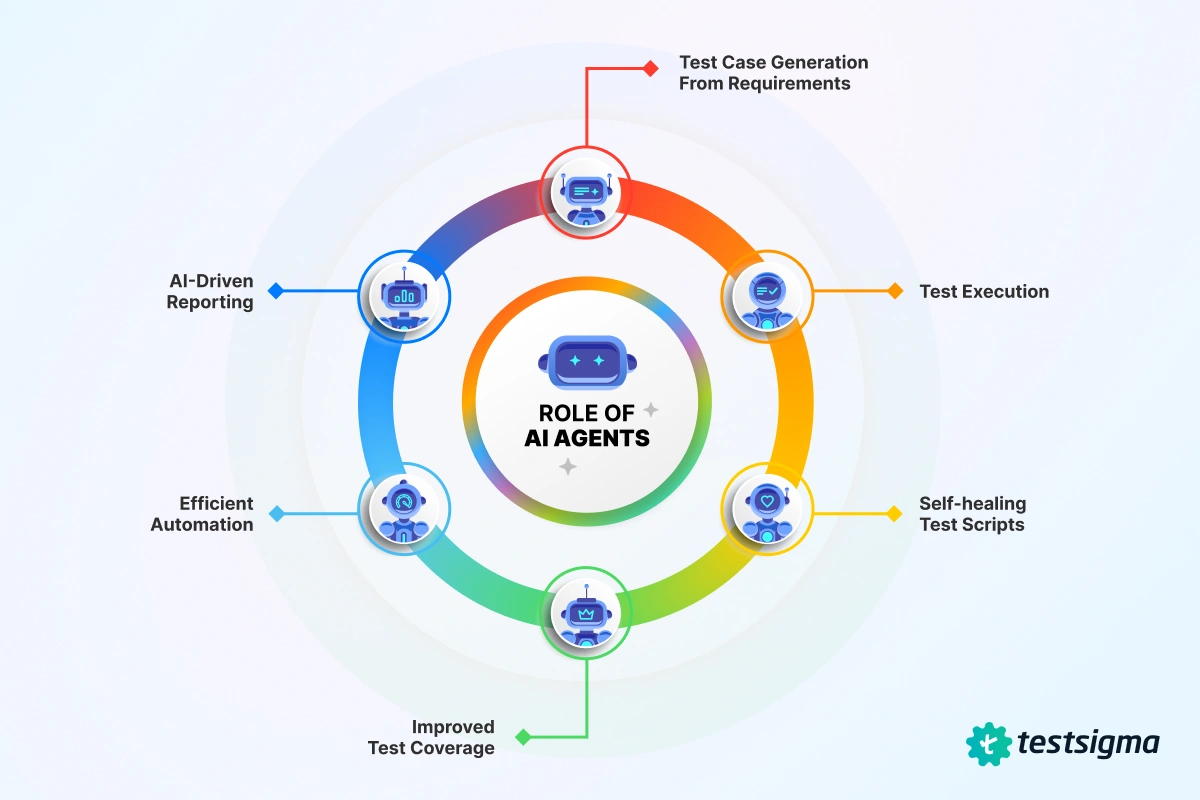
Key Aspects of Agentic AI in Testing
- Autonomous Testing Agents: agents operate without human intervention, deciding what, when, and how to test based on goals and inputs. Think of them as task-specific workers: generation, execution, analysis, each with built-in intelligence.
- Context Awareness: agents understand the AUT by analyzing DOM structure, XML, visual layout, API responses, product documentation, and test artifacts, then adapt test plans as the environment changes.
- Goal-Driven Decision Making: agents are guided by testing objectives (maximize coverage, minimize execution time, reduce flaky tests) and apply reasoning to prioritize actions aligned with those goals.
- Continuous Learning: agentic systems use feedback loops from historical test results, failure patterns, and code changes, improving accuracy and relevance over time.
- Real-Time Decision Making: Retrieval-Augmented Generation (RAG) lets agents pull current, relevant context into their decisions as conditions change, rather than acting on stale assumptions.
Benefits of Using Agentic AI in Testing
- Autonomous test execution: agents act as a QA coworker, independently creating, running, and adapting tests based on system changes and human input.
- Faster test creation and maintenance: agents generate test cases from requirements, user flows, or UI changes, drastically reducing manual scripting time.
- Self-healing capabilities: when a test breaks due to UI/API changes, the agent detects and fixes the locator or logic, preventing flaky failures and reducing maintenance overhead.
- Scalable, parallel execution: multiple agents test different features, devices, or platforms simultaneously, boosting coverage and speed.
- Intelligent test coverage: agents prioritize test cases by risk, recent code changes, user behavior, or business criticality, making regression testing smarter, not just faster.
- Better insights and reporting: agents analyze failures, generate summaries, and trace bugs to specific commits or modules, improving debugging efficiency.
Why Businesses Need to Adopt Agentic AI
The AI agents market was valued at $3.7 billion in 2023 and is projected to reach $103.6 billion by 2032, a 44.9% CAGR; a clear signal of the broader shift toward autonomous, decision-making AI systems across industries.
For QA specifically:
- Modern applications are growing in complexity as release cycles accelerate, and traditional testing methods increasingly fail to deliver the needed speed, scale, and precision, agents with self-healing capabilities directly address this.
- Agentic AI test automation gives teams self-directed agents that autonomously plan, execute, and adapt test strategies, cutting manual effort and increasing test resilience.
- Teams that adopt agentic AI early gain faster time-to-market, lower maintenance costs, and a real competitive edge in quality coverage.
Best Practices for Implementing Agentic AI Testing
- Start with clear testing goals: define specific outcomes (faster regression, improved stability, better defect detection) to guide agent configuration and measure effectiveness.
- Choose the right testing tool: pick a platform supporting agentic capabilities (autonomous generation, execution, and analysis) that integrates with your existing CI/CD and dev workflows.
- Feed agents high-quality contextual data: the more context (requirements, user journeys, historical bugs, application state), the better their decisions.
- Monitor and fine-tune agent behavior: observe which tests agents prioritize, how they adapt, and what they report, then refine parameters accordingly.
- Adopt an incremental rollout: start with a controlled scope (smoke tests, a single module) and expand coverage and autonomy based on performance benchmarks.
- Stay current on agentic AI evolution: the landscape moves fast with multi-agent systems, LLM advances, and self-adaptive workflows; periodically reassess new capabilities.
How Testsigma Helps with Agentic AI Testing
Testsigma is a codeless, agentic AI-powered test automation platform. It automates web, mobile, API, SAP, Salesforce, ERP, and desktop app testing without requiring coding expertise.
Testsigma’s agentic layer is Atto; the AI coworker for QA teams, coordinating a crew of specialized agents across every phase of the testing process:
- Planner Agent: automatically plans your tests once a Jira sprint starts, mapping intent to sprint-level coverage before a single test runs.
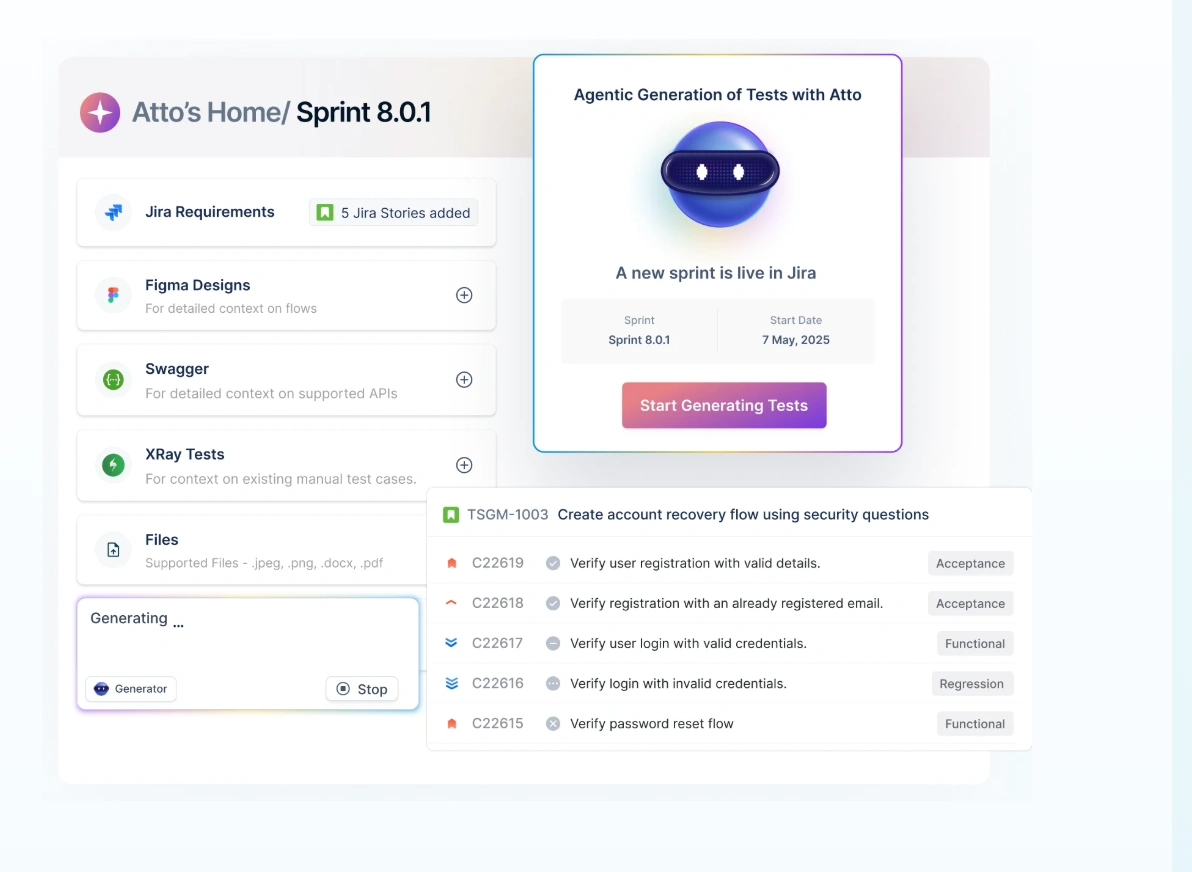
- Generator Agent: automatically generates test cases from natural language; no coding required. Accepts prompts, Figma designs, Jira requirements, videos, documents, images, and more.
- Execution Agent: validates and runs generated tests, including fast in-browser execution for quick sanity checks and low-effort runs.
- Coverage Planner Agent: continuously refines the test suite to stay lean, stable, and high-impact, removing redundancy and identifying scenarios beyond the original prompt.
- Analysis Agent: provides real-time correlation between test failures and code changes, accelerating release cycles.
- Maintenance Agent: auto-heals locators and adapts to UI changes, avoiding the need to manually update tests as the app evolves.
- Reporting Agent: captures detailed logs, screenshots, and step-by-step actions for every failed test, making it easy to share with developers and speed up debugging.
(This is the same seven-agent architecture described in Testsigma’s vibe testing guide; Atto is the coordinating layer, and the agents themselves are consistent across both.)
Crucially, Atto isn’t scoped to one coding tool or one test framework. The Coverage Planner and Analysis agents read whatever changed in a sprint, regardless of which coding agent wrote it, and check it against whatever’s already tested, whether that coverage lives in Testsigma, Playwright, or Appium. The output is a single confidence signal your team can act on before release, instead of piecing that answer together from five disconnected dashboards.
Benefits of Using Testsigma
- Parallel testing: run multiple test cases simultaneously across devices and browsers, reducing execution time and speeding up feedback loops.
- Extensive device lab: 3,000+ real and virtual devices in the cloud, no hardware management required.
- Cross-browser compatibility: Safari, Chrome, Firefox, and Edge tested in real environments in the cloud.
- Reduced flakiness: self-healing tests and smart wait strategies automatically fix broken steps and adapt to UI changes.
- Enhanced test coverage: comprehensive coverage via AI suggestions beyond what was originally scripted.
- Self-healing capabilities: Testsigma detects application changes and updates tests automatically, avoiding manual rework.
FAQ’s on Agentic AI Testing
AI testing is evolving from automation to intelligent quality engineering, where self-learning agents make decisions and optimize testing continuously. Businesses that invest early in AI-first QA strategies will see faster releases, better quality, and lower costs over time.
Generative AI creates new content (text, images, code) from input prompts. Agentic AI takes goal-directed actions in a given environment, making decisions, learning from feedback, and adapting over time. In testing, that’s the difference between an AI suggesting a test case and an AI agent executing and maintaining that test autonomously.
Testsigma’s Atto is a working example; its specialized agents handle test case creation, planning, organizing, execution, and bug reporting as a coordinated, autonomous workflow rather than isolated AI-assisted steps.
Not when it’s implemented properly, but it’s a fair question, since not every tool marketed as “agentic” delivers genuine autonomous adaptation. The real test is whether the system perceives change and adjusts its own next actions (goal-driven, context-aware), versus simply running a fixed script faster.