

Table Of Contents
- 1 TL;DR
- 2 What Is Vibe Testing?
- 3 Why Does Vibe Testing Exist?
- 4 Vibe Testing vs. Traditional Testing
- 5 How Does Vibe Testing Work?
- 6 What Does Vibe Testing Look Like in Practice?
- 7 Does Vibe Testing Cover Security and Edge Cases?
- 8 Who Should Use Vibe Testing?
- 9 How Does Testsigma Enable Vibe Testing?
- 10 Conclusion: Stop Trusting the Vibes — Start Testing Them
- 11 FAQs
Tl;dr
- Vibe testing = describe intent in plain English → AI generates, runs, and refines tests.
- It exists because vibe-coded apps ship faster than humans can manually review the resulting code. DORA’s research links every 25% rise in organizational AI adoption to a 7.2% drop in delivery stability.
- Five principles: Conversational, Iterative, Creative, Collaborative (AI as co-tester), Minimal boilerplate.
- It is not a replacement for traditional testing. Traditional testing asks, “Does it match the spec?” Vibe testing asks, “Does it do what I meant?” Both are necessary.
- Vibe testing is one application of a broader shift toward agentic AI testing, the same autonomous-agent architecture, applied specifically to intent-first QA for AI-generated code.
- It doesn’t matter which coding agent generated the app or which QA stack your team already runs; Testsigma’s Generator, Planner, Coverage Planner, and Analysis agents read each sprint’s code against existing test coverage, generate whatever’s missing, and produce one confidence signal before you ship. Vibe-coded in Claude Code, Copilot, or something else entirely, the verification step works the same way.
What is Vibe Testing?
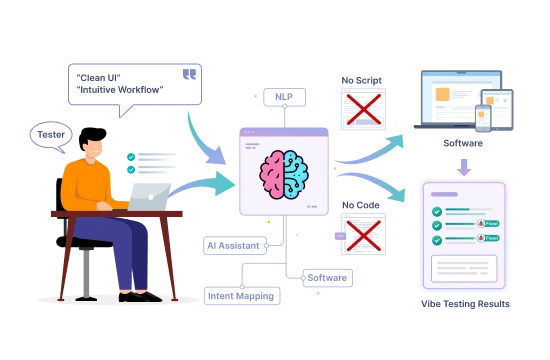
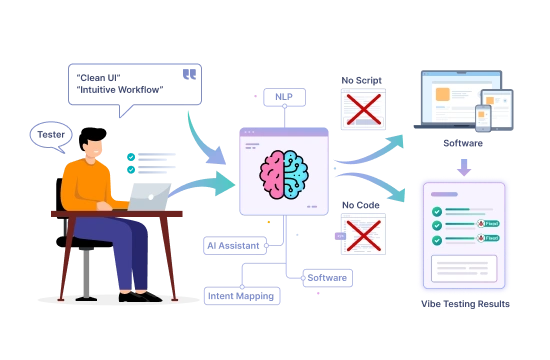
Vibe testing is the direct QA counterpart to vibe coding. Just as vibe coding lets developers describe what they want in natural language and let AI generate the code, vibe testing lets QA teams describe what the app should feel like and let AI take it from there.
It is an AI-assisted, intent-first approach to software quality assurance in which testers describe what an app should do in plain English, and the AI generates, executes, and refines test cases from those descriptions. No scripts, no code, no QA bottleneck, just intent turned into coverage.
If AI builds your software, AI should test it too.
Why Does Vibe Testing Exist?
In early 2025, AI researcher Andrej Karpathy coined the term “vibe coding” to describe a new style of software development: describe what you want in natural language, let AI write the code, and stop worrying about what’s underneath. The result is faster builds, lower barriers, and software created by people who would never have called themselves developers.
But speed without visibility creates a quality problem. When you don’t read every line of AI-generated code, how do you know it’s correct, secure, and doing what you actually intended?
QA practitioners are already wrestling with this in real time. A recurring conclusion in r/softwaretesting discussions: at the scale AI generates code, human review alone can’t keep up. The sweet spot for human QA is external and UX behavior, the parts of software ultimately designed for humans to judge. Everything else needs AI checking.
Vibe testing is built for exactly that, grounded in five principles:
- Conversational tests are written in plain English; no scripting or framework knowledge is required.
- Iterative , rapid prompt-generate-execute cycles keep testing in step with fast-moving development.
- Creative AI actively explores edge cases the team didn’t anticipate, not just the scenarios they thought to ask for.
- Collaborative, AI acts as a co-tester, surfacing gaps and suggesting scenarios rather than just executing instructions.
- Minimal boilerplate, AI handles scaffolding and assertions so testers stay focused on intent and outcomes, not setup.
Vibe Testing Vs. Traditional Testing
| Traditional Testing | Vibe Testing | |
|---|---|---|
| Test Creation | Manual scripting in Python, Java, or JavaScript; requires coding expertise | Plain English description; no code required |
| Test Planning | Upfront specification of every step; rigid plans written before development starts | Intent-first: describe the desired experience; AI generates the scenarios. |
| Who Can Test | QA engineers with technical skills | QA engineers, developers, product managers, UX designers, anyone with domain knowledge |
| Coverage Focus | Predetermined test cases covering known requirements | AI explores edge cases, unexpected flows, and gaps the team didn’t anticipate. |
| Adapts to UI Changes | Scripts break with every UI change; manual repair is required. | Self-heals or regenerates from the original intent description |
| Speed | Hours to days per feature; slow feedback cycles | Generated and executed in minutes |
| Human Role | Execute and maintain scripts. | Define intent, evaluate AI output, and validate the app “feels right.” |
| Risk | Misses behavioral/experience issues scripted tests don’t cover | May miss complex integration bugs structured tests catch; human oversight still required |
Key distinction: Traditional testing asks, “Does the app do what the spec says?” Vibe testing asks, “Does the app do what I meant?” Neither replaces the other.
How Does Vibe Testing Work?
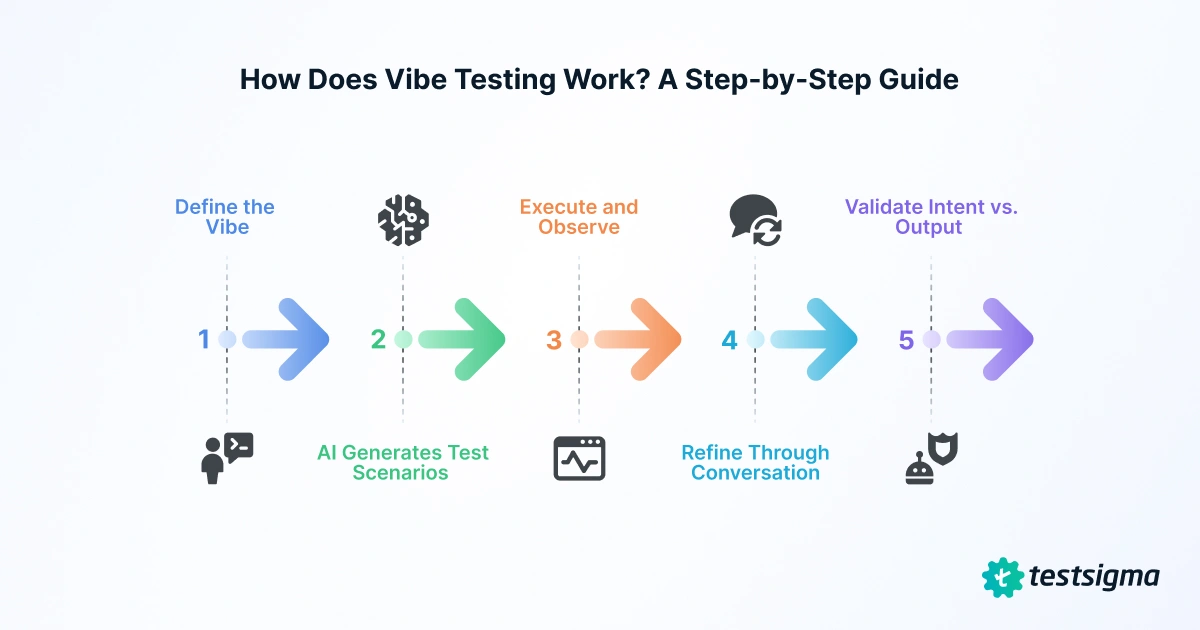
Step 1: Define the Vibe Describe what your app should do in plain English, no scripting, no code, and no framework knowledge. Focus on intent, not test steps. Example: “A user should be able to log in, reset their password, and access their dashboard without confusion or unexpected errors.”
Step 2: AI Generates Test Scenarios The AI expands your intent into full coverage: happy paths, edge cases, negative tests, and experience issues like confusing error messages or unexpected redirects, including data-driven variations and boundary conditions casual prompts typically miss.
Step 3: Execute and Observe Tests run automatically across browsers, devices, and environments. Execution is only half the story, Testsigma’s Analysis Agent identifies gaps in test coverage, surfaces patterns across results, and highlights scenarios your original prompt may have missed. You get a clearer picture of what’s actually been validated, not just a pass/fail report.
Step 4: Refine Through Conversation If something’s off, update your prompt , “focus more on mobile checkout” or “add edge cases for international addresses.” The suite updates instantly, no re-scripting.
Step 5: Validate Intent vs. Output The final human step. Confirm the app does what you meant, not just what was generated. This is where domain knowledge and business context matter most, and where Testsigma’s coverage analysis gives you the confidence to make that call, knowing the AI has already stress-tested its own coverage before it reaches you.
The human role in vibe testing: AI handles generation, execution, and pattern detection. The human provides intent, context, and final judgment on whether the experience is actually right. Vibe testing amplifies QA skills; it doesn’t replace them.
What Does Vibe Testing Look like in Practice?
Example 1: Testing a Login Flow
Traditional approach: Write 15 test cases manually, valid credentials, invalid passwords, account lockout, SQL injection, empty fields, and session expiry, each needing scripting with specific element locators.
Vibe testing approach: Prompt: “Test the login functionality. It should work for valid users, reject invalid credentials clearly, lock accounts after repeated failures, and not expose any security vulnerabilities.” From this single prompt, the AI generates 15+ test scenarios, including security edge cases the team may not have thought to specify.
Example 2: A Non-Technical Creator Testing Their Own App
A product designer builds a feedback tool using an AI app builder, with no developer involved, and traditional testing is out of reach without a QA engineer. With vibe testing, the designer prompts, “Make sure the form saves responses, sends a confirmation email, doesn’t break on long inputs, and looks right on mobile.” The AI generates and runs a complete test suite from that description. No code written, no QA specialist required.
Does Vibe Testing Cover Security and Edge Cases?
A common concern: if tests are generated from casual natural-language prompts, will they miss security vulnerabilities?
Well-designed vibe testing platforms address this through intent enrichment; the AI augments your prompt with security, edge-case, and performance scenarios based on the application type, even if you didn’t explicitly request them. For a login feature, that means automatically adding SQL injection, brute-force detection, session management, and CSRF protection tests, because these are standard concerns for any login implementation.
Vibe testing is strongest where traditional testing struggles most: functional validation, user experience, and edge-case discovery. It handles security basics well too. Where it has real limits is performance testing and complex multi-system integration testing, which still need dedicated tools and structured test engineering alongside your vibe testing workflow. It’s also worth being direct about a related failure mode: AI-generated tests can pass for the wrong reasons, overly permissive assertions or mocked dependencies that hide real bugs, which is exactly why Step 5 (human validation of intent vs. output) isn’t optional.
Who Should Use Vibe Testing?
QA engineers, product managers, UX designers, developers, and vibe coders, anyone who can describe what an app should do, with no code required. As AI puts app-building in everyone’s hands, vibe testing puts quality assurance there too.
How Does Testsigma Enable Vibe Testing?
Describing intent is only half the equation. The other half is an AI system capable of acting on it across the full testing lifecycle, not just generation. That’s what Testsigma’s seven agents do:
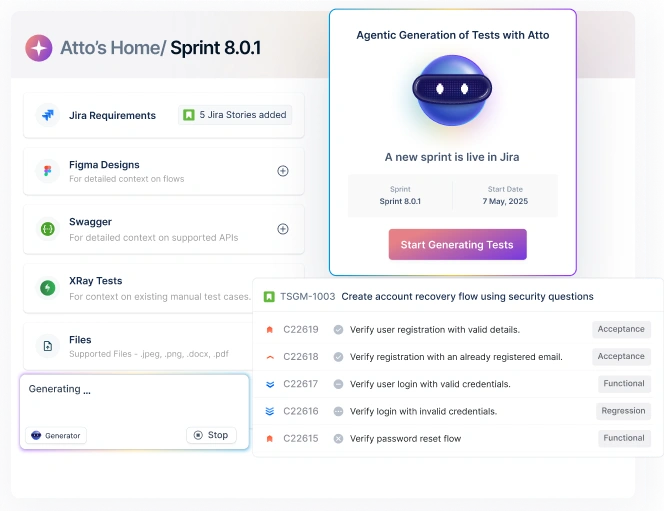
- Generator Agent turns plain English, Jira tickets, Figma files, screenshots, or video walkthroughs into complete test suites. No scripting, no element locators, no QA bottleneck.
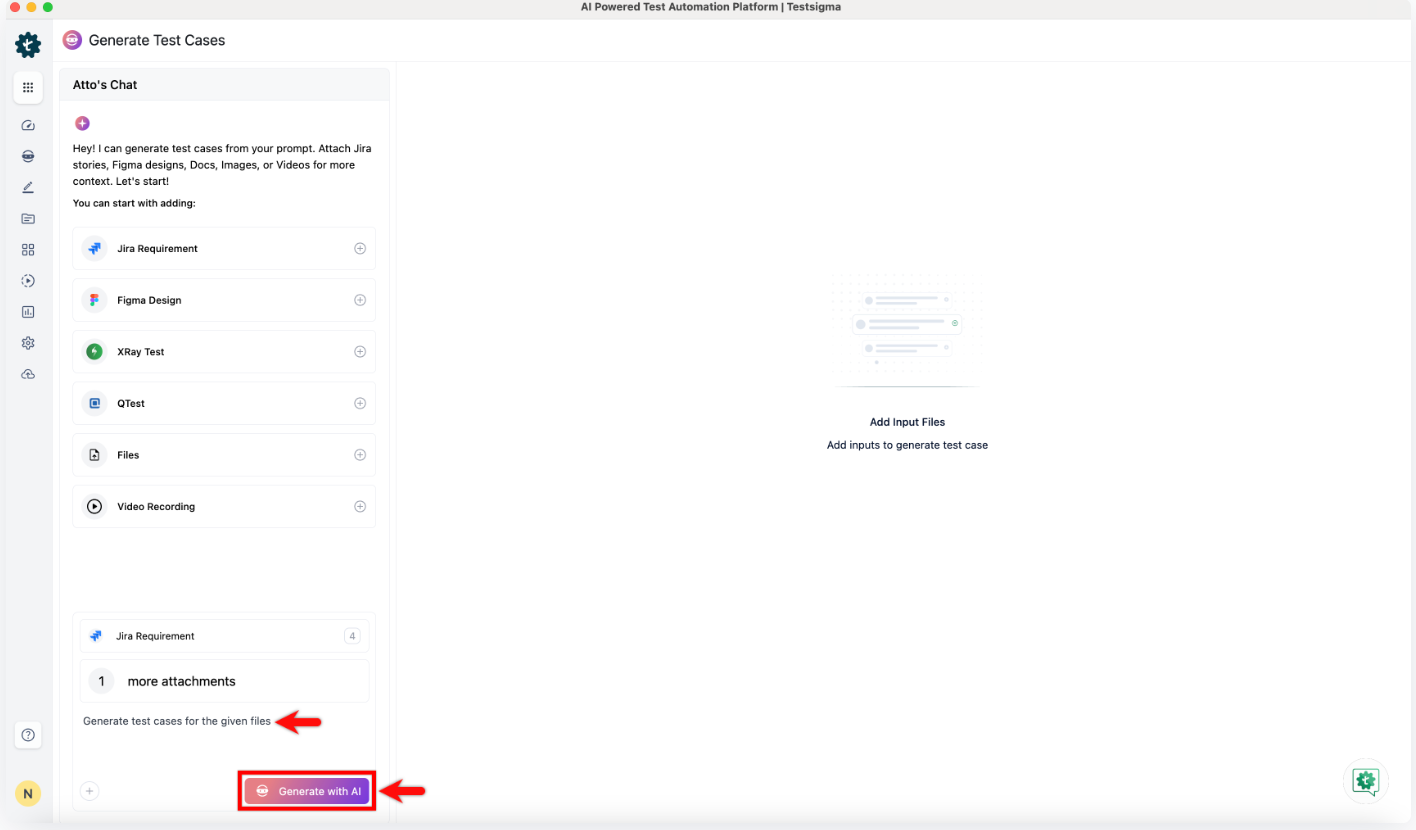
- Planner Agent maps your intent to sprint-level test coverage, identifying what needs to be tested and in what order before a single test runs.
- Execution Agent: runs tests across 3,000+ real and virtual devices instantly, without device procurement or environment configuration.
- Coverage Planner Agent: identifies gaps in your test suite and generates additional scenarios beyond your original prompt, including security edge cases and boundary conditions.
- Analysis Agent: goes beyond pass/fail reporting: surfaces patterns across results, flags coverage gaps, and tells you what’s actually been validated.
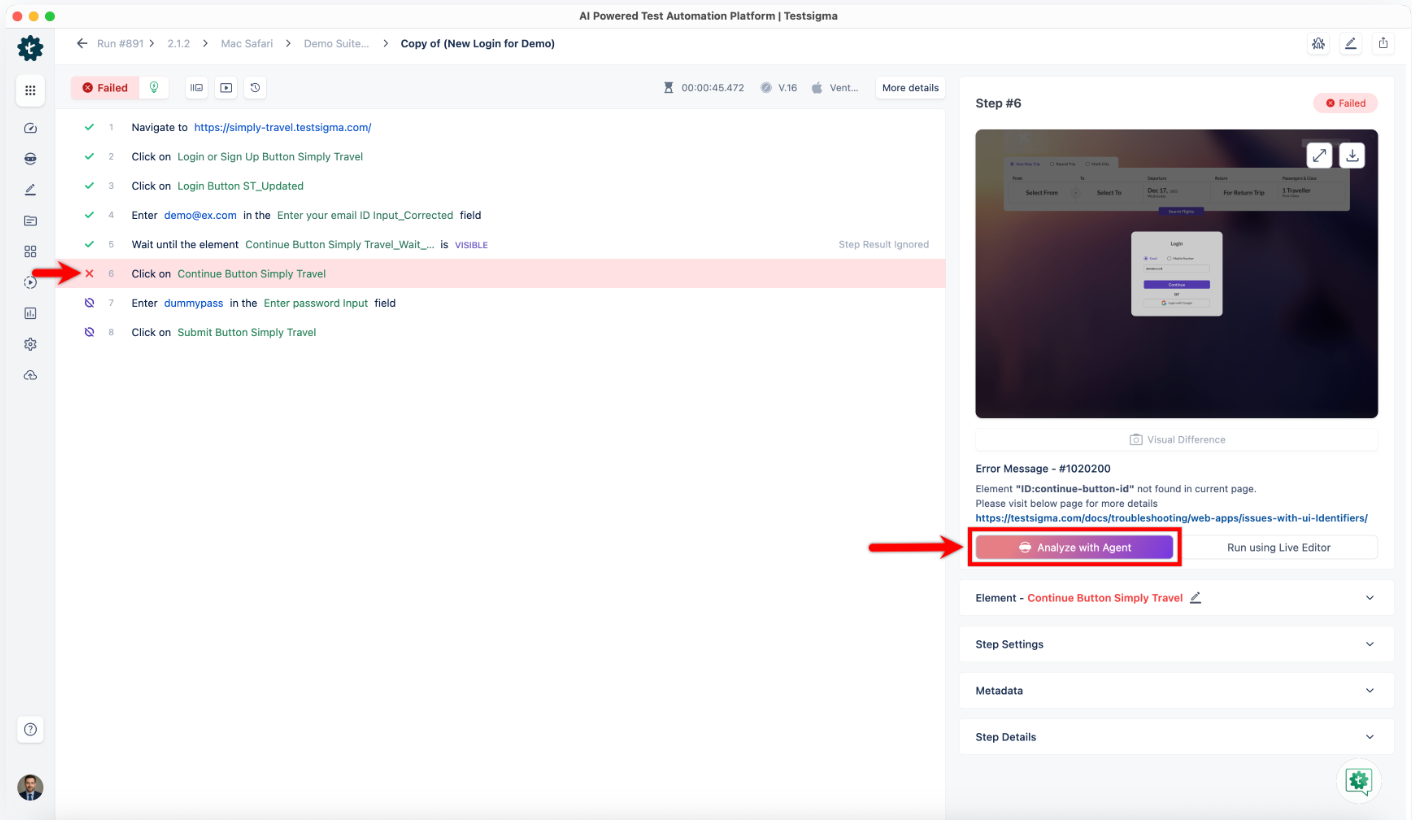
- Maintenance Agent: auto-heals broken tests when the UI changes, detecting and repairing affected steps automatically. Teams using it report a 90% reduction in maintenance overhead.
- Reporting Agent: closes the loop by filing bugs, summarizing results, and delivering the coverage picture to whoever needs it, from developer to engineering manager.
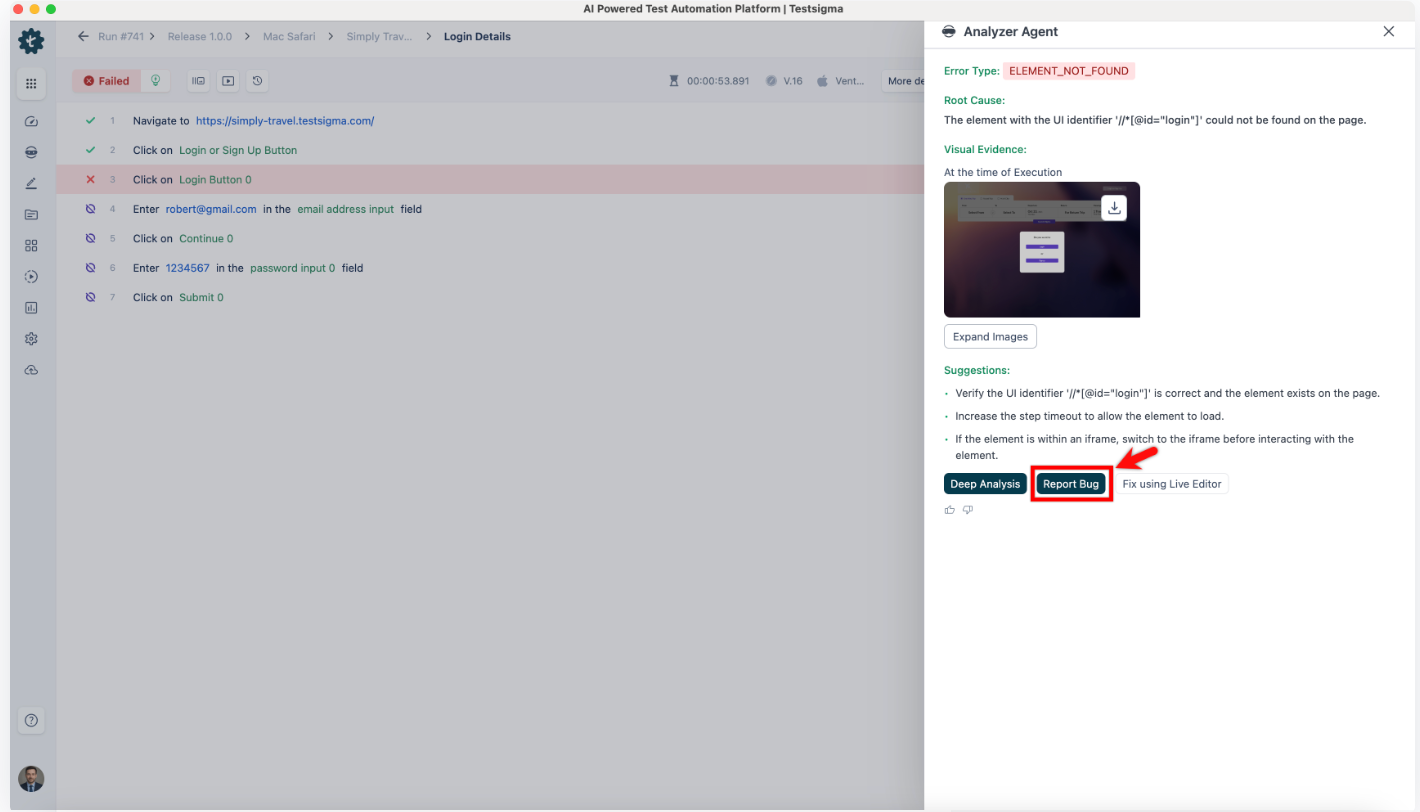
Together, these seven agents take vibe testing from a single prompt to a fully executed, self-maintaining test suite, without handing work back to an engineer at every stage. This is the same agent architecture underpinning agentic AI testing more broadly; vibe testing is that architecture applied specifically to intent-first QA for AI-generated and fast-moving apps.
None of this depends on how the app was built. Whether your team vibe-codes in Claude Code, ships from GitHub Copilot, or writes code by hand, the Coverage Planner and Analysis agents don’t care about the source, they read what changed and check it against what’s actually been tested. That’s the point of treating vibe testing as a verification step, not a coding-agent-specific feature: one confidence check that sits above whatever combination of coding agent and QA tooling (Playwright, Appium, or Testsigma itself) your team happens to use.
Conclusion: Stop Trusting the Vibes — Start Testing Them
AI tools have made building software faster than ever. What they haven’t done is make it safer to ship without validation. Vibe testing closes that gap. You bring the intent. AI brings the coverage. Human judgment decides if it’s ready. The only question is whether you find that out before your users do.
FAQs
Exploratory testing relies on a human tester’s intuition to find unexpected issues. Vibe testing uses AI to do that exploration at scale, surfacing edge cases and gaps automatically, without a human manually probing the app.
Yes. While vibe testing is especially valuable for AI-generated apps, any team wanting faster test coverage without scripting overhead can benefit, regardless of how the underlying code was written.
This is the key governance question. Best practice combines prompt engineering, human sampling of generated tests, and platforms that enrich your intent with known patterns, so the AI isn’t just generating tests; it’s generating meaningful ones.
Not if implemented well. Tests are generated and executed in minutes, and AI maintenance agents repair broken tests automatically after deployments, reducing the manual overhead that typically bottlenecks pipelines.
No. It removes the scripting bottleneck, not the judgment step. AI generates and runs the tests; a human still validates that the result matches actual intent. That’s exactly the “Validate Intent vs. Output” checkpoint above.