

AI-Powered Automated Integration Testing
Powered by agents, driven by you.
Automated integration testing that checks real handoffs across UI, APIs, and services. With Testsigma, integration test automation stays quick, scalable, and low-maintenance with AI Agents.
Automate integration testing in minutes with AI Agents.
Create integration tests 5x faster with plain English, no coding needed.
Run integration tests on 3000+ browsers and real devices on the Cloud.


Get started with Testsigma
By signing up, you agree to our Privacy Policy.
















Scale Integration Test Automation with
Agentic AI and No-Code

Define Integration Scope
Use AI Agents to surface high-risk integration points early, then convert them into an automation integration testing checklist mapped to requirements. This keeps the tests focused on real handoffs.

Create Tests Using No-Code
Build automated integration tests with the Generator Agent, NLP steps, Record, and data-driven inputs, without scripting. AI assistance helps speed up test creation while keeping integration test automation easy to update.

Validate API Contracts
Validate endpoints, payloads, data integrity, and error handling as part of automated integration testing. This strengthens test automation when backend changes roll out.

Run Tests in Parallel
Scale integration test automation with parallel execution for faster feedback across 3000+ real devices, browser, and OS combinations. Increase coverage without extending cycle time.

Reduce Test Maintenance
Keep automated integration tests stable with self-healing that adapts to UI and flow changes. Reduce rework and improve the reliability of automation integration testing across releases.
Testament of the Value We Delivered


We chose Testsigma for its ease of use and flexibility. 80% of our test coverage is automated now, improving our software quality.


Automated Test Coverage

We run 5000+ test cases overnight, wake up to the results, and fix issues swiftly. The productivity boost and resource optimization achieved with Testsigma are truly commendable.

Automated Test Coverage


Testsigma has been a game-changer for our QA process. By automating 60–70% of our regression testing, we’ve significantly improved test coverage and reduced manual effort.

Regression Suite Automated


With Testsigma, we′ve reduced our test execution time from 8 weeks to just 5 weeks per sprint.

Regression Suite Automated


Testsigma changed the game for us - strategically, emotionally, and operationally. We’re not just building test scripts anymore. We’re building credibility.

Lower QA Effort


The clean UI and intuitive workflows make automation effortless. Instead of writing test cases from scratch, I can generate accurate AI-driven cases in minutes for any type of testing.

Reduced Test Creation Time


Testsigma has been a great addition to our QA workflow. We now catch bugs faster and run full regressions with ease.

Faster regression cycles
We run 5000+ test cases overnight, wake up to the results, and fix issues swiftly. The productivity boost and resource optimization achieved with Testsigma are truly commendable.
Automated Test Coverage
Testsigma has been a game-changer for our QA process. By automating 60–70% of our regression testing, we’ve significantly improved test coverage and reduced manual effort.
Regression Suite Automated
With Testsigma, we′ve reduced our test execution time from 8 weeks to just 5 weeks per sprint.
Regression Suite Automated
Testsigma changed the game for us - strategically, emotionally, and operationally. We’re not just building test scripts anymore. We’re building credibility.
Lower QA Effort
The clean UI and intuitive workflows make automation effortless. Instead of writing test cases from scratch, I can generate accurate AI-driven cases in minutes for any type of testing.
Reduced Test Creation Time
Testsigma has been a great addition to our QA workflow. We now catch bugs faster and run full regressions with ease.
Faster regression cycles
Testsigma vs Top Players
Automated Integration Testing
Best fit
Test creation
Execution for integration testing at scale
AI capabilities
Unique capability

End-to-end automated integration testing across web, mobile, desktop, and APIs in one platform.
Agent-assisted generation for faster setup, plain-English NLPs, and reusable components.
Cloud execution with parallel runs across a built-in device and browser cloud (3,000+ environments).
AI agents plus self-healing to keep automated integration tests stable as UIs and flows change+ Atto, an AI coworker, to provide assistance.
A single place to create, run, and maintain test automation integration across UI + API with plain-English authoring and agent support.

Teams that want an IDE-style platform for web, mobile, API, and desktop automation.
Record and playback plus keyword-driven “Manual view”, with API test objects for REST and SOAP.
Cloud execution with parallel runs across a built-in device and browser cloud (3,000+ environments).
Built-in AI assistant (StudioAssist) and self-healing mechanisms for broken object locators.
Strong IDE experience with keyword-driven testing, API objects, and self-healing for locator drift.

API-first teams doing automated integration tests at the contract and workflow layer using collections.
Write assertions and checks in JavaScript using Postman’s scripting, with AI help to draft test scripts when needed.
Run collections in CI using Newman, plus scheduled collection runs for ongoing checks.
Postbot helps troubleshoot requests and draft scripts, but test resilience is still largely scripting and design-driven.
Fast API workflow testing with collections, scripting, Newman CI runs, and scheduling.

API QA teams focused on SOAP and REST testing with strong functional, load, security, and mocking support.
GUI-driven API test suites with optional Groovy scripting for custom logic.
Run functional tests from the command line using SoapUI’s testrunner for CI and build workflows.
No AI layer by default, resilience comes from assertions, mocks, and disciplined test design.
Deep API testing breadth (functional, load, security, mocking) with CLI automation support.

and Earning Industry Recognition



Users love us



Enterprise-grade security


Seamless Integrations for Your AI-Powered Test Automation
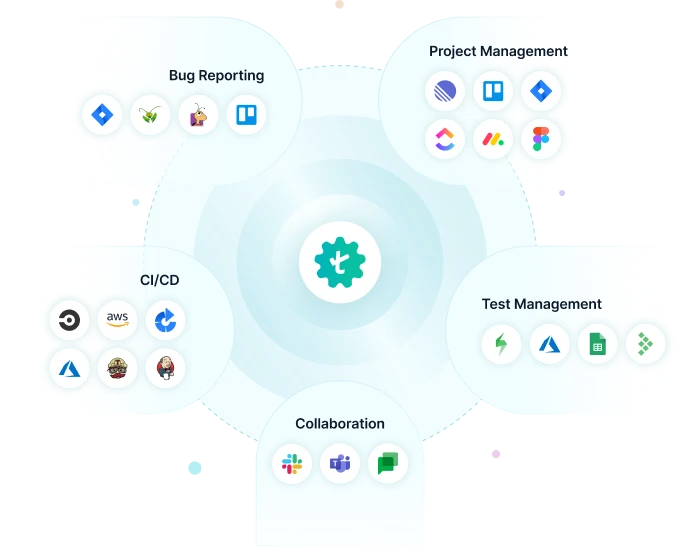
Testsigma integrates with all your favourite tools, including JIRA, Jenkins, Azure DevOps, GitHub, and Bamboo to achieve continuous testing and feedback at DevOps speed. Ultimately, accelerate your release cycles and reduce time-to-market.
What is Automated Integration Testing?
Types of Automated Integration Testing
Validates how internal modules interact, like cart + inventory + payment, beyond unit-level checks.
- Catches broken handoffs between modules early
- Confirms shared data behavior across components
- Verifies workflows across multiple code owners
Automated Integration Testing Benefits

Faster Defect Detection
Automated integration testing catches broken connections early, before issues spread across teams and environments.

Higher Confidence Across Workflows
Automated integration tests validate complete handoffs, so releases feel safer than isolated unit checks.

Better CI/CD Fit
Integration test automation can run on every commit, making failures visible when they are easiest to fix.

Wider Coverage with Less Effort
Automation integration testing scales across more datasets, flows, and environments without adding manual cycles.

Reduced Maintenance Over Time
With reusable steps and stable test design, test automation integration stays manageable even as systems evolve.

Lower Cost of Regressions
Catching integration failures early reduces debugging time, rollbacks, and production incidents.
Manual vs Automated Acceptance Testing
| Manual Acceptance Testing | Automated Integration Testing | |
|---|---|---|
| Speed | Slower because teams must repeat the same scenarios across services and environments | Faster because automated integration tests run on demand and in CI/CD |
| Consistency | Results vary based on tester setup, timing, and interpretation | Results are repeatable since integration test automation follows the same steps every run |
| Coverage | Limited by time, test data setup, and team capacity | Broader coverage with automation integration testing across more flows, datasets, and integrations |
| Maintenance | Easy to tweak steps, but reruns are costly and repetitive | Tests require updates as integrations change, but automated integration testing reduces repeated effort |
| Collaboration | Findings often live in tickets and docs with limited traceability | Test automation integration keeps tests, runs, and failures connected for quicker triage |
| Scalability | Hard to scale without adding more testers and environments | Scales with parallel runs, reusable assets, and repeatable pipelines |
| Release Confidence | Higher risk of missed integration regressions under time pressure | Higher confidence because automated integration tests can run frequently and predictably |
How to Automate Integration Testing

Identify Integration Points
List the critical handoffs between modules, APIs, databases, and third-party services that must work together.
Define Test Scenarios and Data
Write scenarios that mirror real workflows and prepare stable, reusable test data for each integration path.

Build Automated Integration Tests
Create integration test automation that validates requests, responses, and business outcomes across connected systems.

Run in CI/CD
Trigger automated integration testing on every commit or deployment so failures surface immediately.

Add Assertions and Failure Handling
Validate not just success paths but also retries, timeouts, errors, and data consistency across services.
Monitor, Maintain, and Expand Coverage
Review failures, update tests when interfaces change, and steadily grow automation integration testing coverage sprint over sprint.
Frequently Asked Questions

Ship Confidently With Agentic AI Automated
Integration Testing