




Prompt Templates for Pro-level test cases
Get prompt-engineered templates that turn requirements into structured test cases, edge cases, and negatives fast every time.

Table Of Contents
Table Of Contents
- 1 Overview
- 2 What are Test steps :
- 3 Why Create Test Steps?
- 4 Who creates test steps?
- 5 How to Create Test Steps:
- 6 Test Steps for Manual Testing:
- 7 How Test Management by Testsigma Structures and Manages Test Steps
- 8 Conclusion :
- 9 Overview
- 10 What are Test steps :
- 11 Why Create Test Steps?
- 12 Who creates test steps?
- 13 How to Create Test Steps:
- 14 Test Steps for Manual Testing:
- 15 How Test Management by Testsigma Structures and Manages Test Steps
- 16 Conclusion :
Overview
What are test steps? Test steps are the building blocks of tests that are designed to simplify the test process and facilitate the seamless execution of scenarios over an extended period of time.
What is the importance of having test steps? Creating test steps is a crucial aspect of the testing process, as it enhances the effectiveness and efficiency of the testing effort. Here are a few key reasons for the same:
- Enhanced clarity and organisation
- Ease of execution
- Reusability
- Collaboration and documentation
- Traceability
- Automation readiness
- Error isolation
What Are Test Steps:
we often hear and talk about the term “test steps,” a key term for testers. Put simply, test steps are like the building blocks of tests. They are designed to simplify the testing process and facilitate the seamless execution of scenarios over an extended period. Each step corresponds to an action taken to comprehensively cover a scenario in a systematic manner.
Why Create Test Steps?
Creating test steps is a crucial aspect of the testing process, serving several purposes to enhance the effectiveness and efficiency of the overall testing effort. Let’s understand the reasons behind the creation of test steps, exploring key pointers for their significance.
Enhanced Clarity and Organization:
- Test steps introduce a structured and organized method to the testing process.
- They simplify complex test steps by breaking them down into manageable components, improving overall clarity.
- The step-by-step format guarantees that each action is precisely defined, eliminating any potential for ambiguity.
Ease of Execution:
- Well-defined test steps facilitate easy execution of test cases.
- Testers can follow a systematic sequence, reducing the likelihood of errors during testing.
- It streamlines the testing process, making it more straightforward and manageable.
Reusability:
- Test steps contribute to reusability by breaking down scenarios into reusable components.
- Common actions or validations can be replicated across multiple test cases, saving time and effort.
Collaboration and Documentation:
- Test steps serve as a communication tool among team members.
- They enable clear documentation of the testing process, making it accessible to the entire team.
- Team collaboration is enhanced as testers can easily understand, share, and contribute to test cases.
Traceability:
- Each test step establishes a traceable link between the requirements and the testing process.
- It becomes easier to track which steps correspond to specific functionalities or user scenarios. This traceability aids in comprehensive test coverage.
Automation readiness:
- Test steps lay the groundwork for test automation.
- Clearly defined manual test steps can be translated into automated scripts, facilitating a seamless transition to automated testing.
- Automation frameworks often leverage well-structured test steps for efficient script creation.
Error Isolation:
- In the event of a test failure, well-defined test steps assist in isolating the source of the error.
- Testers can pinpoint the specific step that failed, expediting the debugging process. It contributes to faster issue resolution and a more agile testing cycle.
Who Creates Test Steps?
Test steps are mainly made by the testing team, which includes both manual and automated testers. These testers understand the software well. In manual testing, individual testers are important for creating detailed test steps. They use their knowledge to turn big test cases into clear and organized steps. Automated testers, especially those using tools like Testsigma, also help make automated test steps. They use their programming skills and knowledge to change manual steps into automated scripts. Working closely with other team members like developers and product managers ensures that the steps match what the software should do. The team keeps learning and improving the steps based on project changes, creating a cycle of feedback for better testing.
How to Create Test Steps:
Creating effective test steps is a crucial aspect of the testing process, requiring careful planning and precision. Here are some pointers to keep in mind before start writing the test steps :
- Begin with a comprehensive understanding of software requirements and the specific functionality to be tested.
- Break down the overall testing scope into specific test scenarios, focusing on critical paths and user interactions.
- Create granular, detailed actions for each test scenario, ensuring clarity and precision.
- Clearly define inputs and articulate expected outputs for each test step.
- Consider and document any preconditions required for valid test execution.
- Organize the test steps in a logical and sequential order, following the natural flow of user interactions.
- Review and refine test steps for alignment with testing objectives, removing ambiguity or redundancy.
- Find a balance between providing sufficient detail and keeping steps simple and easy to follow.
- Anticipate and include steps to cover edge cases or scenarios under unique conditions.
- Thoroughly document test steps, including expected outcomes, data inputs, and specific execution conditions.
- Collaborate with team members for validation, incorporating feedback to enhance step quality.
- Structure test steps for adaptability to automation, facilitating seamless translation into automated scripts.
- Treat the creation of test steps as an iterative process, continuously learning and adapting based on feedback and evolving project requirements.
Test Steps for Manual Testing:
In manual testing, human involvement is crucial for assessing software functionality. Manual test steps consist of a set of carefully designed actions and guidelines, aiming to comprehensively evaluate specific aspects of the software. Let’s simplify the concept of test steps in manual testing:
- Understand the specific scenario or functionality in the test case.
- Break down the overall test case into step-by-step actions for a systematic approach.
- Define inputs and articulate expected outputs for each test step.
- Document any preconditions required for valid test execution.
- Organize test steps in a logical sequence for comprehensive coverage.
- Verify actual outcomes align with expected results during execution.
- Thoroughly document each step, recording any encountered issues.
- Generate a comprehensive report detailing execution, outcomes, and issues.
- Craft test steps for reusability and adaptability across different cases.
- Update specific test steps as needed for easy maintenance.
How Test Management by Testsigma Structures and Manages Test Steps
Test Management by Testsigma structures and manages test steps in an organized manner:
- Steps live inside Test Cases
Every test case in Test Management has its own ordered list of steps along with preconditions and expected results.
- Two templates control how steps are structured
- Documentation Template: Test steps are written as a simple sequential list (good for high-level/manual flows).
- Steps Template: Each step is broken down more granularly as
- Step Description
- Expected result per step
- Optional preconditions + attachments
- Per-step clarity, not just overall expected result
In the Steps template, every individual action has its own expected result, so you know precisely what to verify at each point in the flow.
- Auto-saved, in-place editing
Steps are added and edited directly on the Test Case details page; changes are automatically saved and can be updated at any time, along with case properties such as priority, owner, status, etc.
- Reusable Step Groups
Common flows (login, checkout, onboarding, etc.) can be extracted into step groups and reused across multiple cases, improving maintainability and consistency. Step groups can also be imported/exported at the project level.
- AI-generated Detailed Steps
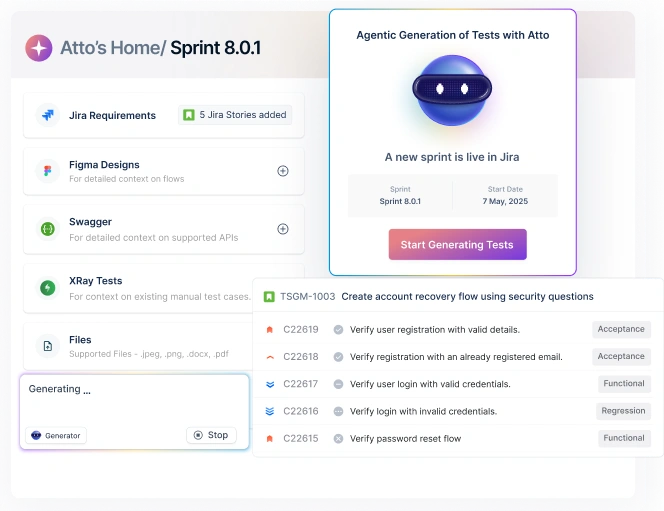
Atto’s Generator agent can create test cases with detailed steps from prompts, Jira stories, Figma flows, videos, and more, so a lot of the step authoring is automated instead of handwritten.
- Step-level Execution & Reporting
When test cases are added to test runs, you can execute them with step-level results, attach evidence, and roll those up into run-level reports. This enables you to analyse each step if needed.
In this way, Test Management by Testsigma treats test steps as structured, reusable, and AI-assistable building blocks inside each test case, with precise expected results and step-level tracking during execution.
Conclusion:
In summary, test steps are like building blocks in software testing, making things clear and easy. They help us work together and make testing efficient. For manual testing, we follow a step-by-step approach, and for automated testing using Testsigma, it’s even simpler with a tool that doesn’t need scripts. Everyone in the testing team, whether doing manual or automated testing, helps create these steps, promoting teamwork and learning. Understanding what’s needed and keeping things simple is crucial.
Frequently Asked Questions
In software testing, testing steps refer to the individual, ordered actions performed to verify that a specific behavior or feature works as expected. They usually sit inside a test case and act as a guide to help you execute a test case from start to finish.
Test steps are documented inside a test case as a numbered sequence of clear actions and expected results. Each step states what to do, where to do it, and what should happen, often including data, preconditions, and references so testers can execute consistently and reproduce outcomes across teams and time.
Overview
What are test steps? Test steps are the building blocks of tests that are designed to simplify the test process and facilitate the seamless execution of scenarios over an extended period of time.
What is the importance of having test steps? Creating test steps is a crucial aspect of the testing process, as it enhances the effectiveness and efficiency of the testing effort. Here are a few key reasons for the same:
- Enhanced clarity and organisation
- Ease of execution
- Reusability
- Collaboration and documentation
- Traceability
- Automation readiness
- Error isolation
What Are Test Steps:
we often hear and talk about the term “test steps,” a key term for testers. Put simply, test steps are like the building blocks of tests. They are designed to simplify the testing process and facilitate the seamless execution of scenarios over an extended period. Each step corresponds to an action taken to comprehensively cover a scenario in a systematic manner.
Why Create Test Steps?
Creating test steps is a crucial aspect of the testing process, serving several purposes to enhance the effectiveness and efficiency of the overall testing effort. Let’s understand the reasons behind the creation of test steps, exploring key pointers for their significance.
Enhanced Clarity and Organization:
- Test steps introduce a structured and organized method to the testing process.
- They simplify complex test steps by breaking them down into manageable components, improving overall clarity.
- The step-by-step format guarantees that each action is precisely defined, eliminating any potential for ambiguity.
Ease of Execution:
- Well-defined test steps facilitate easy execution of test cases.
- Testers can follow a systematic sequence, reducing the likelihood of errors during testing.
- It streamlines the testing process, making it more straightforward and manageable.
Reusability:
- Test steps contribute to reusability by breaking down scenarios into reusable components.
- Common actions or validations can be replicated across multiple test cases, saving time and effort.
Collaboration and Documentation:
- Test steps serve as a communication tool among team members.
- They enable clear documentation of the testing process, making it accessible to the entire team.
- Team collaboration is enhanced as testers can easily understand, share, and contribute to test cases.
Traceability:
- Each test step establishes a traceable link between the requirements and the testing process.
- It becomes easier to track which steps correspond to specific functionalities or user scenarios. This traceability aids in comprehensive test coverage.
Automation readiness:
- Test steps lay the groundwork for test automation.
- Clearly defined manual test steps can be translated into automated scripts, facilitating a seamless transition to automated testing.
- Automation frameworks often leverage well-structured test steps for efficient script creation.
Error Isolation:
- In the event of a test failure, well-defined test steps assist in isolating the source of the error.
- Testers can pinpoint the specific step that failed, expediting the debugging process. It contributes to faster issue resolution and a more agile testing cycle.
Who Creates Test Steps?
Test steps are mainly made by the testing team, which includes both manual and automated testers. These testers understand the software well. In manual testing, individual testers are important for creating detailed test steps. They use their knowledge to turn big test cases into clear and organized steps. Automated testers, especially those using tools like Testsigma, also help make automated test steps. They use their programming skills and knowledge to change manual steps into automated scripts. Working closely with other team members like developers and product managers ensures that the steps match what the software should do. The team keeps learning and improving the steps based on project changes, creating a cycle of feedback for better testing.
How to Create Test Steps:
Creating effective test steps is a crucial aspect of the testing process, requiring careful planning and precision. Here are some pointers to keep in mind before start writing the test steps :
- Begin with a comprehensive understanding of software requirements and the specific functionality to be tested.
- Break down the overall testing scope into specific test scenarios, focusing on critical paths and user interactions.
- Create granular, detailed actions for each test scenario, ensuring clarity and precision.
- Clearly define inputs and articulate expected outputs for each test step.
- Consider and document any preconditions required for valid test execution.
- Organize the test steps in a logical and sequential order, following the natural flow of user interactions.
- Review and refine test steps for alignment with testing objectives, removing ambiguity or redundancy.
- Find a balance between providing sufficient detail and keeping steps simple and easy to follow.
- Anticipate and include steps to cover edge cases or scenarios under unique conditions.
- Thoroughly document test steps, including expected outcomes, data inputs, and specific execution conditions.
- Collaborate with team members for validation, incorporating feedback to enhance step quality.
- Structure test steps for adaptability to automation, facilitating seamless translation into automated scripts.
- Treat the creation of test steps as an iterative process, continuously learning and adapting based on feedback and evolving project requirements.
Test Steps for Manual Testing:
In manual testing, human involvement is crucial for assessing software functionality. Manual test steps consist of a set of carefully designed actions and guidelines, aiming to comprehensively evaluate specific aspects of the software. Let’s simplify the concept of test steps in manual testing:
- Understand the specific scenario or functionality in the test case.
- Break down the overall test case into step-by-step actions for a systematic approach.
- Define inputs and articulate expected outputs for each test step.
- Document any preconditions required for valid test execution.
- Organize test steps in a logical sequence for comprehensive coverage.
- Verify actual outcomes align with expected results during execution.
- Thoroughly document each step, recording any encountered issues.
- Generate a comprehensive report detailing execution, outcomes, and issues.
- Craft test steps for reusability and adaptability across different cases.
- Update specific test steps as needed for easy maintenance.
How Test Management by Testsigma Structures and Manages Test Steps
Test Management by Testsigma structures and manages test steps in an organized manner:
- Steps live inside Test Cases
Every test case in Test Management has its own ordered list of steps along with preconditions and expected results.
- Two templates control how steps are structured
- Documentation Template: Test steps are written as a simple sequential list (good for high-level/manual flows).
- Steps Template: Each step is broken down more granularly as
- Step Description
- Expected result per step
- Optional preconditions + attachments
- Per-step clarity, not just overall expected result
In the Steps template, every individual action has its own expected result, so you know precisely what to verify at each point in the flow.
- Auto-saved, in-place editing
Steps are added and edited directly on the Test Case details page; changes are automatically saved and can be updated at any time, along with case properties such as priority, owner, status, etc.
- Reusable Step Groups
Common flows (login, checkout, onboarding, etc.) can be extracted into step groups and reused across multiple cases, improving maintainability and consistency. Step groups can also be imported/exported at the project level.
- AI-generated Detailed Steps
Atto’s Generator agent can create test cases with detailed steps from prompts, Jira stories, Figma flows, videos, and more, so a lot of the step authoring is automated instead of handwritten.
- Step-level Execution & Reporting
When test cases are added to test runs, you can execute them with step-level results, attach evidence, and roll those up into run-level reports. This enables you to analyse each step if needed.
In this way, Test Management by Testsigma treats test steps as structured, reusable, and AI-assistable building blocks inside each test case, with precise expected results and step-level tracking during execution.
Conclusion:
In summary, test steps are like building blocks in software testing, making things clear and easy. They help us work together and make testing efficient. For manual testing, we follow a step-by-step approach, and for automated testing using Testsigma, it’s even simpler with a tool that doesn’t need scripts. Everyone in the testing team, whether doing manual or automated testing, helps create these steps, promoting teamwork and learning. Understanding what’s needed and keeping things simple is crucial.
Frequently Asked Questions
In software testing, testing steps refer to the individual, ordered actions performed to verify that a specific behavior or feature works as expected. They usually sit inside a test case and act as a guide to help you execute a test case from start to finish.
Test steps are documented inside a test case as a numbered sequence of clear actions and expected results. Each step states what to do, where to do it, and what should happen, often including data, preconditions, and references so testers can execute consistently and reproduce outcomes across teams and time.