





Table Of Contents
- 1 Overview
- 2 Why Telecom QA Matters?
- 3 What Telecom QA Covers?
- 4 Building a Robust Telecom QA Strategy
- 4.1 1. Define Business And QA Objectives
- 4.2 2. Map The Telecom Architecture and Test Scope
- 4.3 3. Design Test Environments and Data
- 4.4 4. Prioritise Test Cases & Types
- 4.5 5. Choose the Right Tools & Automation Framework
- 4.6 6. Execute, Monitor and Report
- 4.7 7. Adopt Continuous Testing & Feedback Loops
- 5 Popular Tools & Frameworks for Telecom QA: A Quick Comparison
- 6 Common Challenges and How to Overcome Them
- 6.1 Challenge 1: Testing Across Diverse Device and Network Combinations
- 6.2 Challenge 2: Simulating Real-World Network Conditions
- 6.3 Challenge 3: Managing Test Data at Scale
- 6.4 Challenge 4: Keeping Up with Rapid Technology Changes
- 6.5 Challenge 5: Integrating QA into Fast-Paced DevOps Cycles
- 6.6 Challenge 6: Ensuring Security and Compliance
- 7 Final Thoughts: Simplify Your Telecom QA with Testsigma
- 8 FAQs
Overview
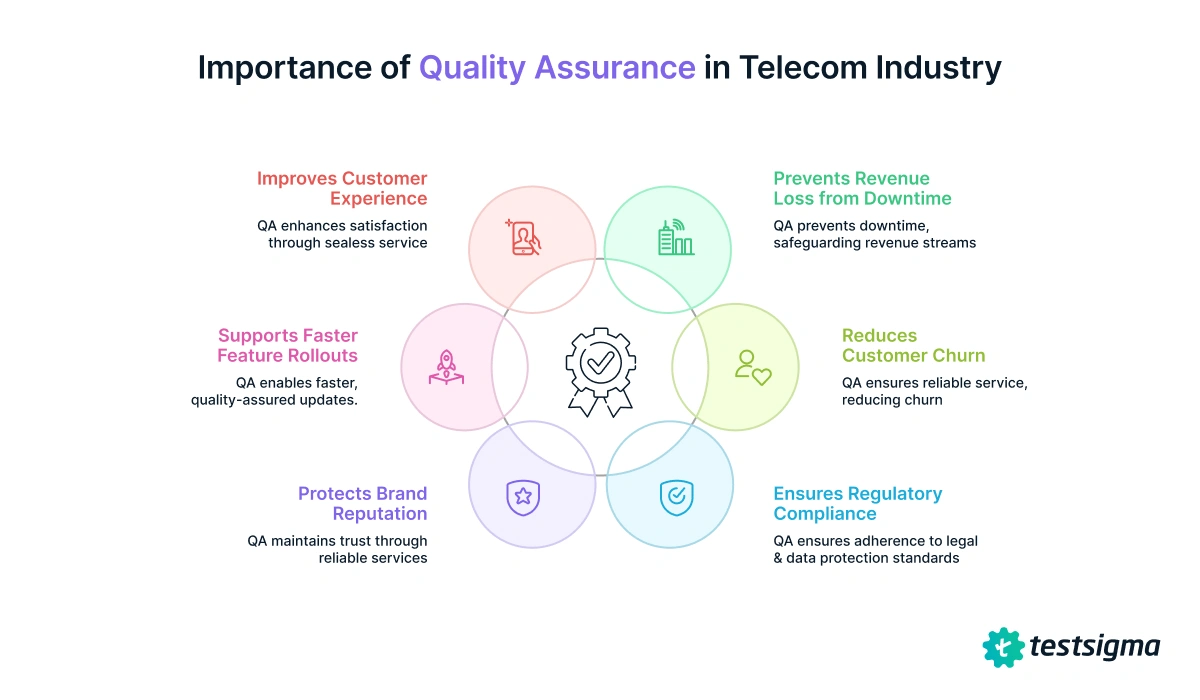
Telecom QA prevents costly downtime, reduces customer churn, ensures compliance, protects the brand reputation, and enables faster feature rollouts.
Why Telecom QA Matters?
Telecom services power voice calls, messaging, IoT devices, and business systems, so even a small failure creates widespread disruption. A brief outage can block calls, break app sessions, and cut off business connectivity within minutes. Telecom QA helps teams catch these problems early, validate performance under real demand, and protect service quality at scale.
What Telecom QA Covers?
- Network testing
- Service testing
- Application testing
- Performance testing
- Security testing
- Interoperability testing
- Usability testing
Building a Robust Telecom QA Strategy
- Define business and QA objectives
- Map telecom architecture and test scope
- Design test environments and data
- Prioritize test cases and types
- Choose the right tools and automation framework
- Execute, monitor, and report
- Adopt continuous testing and feedback loops
Did you know downtime costs IT and telecom an average of $12.71 million per year? And that covers only direct revenue loss, not the wider damage that follows.
Telecom services power voice calls, messaging, IoT devices, and business systems, so even a small failure creates widespread disruption. A brief outage can block calls, break app sessions, and cut off business connectivity within minutes.
Telecom QA helps teams catch these problems early, validate performance under real demand, and protect service quality at scale.
In this guide, we will discuss how to build a strong Telecom QA team, the tools and frameworks available to support it, and common challenges and their solutions.
Why Telecom QA Matters?
Telecom services touch millions of users every day, and even small failures create massive ripple effects across customers, revenue, and brand reputation. That’s why investing in strong quality assurance isn’t optional; it’s essential for staying competitive and protecting what matters most.
1. Prevents Revenue Loss From Downtime
Network disruptions directly impact revenue streams across voice, data, and value-added services. For large telecom operators, the financial damage is even higher during peak periods when millions of subscribers need service simultaneously.
Every minute of downtime means lost call revenue, failed transactions, and missed business opportunities that add up fast.
2. Reduces Customer Churn
About 45% of smartphone users churn results from poor network quality, making it one of the top reasons people switch providers.
With thorough QA, teams can test network performance under different conditions and catch quality issues before they reach users. This proactive approach catches quality issues before they reach users, protecting your subscriber base.
3. Ensures Regulatory Compliance
For 23% of enterprises, downtime costs exceed $5 million per hour. On top of that, regulatory penalties add to the burden when data protection or service standards slip.
QA testing catches compliance issues before regulators step in, preventing fines and ensuring systems consistently meet legal requirements.
4. Protects Brand Reputation
One major outage or security breach can undo years of brand work. When a customer has a negative experience, they are highly likely to share it with their friends and family. You do not just lose users; you gain a reputation that makes acquiring new ones harder.
Testing prevents this damage by catching critical failures early, validating security measures, and ensuring backup systems activate when needed.
5. Supports Faster Feature Rollouts
Solid QA processes let teams release new services and updates confidently. When testing catches issues early, development cycles shorten and time-to-market improves without sacrificing quality.
Teams can innovate knowing their releases won’t break existing services. This speed matters in competitive markets where delays cost you some good opportunities.
6. Improves Customer Experience
QA testing ensures services work across different devices, networks, and usage patterns. This means validating compatibility with various phone models, checking performance on 4G and 5G networks, and testing how apps behave under poor connectivity.
When everything runs smoothly, customers experience fewer disruptions. They’re more likely to recommend the service to friends and family, which brings in new subscribers without heavy marketing spend.
What Telecom QA Covers?
The telecom QA process isn’t just about finding bugs in apps or websites. It spans the entire telecom ecosystem, from network infrastructure to customer-facing services.
The goal is to ensure everything works reliably in real-world conditions, whether it’s a voice call, data transfer, or billing transaction.
Here’s what telecom QA typically covers:
- Network testing: This includes voice calls, data transmission, and signaling. QA teams verify that calls connect without dropping, data flows smoothly, and network protocols behave as expected under different conditions.
- Service testing: Telecom providers offer OTT platforms, value-added services, roaming, and billing systems. Testing ensures these services work correctly across user scenarios, devices, and geographies without errors.
- Application testing: Mobile apps, customer portals, and backend systems like OSS and BSS need validation. These are how customers access services, so they must load fast, function reliably, and provide smooth experiences.
- Performance testing: Networks must handle thousands of simultaneous users without slowing down or crashing. Load testing, stress testing, and capacity planning help identify bottlenecks before they affect real users.
- Security testing: This protects networks and customer data from breaches, unauthorized access, and cyber threats. Security gaps can lead to data leaks, regulatory fines, and loss of customer trust.
- Interoperability testing: Devices from different manufacturers must work across various operating systems, networks, and carriers. Testing catches compatibility issues that could block service for certain user groups.
- Usability testing: Customer experience matters. Usability testing ensures apps and portals are intuitive, accessible, and easy to navigate, reducing frustration and support calls.
Building a Robust Telecom QA Strategy
Telecom systems involve many moving parts, from network infrastructure to customer apps. Without a clear plan, testing becomes chaotic and teams miss critical issues.
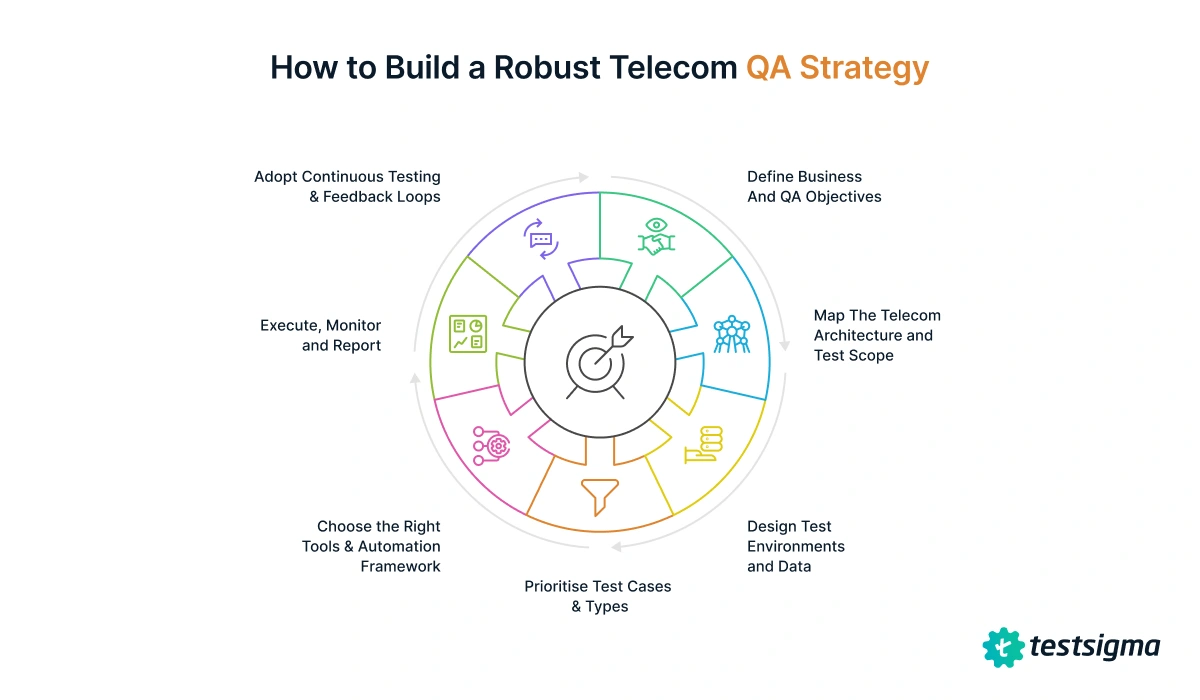
A structured QA strategy helps you test faster, measure results, and maintain reliability across different services and environments.
Here’s how to build one:
1. Define Business and QA Objectives
Start by defining clear QA objectives to give your testing efforts direction and purpose. Make sure to tie these objectives directly to your business goals.
When QA aligns with what leadership cares about, it becomes easier to secure resources, prove value, and prioritize the right work.
Some common QA goals include:
- Reduce network downtime to meet SLA commitments
- Lower call drop rates across all coverage areas
- Maintain security standards and pass compliance audits
- Deliver consistent performance across different devices and networks
Once these objectives are clear, define key performance indicators to measure performance against them. KPIs help you track progress and determine whether your strategy needs adjustment. Some examples of KPIs to track are:
- Mean time to repair (MTTR) for network failures
- Call drop rate percentage by region
- Average latency during peak hours
- Billing accuracy rate
- Number of production defects escaped per release
2. Map the Telecom Architecture and Test Scope
You can’t test what you don’t understand. So, map your entire telecom architecture, from network infrastructure to customer-facing applications. This includes OSS and BSS systems, billing platforms, device ecosystems, and third-party integrations.
In addition, identify every integration point where systems connect. These interfaces are where failures often happen, especially when vendors use different protocols or data formats.
Remember also to document both internal and external interfaces. Internal ones connect your own systems while external ones link to roaming partners, payment gateways, or third-party services. Each connection point must be validated to ensure smooth data flow.
3. Design Test Environments and DATA
Telecom services behave differently across networks, devices, and regions. A realistic test environment and data is essential for accurate results.
Your test environment should include:
- Network configurations that match production settings
- Vendor equipment from multiple manufacturers
- Device mix covering different models and OS versions
- Emulators and simulators for initial validation
- Real devices for final compatibility testing
- Network condition simulators (low bandwidth, high latency, packet loss)
- Load generators to test concurrent user scenarios
Your test data should cover:
- Realistic user profiles across subscription tiers
- Different device types and operating systems
- Geographic variations in network quality
- Edge cases like roaming, handoffs, and service switches
- Peak and off-peak usage patterns
4. Prioritise Test Cases & Types
Not everything deserves equal attention. Focus first on high-risk areas like new service launches, vendor integrations, and major platform updates. These changes carry the most potential for error and need thorough validation.
Moreover, automate stable, repeatable test paths that run frequently, like regression suites, API validations, and smoke tests.
Reserve manual testing for novel features, edge cases, and scenarios that require intuition. Automation handles predictable paths, while your team can catch unexpected behaviors and usability issues.
5. Choose the Right Tools & Automation Framework
Pick QA testing solutions designed for telecom-specific needs. The right tools understand network protocols, support device farms, and handle the unique complexity of testing voice, data, and messaging services at scale.
Here are some additional factors to consider when selecting tools:
- Performance and load testing features
- Integration with CI/CD pipelines
- Maintainability and script reusability
- Plain-English test authoring for non-technical stakeholders
- Vendor support and community resources
- Scalability to handle growing test suites
6. Execute, Monitor and Report
Once your strategy is in place, execute tests across functional, performance, security, and regression scenarios. Run tests in parallel where possible to get faster feedback without losing coverage.
During execution, monitor your tests in real-time to spot failures immediately and handle issues before they spread.
Build dashboards that show trends over time and highlight critical failures tied to business goals. Clear reporting helps stakeholders understand quality status without going through technical details.
7. Adopt Continuous Testing & Feedback Loops
Testing shouldn’t stop after deployment. Set up continuous monitoring to track how services perform in production. When issues surface, use that information to update your test cases and close coverage gaps.
Integrate testing into every stage of development, not just at the end. Run automated tests with each code commit so teams catch problems while the context is fresh.
Use analytics and AI to spot patterns in failures and predict which areas need deeper validation. This helps you stay ahead of issues rather than react to them.
Popular Tools & Frameworks for Telecom QA: A Quick Comparison
| Aspect | Network simulation tools | Performance/load testing tools | Automation frameworks |
| Definition | Tools that emulate real-world telecom networks and traffic in a lab setup | Tools that measure how telecom systems behave under stress and high traffic | Frameworks that support repeatable functional and regression test automation |
| Common use cases | Testing roaming, handovers, call setup, signaling behavior, and failure scenarios without live impact | Validating the capacity of billing, provisioning, API gateways, self-care apps, and core services | Testing self-care apps, web portals, CRM, OSS/BSS workflows, and APIs across frequent releases |
| Key Capabilities | Simulating 2G/3G/4G/5G networks, modeling latency and packet loss, generating signaling traffic, and fault injection | Generating concurrent users and sessions, measuring response times, throughput, error rates, and resource usage | Reusable test components, CI/CD integration, reporting, support for UI and API testing, scriptless options |
| Examples | Keysight IxLoad / IxNetwork, Spirent Landslide, 5G/4G core simulators | JMeter, LoadRunner, Gatling, Locust | Testsigma, Selenium, Cypress, Playwright |
Common Challenges and How to Overcome Them
Telecom QA teams often face certain challenges that slow down testing and increase risk. Here’s what they are and how to tackle them well:
Challenge 1: Testing across Diverse Device and Network Combinations
Telecom services must work across thousands of device models, OS versions, and network types. Testing every combination manually is impossible and delays releases.
Solution: Use device farms and cloud-based testing platforms to cover a wide range of configurations. Prioritize testing on the most popular devices and networks first, then expand coverage based on user analytics.
Challenge 2: Simulating Real-World Network Conditions
Lab environments rarely match real-world scenarios, such as poor signal, network congestion, or handoffs between towers. Tests that pass in controlled settings often fail in production.
Solution: Use network emulators to simulate varying conditions, such as latency, packet loss, and bandwidth throttling. Also, combine lab testing with field testing in actual network environments.
Challenge 3: Managing Test DATA at Scale
Telecom systems handle millions of subscribers with different profiles, plans, and usage patterns. Creating and maintaining realistic test data is complex and time-consuming.
Solution: Use data-generation tools to create synthetic user profiles that mirror the production diversity. Mask and anonymize real production data where regulations allow for more accurate testing.
Challenge 4: Keeping up with Rapid Technology Changes
Technologies like 5G, network slicing, and IoT devices add layers of complexity to testing. Teams must validate new capabilities while keeping existing services stable, which stretches resources thin.
Solution: Invest in continuous learning and upskilling for QA teams. Adopt modular test frameworks that adapt easily to new technologies without rebuilding from scratch.
Challenge 5: Integrating QA into Fast-Paced Devops Cycles
Developers push updates daily, but traditional QA processes take days or weeks. This mismatch creates bottlenecks that delay releases and frustrate teams on both sides.
Solution: Automate repetitive tests and integrate them into CI/CD pipelines. Shift-left testing practices bring QA into planning stages, reducing last-minute surprises and rework.
Challenge 6: Ensuring Security and Compliance
Customer data flows through telecom networks constantly, making security and compliance non-negotiable. A single breach or audit failure can trigger regulatory fines, lawsuits, and loss of customer trust.
Solution: Include security testing in every release cycle, not just during audits. Use automated tools to scan for vulnerabilities and validate compliance with standards like GDPR and PCI-DSS.
Final Thoughts: Simplify Your Telecom QA with Testsigma
Telecom QA might seem complex, but it doesn’t have to be. Using Testsigma alongside your network tools makes the process easier and more effective. You can automate testing for customer apps, self-service portals, and backend APIs using plain-English commands that don’t require coding skills.
When tariffs change or workflows update, Testsigma’s self-healing features keep test maintenance simple. Run tests across thousands of real devices without managing labs or infrastructure.
While your network tools handle protocols and infrastructure, Testsigma covers application testing, helping you catch issues faster and ship updates confidently.
FAQs
Start with regression tests, smoke tests, and stable user flows like login, billing, and plan activation that run frequently.
Use network simulators to replicate 5G and 4G conditions, then validate performance differences like speed, latency, and handoff behavior.
Yes, use roaming simulators or test in lab environments that mimic partner network connections and international scenarios.
Focus on the top 15-20 devices by market share first, then expand based on user analytics and regional preferences.