


Rainforest QA is known for its no-code, crowd-powered test automation and fast cloud execution, making it a convenient choice for teams wanting quick test creation without coding. But as QA needs evolve, many teams are now seeking alternatives that offer greater speed, stability, and scalable automation.
Modern DevOps workflows demand AI-assisted test maintenance, unified coverage across web, mobile, and API testing, and more reliable execution without crowd-based inconsistencies. Growing teams also look for stronger analytics, deeper CI/CD integrations, and cost-effective scalability.
As a result, several newer platforms now outperform Rainforest QA in flexibility, automation maturity, and long-term efficiency.
This guide highlights the 8 best Rainforest QA alternatives for 2025, based on real user feedback and feature comparisons.
Table Of Contents
Why Seek Rainforest QA Alternatives?
While Rainforest QA offers accessible no-code testing and fast setup, many teams outgrow its limitations as their test suites and release cycles scale. Factors like slower execution speeds, limited cross-platform coverage, rising costs, and inconsistent results from crowd-based testers often lead teams to explore more stable, AI-driven, and fully automated alternatives that better support modern DevOps workflows.
Common User Pain Points & Feedback
Users across Reddit, G2, Capterra, and StackOverflow consistently highlight recurring challenges with Rainforest QA. Below is a summary of the most common issues that push teams to evaluate other testing platforms.
- Test execution slowness: Larger test suites often run significantly slower, extending CI/CD cycles and delaying releases.
- False negatives from inconsistent testers: The crowd-based testing model can introduce human errors, leading to unreliable failures.
- Reporting and dashboard constraints: Users report limited analytics, making debugging and performance tracking harder.
- Expensive scalability at the enterprise level: Costs rise quickly as teams scale beyond a few hundred tests per month.
- UI/UX clutter and maintenance difficulties: Issues like screenshot overload and complex step edits make test upkeep time-consuming.
- Crowd-testing inconsistency: Test quality can vary widely based on the skill and availability of the assigned testers.
- Delayed support response in time zones: While helpful, support isn’t always aligned with global teams’ working hours, affecting quick issue resolution.
Comparison Table: Top 5 Alternatives
To help teams quickly compare the strongest options, here’s a simplified look at the top five Rainforest QA alternatives. These tools stand out for their reliability, scalability, and ability to support modern, automated testing workflows more efficiently than crowd-based approaches.
| Tool | Major Feature | Best For | Unique Edge |
| Testsigma | AI-powered, no-code test automation across web, mobile & API | Growing and enterprise QA teams needing unified automation | All-in-one, cloud-based platform with no-code + extensible with JavaScript. |
| LambdaTest | Cloud-based cross-browser and cross-platform testing | Teams focused on browser/device coverage at scale | Huge device/browser farm with strong CI/CD integrations. |
| QA Wolf | Managed testing-as-a-service using Playwright | Teams that want to outsource most test creation & maintenance | Delivers and maintains your automated tests as a service. |
| Autify | AI-driven, self-healing UI test automation | Product teams wanting low-maintenance web & mobile testing | Strong AI-based self-healing for UI changes. |
| Testlio | Crowd-based QA network with curated testers | Usability, exploratory, and real-user testing scenarios | Highly vetted tester network and managed QA services. |
Top 8 Rainforest QA Alternatives
To help teams find a more scalable and reliable testing solution, here are the eight strongest alternatives to Rainforest QA in 2025. Each tool offers unique advantages, from AI-driven automation to crowd testing and visual validation, making it easier to choose the right fit for your QA needs.
1. Testsigma

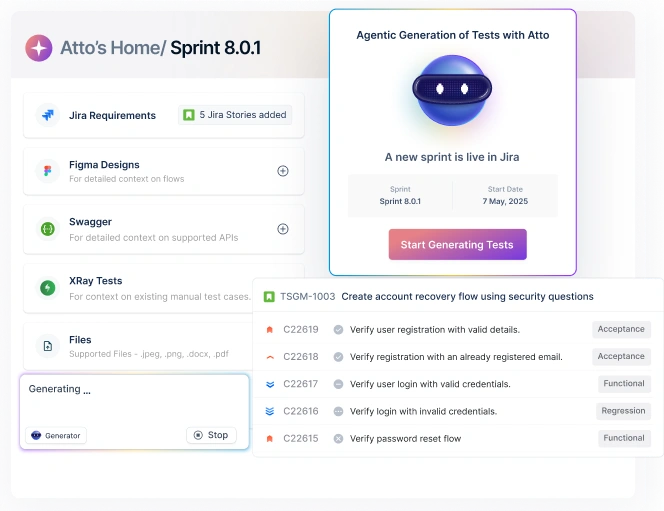
Testsigma is a unified, AI-powered, no-code test automation platform for web, mobile, API, and desktop applications. It uses agentic AI co-worker Atto to allocate tasks to agents who, in turn, look at the requirements (like Jira tickets, Figma designs, or user stories) and turn them into executable tests in plain English, while also handling execution, self-healing, and reporting in the cloud.
Key Features
- AI agents for automated test creation, optimization, and self-healing
- No-code and low-code test authoring in natural language
- 3000+ real browsers and devices with parallel cloud execution
- Built-in test management workflows and review cycles
- Detailed debugging with screenshots, logs, videos, and root-cause analysis
- Seamless integration with Jira, GitHub, Jenkins, Azure DevOps, and CI/CD pipelines
Pros
- All-in-one platform covering web, mobile, API, and end-to-end testing
- Strong AI and self-healing capabilities dramatically cut maintenance
- Fast cloud execution with parallel runs suited for agile teams
- Accessible to both technical and non-technical team members
Cons
- The wide range of features may feel overwhelming initially for very small teams
- Teams used to scripting may need a short adjustment period to adopt no-code workflows
2. LambdaTest

LambdaTest is a leading cloud-based testing platform that enables teams to run automated and manual tests across 10,000+ real browsers, devices, and operating systems. Known for its speed, HyperExecute test orchestration, and broad framework support (Selenium, Playwright, Cypress, Appium, and more), it helps teams scale cross-browser and cross-platform testing without infrastructure setup.
Key Features
- Massive real device and browser cloud with 10,000+ environments
- HyperExecute test orchestration, up to 70% faster execution
- Auto-healing for reducing flaky test failures
- AI-native test triage and analytics for debugging and RCA
- Supports all major automation frameworks
- Extensive integrations with CI/CD tools and project management systems
- Real-time and automated visual testing, geolocation testing, and responsive tests
Pros
- Extremely fast test execution, especially with HyperExecute
- Wide device/browser coverage suitable for enterprise-scale testing
- Strong AI-powered debugging and auto-healing features
- 24/7 support and detailed documentation for quick onboarding
- Highly reliable cloud infrastructure with built-in parallelization
Cons
- Costs can rise quickly for teams running heavy parallelization or large-scale automated suites, especially compared to fixed-pricing platforms.
- Steeper learning curve for teams not familiar with distributed execution platforms or multiple automation frameworks.
3. QA Wolf

QA Wolf is an AI-native, done-for-you test automation service that delivers 80% and end-to-end test coverage for web and mobile apps within weeks. Instead of providing a tool your team must manage, QA Wolf builds, maintains, and runs your entire Playwright- and Appium-based test suite for you, while guaranteeing zero flakes and near-instant test results.
Key Features
- AI + human hybrid test creation and maintenance
- Playwright (web) and Appium (mobile) automated tests with no vendor lock-in
- 100% parallel execution infrastructure included
- Zero-flake guarantee with AI-led failure triage
- Bug reports with rich context (screenshots, logs, videos)
- Pass/fail feedback within ~3 minutes
- Achieves 80% test coverage in 4 months
- Unlimited test runs and 24-hour maintenance turnaround
Pros
- Completely offloads QA automation from internal teams
- Extremely fast test cycles (minutes instead of hours)
- High-reliability results due to the zero-flake guarantee
- No need to maintain infrastructure, parallel execution is built in
- Open-source Playwright and Appium code gives flexibility and ownership
Cons
- Fully managed model may not suit teams wanting direct control over test creation
- More expensive than self-service tools, especially for early-stage startups
4. Testlio

Testlio is a leading crowdtesting platform that blends automated testing with a global network of expert manual testers. Designed for high-quality, real-device validation, it supports web, mobile, and cross-platform testing through fused workflows, where automated test results seamlessly transition to human testers for deeper investigation and high-confidence issue validation.
Key Features
- Supports Selenium and Appium automation alongside third-party integrations (Applitools, BrowserStack, HeadSpin, Sauce Labs, mabl)
- 1,200+ real devices in the Testlio network, plus AWS Device Farm access
- Fused testing workflow: automated signals handed off to manual experts for validation
- Built-in reporting with screenshots, videos, and utilisation metrics
- On-demand access to vetted Quality Engineers (QE Profiles)
- Ability to run automated tests directly in the Testlio platform or CI/CD pipeline
- Includes monthly device slots and automated testing hours
Pros
- Exceptionally strong for real-world device coverage and manual + automated blended QA
- Great for teams prioritising high-quality user experience testing
- Access to expert testers ensures reliable validation and deep insights
- Scales easily for large enterprises needing global coverage
- Strong reporting and context-rich defect logs
Cons
- More expensive than standard automation tools due to crowdtesting components
- Not ideal for teams needing full in-house automation ownership
5. Autify

Autify is an AI-powered test automation platform designed to simplify end-to-end testing across web and mobile applications. With its no-code interface, self-healing capabilities, Playwright-based engine (Autify Nexus), and AI-driven test case generation (Autify Genesis), the platform helps teams accelerate test creation while reducing ongoing maintenance.
Key Features
- No-code automation for web and mobile testing
- Autify Nexus: Playwright-powered scalable test automation
- Autify Genesis: AI agent for generating test cases and test scripts
- Self-healing tests with flexible locator strategies
- Native support for testing on real iOS and Android devices
- Visual, regression, smoke, and functional test coverage
- Professional services for teams lacking automation resources
- AI-human collaboration workflows for faster test creation and upkeep
Pros
- Strong AI capabilities for generating and maintaining tests
- Extremely easy for non-technical teams thanks to no-code UI
- Playwright foundation offers reliability and modern E2E automation
- Excellent for mobile app testing with real device execution
- Self-healing features significantly reduce flakiness and maintenance
Cons
- Pricing may be high for smaller teams compared to lightweight no-code tools
- No-code abstraction can feel limiting to teams wanting full scripting flexibility
- Heavy reliance on proprietary AI features may reduce transparency for advanced users
6. Ghost Inspector
Ghost Inspector is a no-code/low-code automated browser testing platform that helps teams quickly create and run end-to-end tests for websites and web applications. With its built-in recorder, visual testing capabilities, and easy scheduling, it enables both technical and non-technical users to monitor critical user flows and catch regressions before they reach production.
Key Features
- No-code/low-code browser test recorder for fast test creation
- Codeless editor with actions, assertions, JavaScript, variables, and reusable modules
- Visual regression testing with screenshot comparisons
- Cross-browser and responsive testing (desktop, mobile, tablet views)
- Scheduled test runs for monitoring uptime and functionality
- Alerts via Slack, Teams, PagerDuty, GitHub, and more
- Detailed debugging with screenshots, logs, and video recordings
- Integrations and API support for CI/CD pipelines
Pros
- Very easy for non-technical teams to create and maintain tests
- Great for continuous monitoring of critical user flows
- Strong visual testing capabilities built into every run
- Lightweight and fast to onboard compared to full-scale automation frameworks
- Excellent reporting and alerting make failures easy to investigate
Cons
- Primarily focused on web browser testing, no mobile app or API automation
- Not ideal for large or complex test suites requiring advanced logic
7. Doesqa
DoesQA is a modern, visual-first test automation platform designed to offer the speed of codeless automation with the power and flexibility of code. It focuses on delivering highly reliable, zero-flake web testing through a no-code flow designer, unlimited test runs, and advanced capabilities like visual regression, accessibility audits, and email testing — all within a single platform.
Key Features
- No-code visual test designer with branching logic and complex flows
- Unlimited test runs across browsers and devices
- Unlimited parallel execution (enterprise plans)
- Zero-flake test execution and centralised runner infrastructure
- Visual regression, accessibility, SEO, and email interaction testing
- CI/CD integrations and scheduling
- Support for custom JavaScript to extend advanced scenarios
- Real-time debugging with videos, screenshots, and step-level context
Pros
- Very fast test creation with powerful visual workflows
- Zero-flake execution significantly increases trust in test results
- Unlimited testing makes it cost-effective for teams scaling automation
- All-in-one testing capabilities (functional + non-functional) reduce tool overhead
- Easy for non-technical users while still offering extensions for developers
Cons
- Limited mobile app automation support compared to broader testing platforms
- Browser coverage is strong but not as extensive as large device cloud providers
- Heavy reliance on DoesQA’s proprietary visual editor may reduce portability
8. Reflect.run

Reflect.run is a no-code, AI-powered test automation platform that allows teams to create, run, and maintain web, mobile, and API tests without writing code. Built on SmartBear’s HaloAI, Reflect transforms plain-English instructions into automated steps while eliminating reliance on fragile selectors, making tests far more stable as the UI evolves.
Key Features
- No-code AI-driven test generation from natural language prompts
- SmartBear HaloAI eliminates selectors for highly stable tests
- Record-and-play browser testing in the cloud
- Supports web, mobile, API, and visual testing
- Email/SMS and 2FA workflow testing
- Data-driven testing with parameterisation
- Auto-maintenance for reducing flaky failures
- CI/CD, issue tracker, and test management integrations
- HD video, network logs, and console logs for debugging
- Tests run directly in the cloud, no setup required
Pros
- Extremely fast test creation using English prompts
- No selectors means significantly reduced flakiness and maintenance
- Ideal for functional, mobile, web, and cross-browser regression testing
- Easy onboarding, no installation or framework knowledge needed
- Excellent debugging detail for developers and QA teams
- Fits into existing workflows through integrations
Cons
- No advanced coding layer, which may limit customization for engineering-heavy teams
- AI-generated steps may require adjustments for complex or highly conditional flows
- Not ideal for organizations needing deep control over underlying automation logic
How to Choose the Rainforest QA Alternative
With so many testing platforms available, the best Rainforest QA alternative should align with your team’s workflows, technical maturity, and long-term automation goals. Use the checklist below to evaluate which tool fits your needs best:
- CI/CD Compatibility: Ensure the platform integrates seamlessly with your pipeline (GitHub Actions, Jenkins, Azure DevOps, Bitbucket, etc.) for smooth automated execution.
- AI & Automation Maturity: Look for AI-assisted test generation, self-healing abilities, and flake reduction to minimize long-term maintenance.
- Test Coverage Requirements: Confirm the tool supports all critical layers of your product, web, mobile, API, visual regression, and cross-browser testing.
- Speed & Scalability: Assess test execution speed, parallelization options, and the platform’s ability to handle large or growing test suites.
- Ease of Use & Learning Curve: Consider whether your team prefers no-code, low-code, or code-based tools depending on engineering comfort and team skill sets.
- Reporting & Debugging Quality: Look for features like screenshots, videos, logs, AI triage, or root-cause analysis for faster issue resolution.
- Cost Structure & ROI: Compare pricing tiers, scalability costs, and whether the tool provides good long-term value as your test suite grows.
- Maintenance Overhead: Evaluate how well the platform handles selector changes, UI updates, flaky tests, and ongoing test upkeep.
Conclusion
Rainforest QA remains a well-known option for quick, no-code testing, but modern QA teams now need faster execution, higher reliability, and automation that scales effortlessly. The tools featured in this guide, ranging from AI-driven platforms like Testsigma and Reflect.run to managed services like QA Wolf and crowdtesting leaders like Testlio, offer stronger flexibility, stability, and long-term value. The right Rainforest QA alternative ultimately depends on your team’s size, technical skill, and testing goals, but for most growing teams, a unified, AI-augmented platform delivers the best balance of speed, cost, and maintainability.
FAQ
The top Rainforest QA alternatives in 2025 include Testsigma, LambdaTest, QA Wolf, Testlio, Autify, Ghost Inspector, DoesQA, and Reflect.run. Each tool offers a unique approach, whether AI-assisted automation, managed testing services, or crowd-based validation, so teams can choose based on their workflow and product complexity.
Testsigma stands out because it offers a unified platform for web, mobile, API, and end-to-end testing with powerful AI-driven test creation, self-healing, and test management capabilities. Unlike Rainforest’s crowd-based model, Testsigma provides fast, stable, and scalable automation that fits cleanly into any CI/CD process, making it ideal for agile and enterprise teams.
Several emerging tools, such as Reflect.run, DoesQA, and QA Wolf, are gaining traction by offering faster test creation, AI-driven maintenance, and higher reliability than traditional crowdtesting workflows. These platforms reduce flakiness, improve test coverage, and offer more predictable scaling, making them strong contenders for modern QA teams in 2025.