




Teams ship blockchain apps fast. Yet one tiny bug in a smart contract can freeze funds or break a full release. Strong blockchain testing saves QA and DevOps teams from late-night fire drills and costly fixes.
This guide shows why you should be using blockchain to test along with it’s advantages, limitations and frameworks so your applications stay secure, stable, and ready for real users.
Table Of Contents
- 1 What is blockchain testing and why it matters?
- 2 Features of blockchain testing
- 3 Core types and layers of blockchain testing
- 3.1 1. Smart contract testing – unit, integration, and formal verification
- 3.2 2. Node and network testing – consensus validation, node synchronization, network partitioning
- 3.3 3. API and integration testing – DApp-to-blockchain interfaces, wallet integrations
- 3.4 4. Performance and load testing – measuring TPS, scalability, latency
- 3.5 5. Security testing – fuzzing, vulnerability scanning, code audits
- 3.6 6. Compliance and data privacy testing – GDPR, KYC/AML in blockchain contexts
- 4 Tools and frameworks for blockchain testing
- 5 Advantages of blockchain testing
- 6 Limitations of blockchain testing
- 7 Use cases and applications of blockchain testing
- 8 Best practices for effective blockchain testing
- 9 The road ahead for testing blockchain applications
- 10 FAQs on blockchain testing
What is Blockchain Testing and Why it Matters?
Blockchain testing checks if a blockchain system works the way it should across nodes, networks, smart contracts, and DApps. It looks at logic, data flow, consensus steps, and every action that moves across the chain. It’s like checking every “block” in the system before real users touch it.
This matters because blockchain is immutable. If a smart contract with a payout bug goes live, you cannot just edit a row in a database. Funds can get stuck, users can lose access, and brands can lose trust in minutes.
With the global blockchain market projected to reach over $403 billion by 2030, weak testing quickly turns into real financial and reputational loss.
It is also where blockchain differs from traditional QA. In regular apps, you can patch fast and fix quietly. In blockchain, everything is permanent, distributed, and harder to repair. QA and DevOps teams must get ahead of issues before deployment.
Features of Blockchain Testing
Blockchain testing covers several layers of a distributed system, not just code or UI. It gives QA and DevOps teams a full view of how nodes, contracts, and DApps behave under real conditions.
Here are the key features you should expect:
- Node validation to confirm blocks, peers, sync status, and consensus rules.
- Smart contract testing for logic, events, permissions, and edge-case failures.
- API and integration checks for wallets, oracles, bridges, and external services.
- DApp testing best practices for UI flows, transactions, and on-chain/off-chain data sync.
- Blockchain security testing to catch reentrancy, overflow, access issues, and exploit paths.
- Blockchain performance testing for throughput, latency, block generation time, and network load.
- Data integrity checks to ensure all nodes store and validate the same data.
- Compliance and audit checks for privacy rules, logging, and regulatory needs.
- Network-level testing for forks, partitions, node failures, and recovery.
- Scalability testing for high TPS, stress conditions, and multi-chain setups.
With a proper blockchain QA process in place, you reduce risk and ensure each launch is stable, secure, and ready for real-world users.
Core Types and Layers of Blockchain Testing
Blockchain systems have many moving parts. Smart contracts, nodes, APIs, wallets, and networks all behave differently. A strong blockchain QA process tests each layer so your DApp or protocol stays stable, secure, and predictable in real-world use.
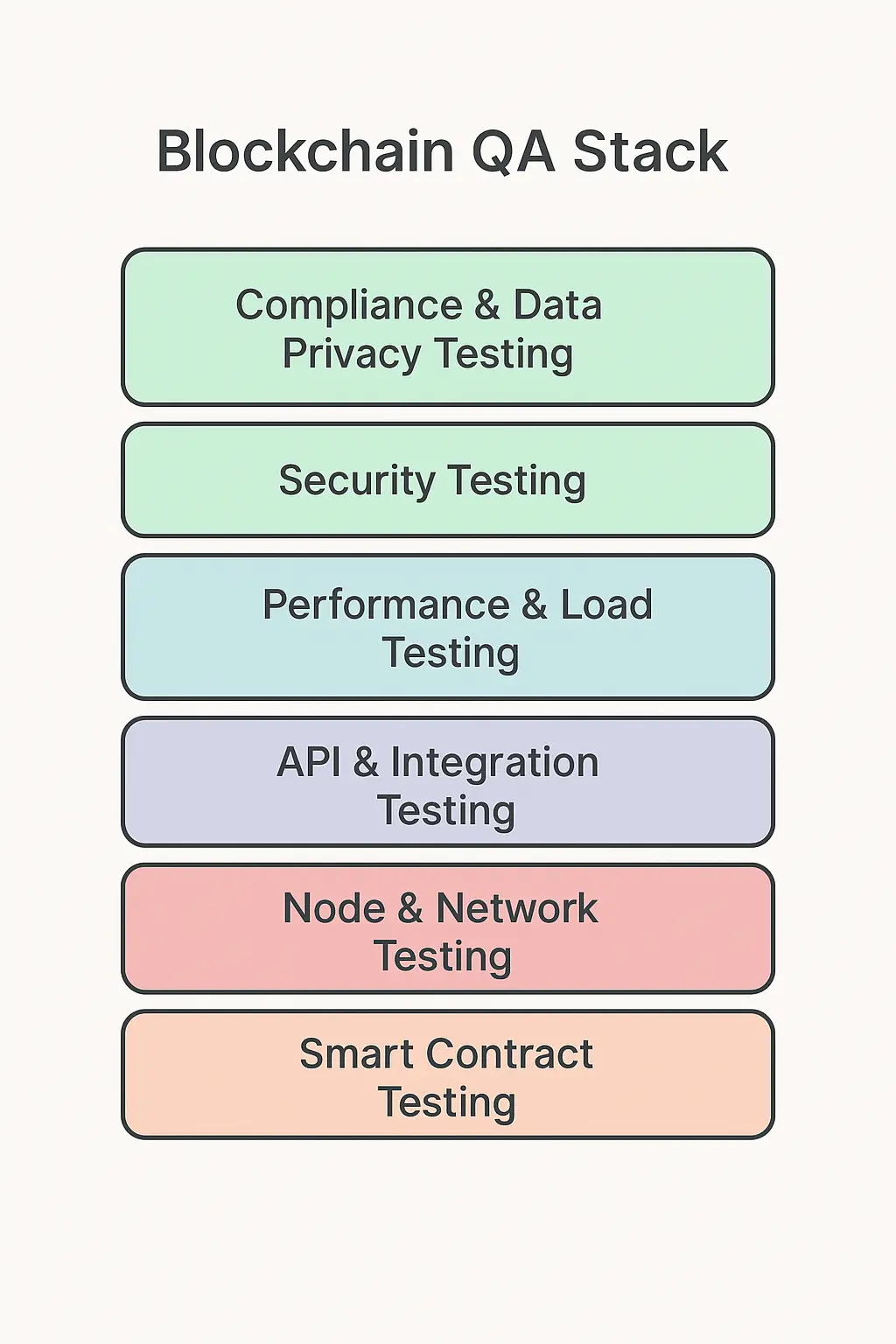
Below are the core testing layers and what teams validate inside each:
1. Smart Contract Testing – Unit, Integration, and Formal Verification
Smart contracts are the “brains” of a blockchain app. They hold the rules, move assets, and enforce logic without a central authority. Because they are permanent once deployed, this layer demands the most scrutiny.
Smart contract testing covers things like:
- Checking each function behaves correctly (unit tests)
- Testing how contracts interact with oracles, tokens, and other contracts (integration tests)
- Proving critical rules with math-based checks (formal verification)
This ensures your on-chain logic behaves exactly as intended before it becomes immutable.
2. Node and Network Testing – Consensus Validation, Node Synchronization, Network Partitioning
Nodes are the machines that run the blockchain. They share transactions, store blocks, and agree on the current state. When we say nodes must “agree,” it simply means each one must have the same view of the blockchain.
It checks:
- Consensus validation: Whether nodes follow the chain’s rules for accepting new blocks
- Synchronization: Whether all nodes end up with the same data even if some temporarily lag
- Partitioning tests: What happens when a node goes offline, gets slow, or splits from the network
Reliable node and network checks help teams keep the blockchain stable, predictable, and aligned across every participant.
3. API and Integration Testing – Dapp-to-blockchain Interfaces, Wallet Integrations
Most users never touch a blockchain node directly. They use a DApp, which talks to the chain through APIs and wallets. This layer tests the connections, not the chain itself.
QA checks how well the app:
- Sends transactions through RPC or REST APIs
- Handles wallet prompts, signatures, errors, and cancellations
- Updates the UI when the blockchain sends back events or confirmations
Healthy API and wallet integrations create smoother user journeys and reduce the number of on-chain surprises during real usage.
4. Performance and Load Testing – Measuring Tps, Scalability, Latency
Blockchains slow down under pressure. If thousands of users mint NFTs or submit transactions at once, the network can become congested.
Performance testing explores questions like:
- How many transactions per second (TPS) can the chain handle
- How quickly blocks are produced
- What happens when fees spike or mempools overflow
- How the DApp responds when the chain is slow
This helps teams prepare for launches, token drops, or periods of heavy demand.
5. Security Testing – Fuzzing, Vulnerability Scanning, Code Audits
Security is not only about smart contracts. The whole system can be attacked: nodes, wallets, APIs, contracts, or DApps.
Security testing includes:
- Fuzzing smart contract functions to break them
- Scanning for common vulnerability patterns
- Manual audits for logic, permissions, and hidden attack paths
- Simulating exploits like reentrancy or oracle manipulation
Doing this ensures user funds are protected and trust is maintained.
6. Compliance and DATA Privacy Testing – Gdpr, Kyc/aml in Blockchain Contexts
Enterprises using blockchain must obey privacy and identity laws. This layer checks whether the blockchain system respects these rules, even with immutable data.
Teams test:
- How personal data is stored, encrypted, or minimized
- How identity checks (KYC/AML) are handled
- Whether access controls match legal requirements
- Whether audit trails meet regulatory expectations
Well-tested privacy and compliance controls help blockchain applications operate safely in regulated industries.
Tools and Frameworks for Blockchain Testing
Blockchain testing uses a mix of dev tools, security analyzers, and performance frameworks. The right stack depends on what you need to test: contracts, nodes, DApps, or full networks.
Here’s a quick priority-based guide to picking the right tools.
- If your priority is smart contract testing: Choose Hardhat or Truffle, with Ganache or Hardhat Node for fast local chains.
- If your priority is security: Use MythX, Tenderly, and fuzzing plugins for deeper blockchain security testing.
- If your priority is performance and scale: Pick Hyperledger Caliper to benchmark TPS, latency, and end-to-end throughput.
- If your priority is DApp and API behavior: Lean on Hardhat + wallet mocks and RPC testing to cover DApp testing best practices.
Pro tip: Tool choice depends on the chain. For instance, EVM networks pair well with Hardhat and security scanners, while Hyperledger ecosystems rely heavily on Caliper.
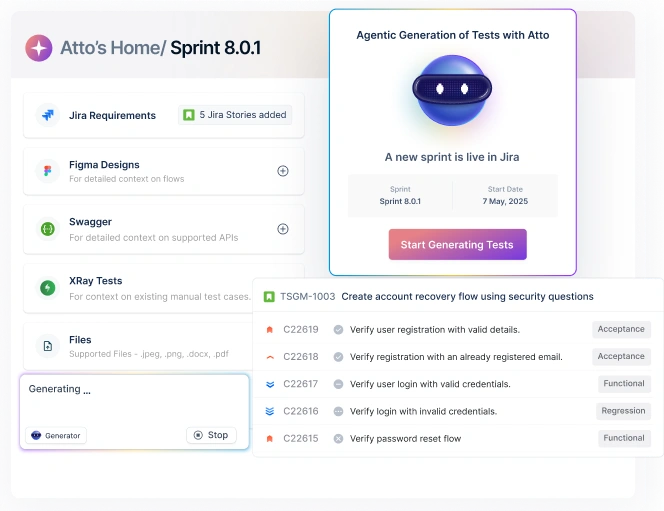
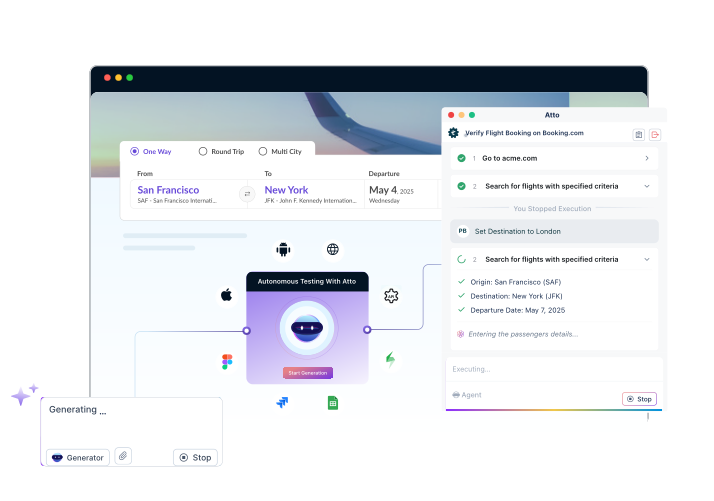
Want to automate this? Use Testsigma’s reusable, no-code workflows
Advantages of Blockchain Testing
Because blockchain code cannot be quietly patched or rolled back, teams need deeper checks across contracts, nodes, and DApps. Effective blockchain testing brings structure and safety to these systems.
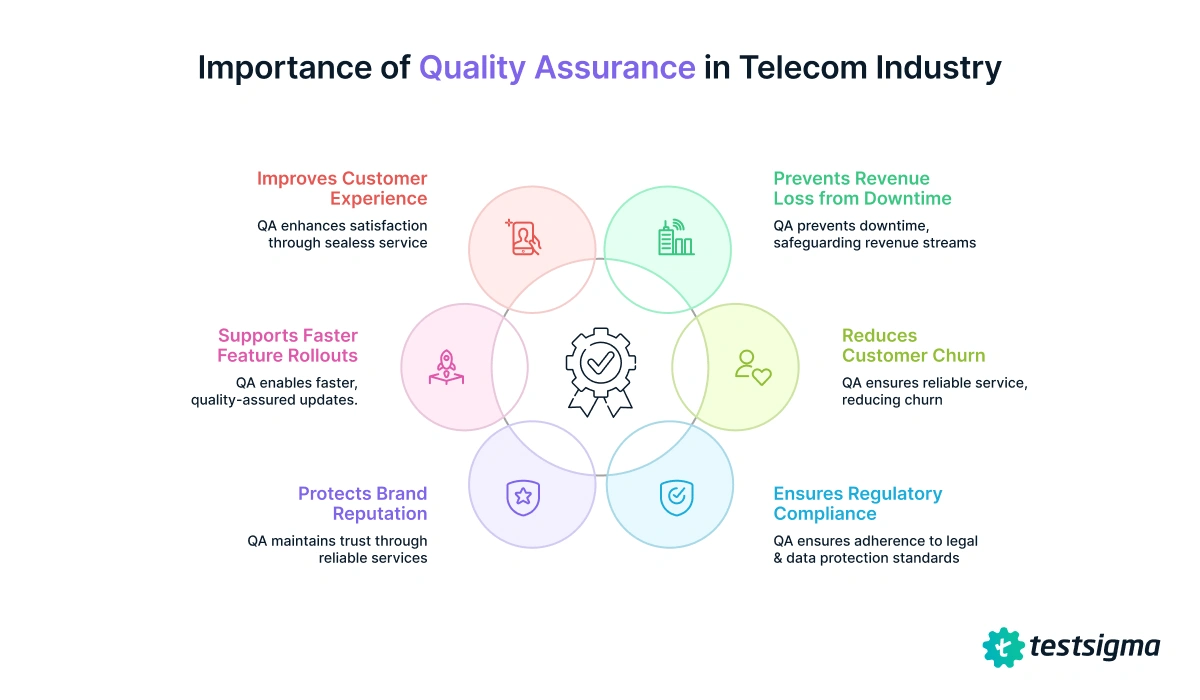
Here are the key benefits:
- Catches irreversible bugs early: Smart contracts are permanent once deployed. Early smart contract testing prevents logic, permission, and state errors before they reach mainnet.
- Stronger security for on-chain systems: Blockchain security testing (fuzzing, exploit simulation, static checks) protects apps from reentrancy, overflow, and oracle manipulation risks.
- Reliable DApps across wallets and networks: DApp testing best practices ensure UI, wallet signatures, events, and on-chain sync work correctly across chains and environments.
- Predictable performance under real traffic: Blockchain performance testing helps teams measure TPS, latency, mempool behavior, and congestion patterns before users experience them.
- Better automation and repeatability: Blockchain test automation supports repeatable test runs, multi-chain scenarios, forking environments, and automated regression coverage.
These advantages show why early testing pays off. Strong coverage leads to cleaner deployments and far fewer on-chain issues later.
Limitations of Blockchain Testing
While powerful, blockchain testing also has real challenges. Many developers and QA engineers discuss these pain points in community threads and Reddit discussions.
Below are the most common limitations:
- Higher learning curve than traditional QA: Testers must understand gas, mempools, consensus, and wallet flows. Blockchain testing can often feel like “testing the app plus the network.”
- Unreliable test environments: Teams report that testnets can be slow, unpredictable, or inconsistent, making testing blockchain applications harder than normal app testing.
- Smart contract testing can feel overwhelming: Many Reddit users say writing tests takes longer than writing the contract itself, especially with deep unit tests and event validation.
- End-to-end DApp testing is still messy: QA teams struggle with UI → wallet → node → chain flows. This creates gaps in DApp testing best practices and real E2E pipelines.
- Automation requires heavy setup: Blockchain test automation needs forking, mocks, fixtures, and multi-node coverage. Developers feel like it’s high maintenance overhead.
Blockchain testing is powerful but demanding. Teams that invest in strong processes, clear tooling, and structured coverage gain safer smart contracts, smoother DApps, and more predictable releases.
Use Cases and Applications of Blockchain Testing
Blockchain Testing supports many real-world systems. It helps QA and DevOps teams validate smart contracts, DApps, nodes, performance, and security across decentralized setups. These three use cases show where it matters most and what gets tested under each.
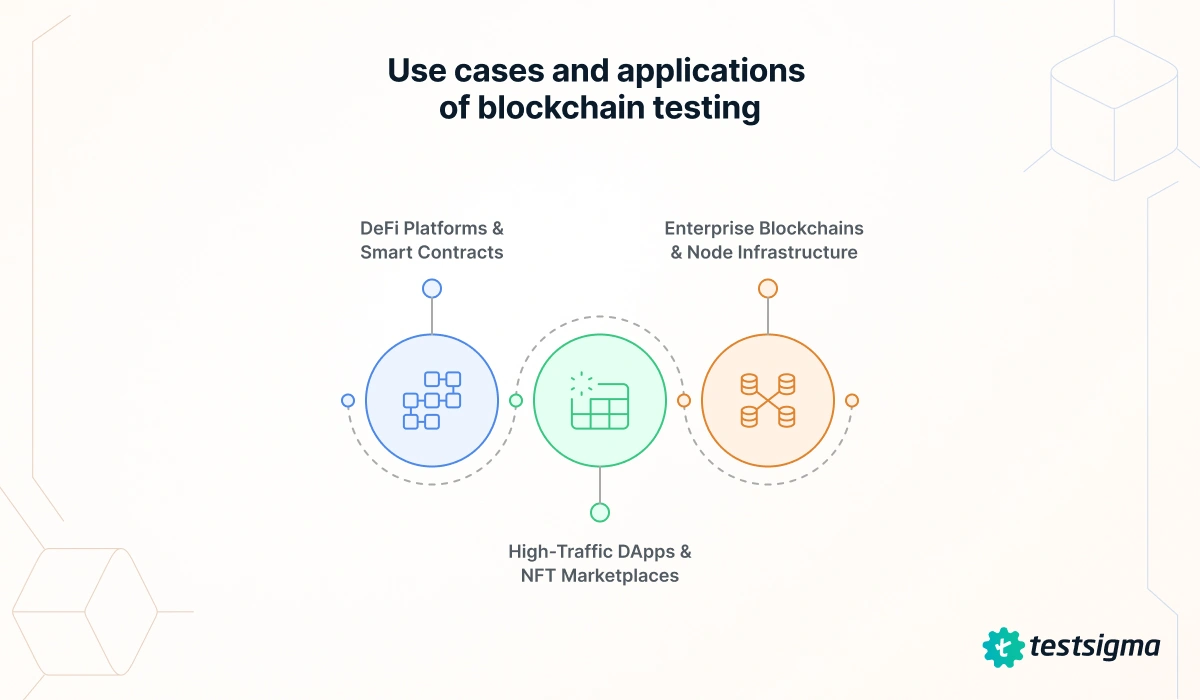
1. Defi Platforms and Smart Contracts
DeFi protocols depend fully on code, so one bug can freeze funds or break the system. In 2023, DeFi hacks led to over $1 billion in losses.
Hence, testing here includes smart contract testing, access control checks, event validation, transaction logic, and blockchain security testing for attacks like reentrancy or oracle manipulation. Teams rely on fuzzing, simulations, and blockchain test automation to validate every path before contracts go immutable.
2. High-Traffic Dapps and Nft Marketplaces
Popular DApps need strong blockchain performance testing and DApp testing best practices to handle real loads. When CryptoKitties went viral, it congested Ethereum and slowed the entire network.
This is where blockchain testing becomes essential and QA teams must validate not just the UI, but how the DApp interacts with the blockchain itself. For instance, transaction flow from wallet to chain, how the DApp handles pending, dropped, or failed transactions, on-chain vs off-chain data sync.
3. Enterprise Blockchains and Node Infrastructure
Enterprises use permissioned blockchains for supply chain, audits, and multi-party data exchange. IBM and Maersk’s TradeLens showed how complex these networks can get, with dozens of partners, multiple node types, and data flowing across borders.
So, testing here must focus on node reliability, data integrity, consensus behavior, permission controls, API integrations, and compliance checks. QA teams run testing blockchain applications scenarios for node failures, network partitions, and blockchain QA process rules tied to security and uptime.
Best Practices for Effective Blockchain Testing
Strong blockchain testing needs structure, repeatability, and real-world conditions. A clear approach helps teams validate logic, nodes, and DApps across every environment.
Follow these essentials:
- Define a test strategy for development, staging, testnet, and mainnet.
- Use private chains or testnets for safe pre-deployment checks.
- Automate regression, integration, and smart contract testing with solid blockchain test automation.
- Maintain clean test data and full transaction traceability.
- Simulate node failures, congestion, and traffic bursts for better blockchain performance testing.
- Continuously monitor security with audits, scanners, and blockchain security testing.
These steps create a stable blockchain QA process that reduces risk and improves confidence when testing blockchain applications.
The Road Ahead for Testing Blockchain Applications
The future of blockchain testing is all about depth, speed, and real-world reliability. As Web3 systems grow more complex, teams need stronger coverage, from smart contract testing to node behavior, API flows, and DApp testing best practices.
Performance expectations are rising too, making solid blockchain performance testing and continuous security testing essential parts of a healthy blockchain QA process. The goal is simple: ship safer, faster, and more predictable releases as the stakes get higher.
You can even do this faster and save meaningful time and resources by using a no-code automation tool designed to streamline blockchain test automation from start to finish.
FAQs on Blockchain Testing
Blockchain testing deals with immutable code, distributed nodes, on-chain state, and consensus, making validation far more complex than traditional apps.
Yes. Use private chains, Hardhat networks, or testnets to run safe smart contract testing before going live.
Hardhat, Truffle, and Ganache work well for blockchain test automation, while Caliper supports performance benchmarking.
Use node throttling, forked networks, and controlled partitions to mimic delays, crashes, or congestion during testing blockchain applications.
Common issues include reentrancy, overflow bugs, broken permissions, and oracle manipulation, highlighted through deep blockchain security testing.